

MIDWEST, Wyo. — By all accounts, the Salt Creek oil field was dying. Production had dropped from 6.3 million barrels in 1978 to 1.7 million in 2004, dragging Wyoming's statewide oil production down with it. By 2020, the field was expected to be dry.
But a project by Anadarko Petroleum Corp. using carbon dioxide to coax more oil out of the ground has revived the Salt Creek field so much that it is expected to single-handedly reverse the entire state's production decline.
It also will clear the landscape of thousands of unsightly power poles, power lines and conventional pumping wells, and prevent tons of greenhouse gases from polluting the atmosphere.
"It's good for the economy. It's good for the country. It's good for the environment," Anadarko spokesman Rick Robitaille said. "It's a very positive scenario."
After 100 years of drilling that yielded about 655 million barrels of oil, Salt Creek is now thought to still hold an estimated 1 billion barrels of oil. However, most of the remaining oil cannot be drawn out using conventional drilling methods, and eventually the falling oil yields would make it impractical to keep the field operating.
Anadarko hopes to draw at least another 200 million barrels of oil out of the field by injecting CO2 into the ground, pushing the oil toward new and previously drilled wells. That 200 million barrels of oil would be enough to supply all residential, commercial, industrial, transportation and power needs in the state of Michigan for all of 2001, the latest year for which figures are available.
Don Likwartz, director of the Wyoming Oil and Gas Conservation Commission, said the Salt Creek project is expected to increase overall oil production in the state through 2009.
"That is quite an accomplishment considering we had 19 years of decline," Likwartz said.
In the early 1970s, Wyoming wells pumped out nearly 160 million barrels a year. Oil fueled the state's economy and gave rise to towns like Midwest, which exist against a background of pumping oil wells.
By 2004, production statewide had dropped to just 51.6 million barrels.
The key to Salt Creek's revival and the revival of Wyoming's oil industry is the carbon dioxide. Conventional wells that dot the oil patch landscape of America aren't capable of reaching most of the oil stored underground.
"Think of when you work on your car how hard you have to scrub your hands to get the oil off," Mike Boyles, a geologist with the University of Wyoming's Enhanced Oil Recovery Institute, said. But when CO2 is injected into the oil reservoir, the carbon dioxide latches onto the oil and moves it toward the conventional wells where it can be extracted.
"CO2 is the magic drug for getting the oil out of the ground," Boyles said.
CO2 injection is predicted to boost Salt Creek's production from about 5,000 barrels a day now to 30,000 barrels a day by 2010.
However, CO2 injection requires huge compressors and miles of pipes that cost hundreds of millions of dollars, Boyles said.
Houston-based Anadarko is investing up to $624 million in Salt Creek. That includes building a 125-mile pipeline to carry the CO2 to the field, installing another 200 miles of new pipe within one two-square-mile area and hauling in huge compressors to push the CO2 underground.
"They're putting a lot of money in the ground up there," Boyles said.
But with world crude oil prices hovering between $50 and $60 a barrel, the investment should pay handsomely for Anadarko.
"They looked at it and decided it would work when oil prices were in the $20 range," Likwartz said.
However, CO2 is a limited commodity, and whether CO2 injection can work depends on geology, well patterns and a host of other factors.
Carbon dioxide is produced in large amounts by coal-fired power plants, but most of it is vented into the atmosphere. It is a major source of greenhouse gases.
It takes expensive equipment to capture and process the pure CO2 that Anadarko and other companies need in order to flood oil fields.
Exxon Mobil Corp. does have a plant in western Wyoming that produces about 250 million cubic feet of CO2 a day. Anadarko has bought rights to half the amount, and the other half is already being sold to other companies, Likwartz said.
"Right now there's nobody else who can get access to any CO2," Likwartz said.
At Salt Creek, Anadarko is injecting 160 million cubic feet a day, recycling 80 million cubic feet for reinjection each day and buying the other 80 million. Half the CO2 injected in the ground stays in the ground and out of the atmosphere.
Anadarko figures it can get at least around 10,000 barrels of oil a day out of Salt Creek until 2035.
"By then maybe someone will have figured out an even more efficient way to get oil out of the ground," Robitaille said.
Erik Molvar, a wildlife biologist with Biodiversity Conservation Alliance in Laramie, said his group applauds projects like Anadarko's in existing oil fields as long as it doesn't mean bulldozing new roads and increasing the number of drilled wells.
"It's a good way to produce more oil and gas without impacts on the environment," Molvar said.
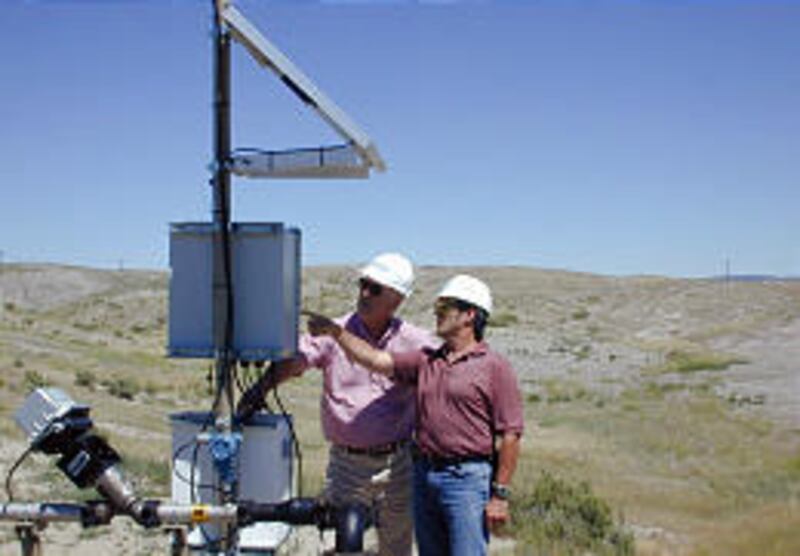
As the company moves through the entire field in sections, it is removing the wood poles and miles of power lines. It is replacing the two-story tall, rusting so-called grasshopper pumps with much smaller wells that consist of a short length of pipe, a solar panel, and boxes with batteries and wiring.
"It's a 100-year-old field, and it definitely will be better when we get through," Robitaille said.
Anadarko, which has other CO2 flooding projects in Kansas and Oklahoma, is investing $160 million in another CO2 project in a formerly abandoned oil field in southwest Wyoming and is looking to start another CO2 project north of Salt Creek.