

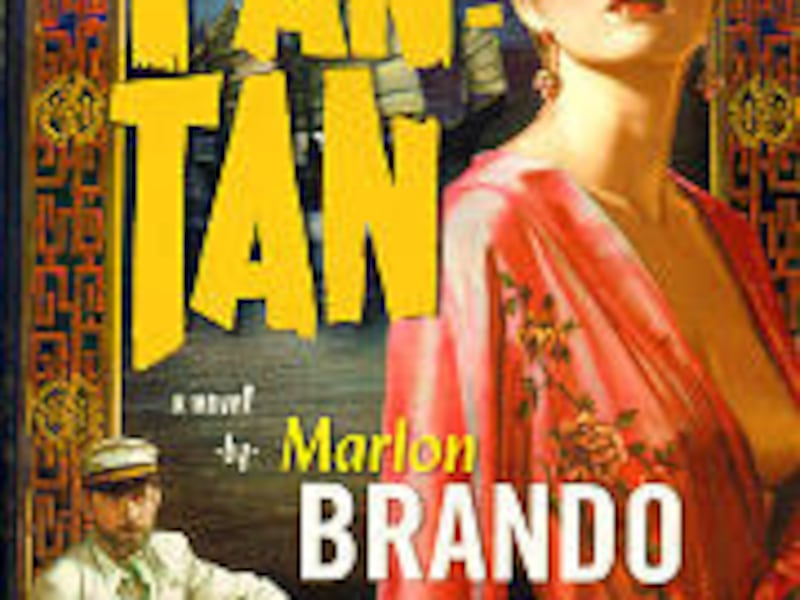
FAN-TAN, by Marlon Brando and Donald Cammell, Knopf, 249 pages, $23.95.
Philip Roth, one of America's finest novelists, said that when he was having difficulty writing in the 1960s, he produced "two or three false starts — significant false starts of a hundred pages or so. They're down in the Library of Congress — the Library of False Starts, they ought to call it."
That's where this novel belongs.
"Fan-Tan" is allegedly written by Marlon Brando and Donald Cammell. The story behind the book is that Brando suggested to Cammell, a film director, that they collaborate on a China Seas pirate novel. That was in 1979. As they talked about it, Brando improvised some scenes and then Cammell wrote a 165-page version of it. In 1982, Cammell worked the same stuff into an incomplete novel.
It would seem that it wasn't working well and that abandonment of the project would have been a brilliant route to follow. Instead, once both Brando and Cammell passed away, Knopf's Sonny Mehta hired David Thomson, an essentially unknown writer, to gather all the materials and finish the book.
Thomson's afterword is the only interesting part of the book. In it, he claims that Brando and Cammell were good friends who had a falling out or two and then came together with this book project, which Brando originally thought should be a film. He felt a book that became a best seller would make it a likely film script.
Brando and Cammell had a lot in common, according to Thomson — "including a tendency toward stylish self-destruction and a taste for creative experiment." They also shared a fascination with Asian women. Whereas Brando became heavier and heavier as he grew older, Cammell retained his good looks but could not control his inner demons. In 1996, at the age of 62, he shot himself in the head.
The novel as organized and "polished" by Thomson, tells a "rollicking" story of Anatole "Annie" Doultry, an early 20th century Scottish pirate, who, like Brando, was in his early 50s and had an imposing physical presence. While living through a hellish six months in a Hong Kong prison, Doultry saves the life of a Chinese prisoner. The prisoner's employer happens to be Madame Lai Choi San, a beautiful but ruthless and shrewd Asian gangster.
Doultry and Madame Lai Choi are drawn to each other. Gradually, the relationship develops into a strange love affair and every undesirable detail is related here, written in an overwrought, awkward style. It's impossible to tell whether it was Brando, Cammell, Thomson — or all of the three — who bear the responsibility for the terrible, self-conscious style. But the book is entirely unreadable, and it concentrates in an overeager manner on all matters relating to sex, making it into nothing but a bad dirty book.
It is obvious that Brando conceived a story about himself — Doultrie is Brando — but that doesn't make the story any more palatable. A small example should suffice:
"Annie, prostrate in his bunk, his socks on his hands and all strewn with cockroach bait, his leathery face menaced by the sagging paraboloid of the Portuguee's mattress, protruding like an appalling fungus through its fret of rusty wire, an instrument that sang tunes of despair with each twist of the poor bugger's bum. A great stain resembling Australia pressed on Annie's eyeballs with the whole weight of that meaty continent, which he had seen more than enough of in the course of his erratic voyages."
Brando was a movie star, but he wasn't a writer. And neither were Cammell or Thomson.
Rent an old Brando film on DVD, but don't bother with this amateur jumble of complex and disgusting sentences.
E-mail: dennis@desnews.com