

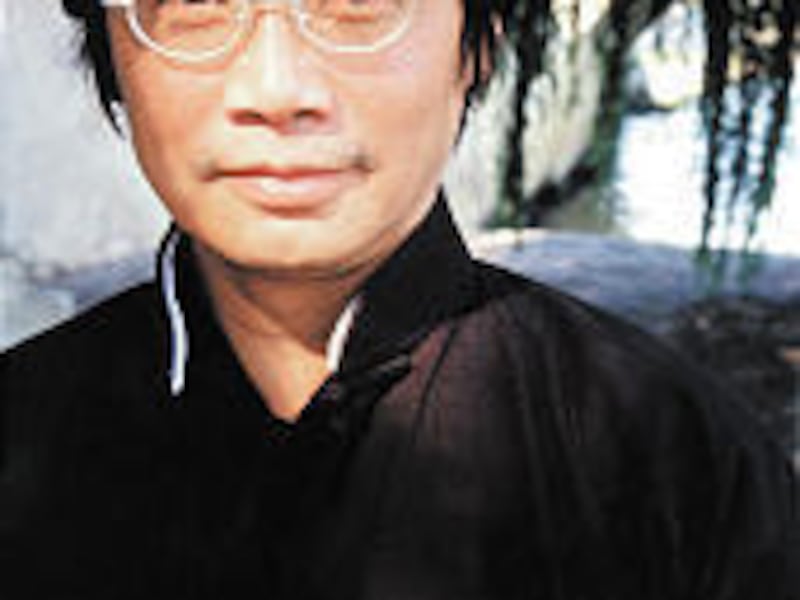
Dai Sijie, a Chinese novelist (and filmmaker) who speaks no English and writes his books in French, is on a conference call from Paris. His answers to my questions are being interpreted by a Frenchwoman who is slightly uncomfortable with English. She had never met him before today, and the conversation is a tense and often frustrating experience. For all of us.
The translator struggles with some of my vocabulary choices, then relays them to the novelist, who speaks for a few minutes in French — then the translator comes back with a sentence or two in English.
I felt like saying, "That's it?" Instead, I ask the question again in a different way. I try to squeeze out the answers. I want to know if Dai is happy with the woman who translated his first two books into English. Ina Rilke is a wonderful and talented translator who renders Dai's books in startlingly beautiful English. But Dai says, "I don't know. I haven't read them. I trust my translator — and what I wrote is easy to translate."
It's lucky that she's so good — but the question I always have in reading a translated work is, "Who deserves the most credit — the novelist or the translator?"
Of course, only those who can read the book in both French and English know the answer to that question.
Dai considers himself above all "a storyteller," but he is also a talented writer who is blessed with a vivid imagination. His work is quirky but very human.
Although humble in manner, Dai is very proud of his two novels — "Balzac and the Little Chinese Seamstress" and "Mr. Muo's Traveling Couch."
The first book was a "sleeper" — a major debut novel that stayed on the New York Times Best-Sellers list for 23 weeks. The second, a comic novel, is still sleeping, but it has many of the touching qualities that made "Balzac" so popular.
Currently, said Dai, a film version of "Balzac" is playing in New York and Los Angeles, and will soon begin to gradually work its way around the country in movie art houses. (Film critic Jeff Vice said it will probably open locally in November; so far, the film is getting good reviews.)
"Balzac" is the sad yet uplifting story of two boys sent to a re-education camp during Mao's infamous Cultural Revolution; they are found guilty of being sons of doctors. Enterprising in the extreme, the two friends figure out a way to enjoy great literature even though it has been banned in China. The story emanates from Dai's own experience in a re-education camp from 1971-74.
Ironically, the film is banned in China. Dai wrote the script and directed the film himself in 2001, but the Chinese government refused to allow it to be shown in China. "You can find it on the black market in China," said Dai. "I'm happy with the movie — it is less funny than the book and it has more emotion. There were some magical moments in making it."
Dai, now in his 50s, left China in 1984 for France, where he worked on a doctorate on the history of painting. He then became a filmmaker and novelist. Although he lives in France and writes in French, Dai does not consider France to be his exclusive home. "I feel very welcome in France. I like it very much, and I get a lot of help with my projects — but I am a citizen of the world."
He wrote about the re-education camps because, especially for his first novel, he felt he should write about something he knew. "For the second novel, I wanted to write something totally different, an imaginary tale with more of a sense of humor."
In the "Mr. Muo" book, there is a lot about dreams and Freud and psychoanalysis. Dai first thought of those things while he was a student and his roommate was studying psychoanalysis. "Even though the story is purely imaginary, I'm convinced the writer is always inspired with real life. I wanted to be comical. Besides, China is much more funny than it was before."
In his student days, Dai was so fascinated by his own dreams that he wrote them down afterward. "They were very mysterious. In 'Mr. Muo's Couch,' dreams are material to give contrast to the differences between civilizations. Realizing that psychoanalysis comes from the Western world, Mr. Muo feels that trying to explain China from the perspective of the Western world is funny. This is about somebody having studied madness trying to explain China — a country that is moving a lot with many changes."
In a personally revealing statement, Dai said "Writing is a way of dreaming."
But he would not want readers to think he is presenting a global view of China. "I'm more interested in this character who wanted to change China with the use of Western ideals. It is someone caught between two cultures."
Dai said his "biggest pleasure is to simply tell a story — but I have no book in the works right now. I've finished this book and I've finished the movie, and I'm very tired. I need a rest."
E-mail: dennis@desnews.com