

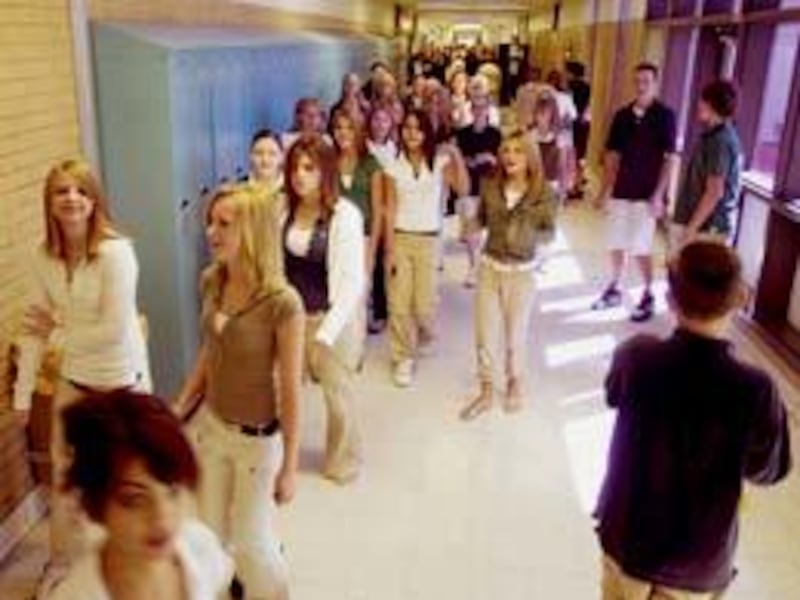
It's back to school again, and many teachers find themselves dealing with the usual distractions: bare bellies, sagging pants, low-cut looks and tiny tops. And added to the fashion rage this year: lace-adorned silk camisoles for girls that one local fashion consultant says are designed specifically to mimic underwear.
Judith Rasband, CEO of Conselle L.C. Institute of Image Management, said the trend in "underwear worn as outerwear" is the perpetuation of a consumer-driven demand in recent decades for clothing that continues to "push the envelope" in terms of social acceptability.
Why should parents and teachers care? Rasband believes both test scores and student behavior would improve if parents and principals simply required kids to dress up instead of down because "trash fashion" creates a casual mentality that often translates into a laissez faire attitude, she said.
The "deconstruction" of American dress standards began in earnest in the 1960s and has been under way ever since, said Rasband, a former professor of clothing and textiles at Brigham Young University who writes a column for the weekly Utah Valley Life section of the Deseret Morning News. Public schools are showcases for the latest in bad apparel, she said.
The trend now involves what Rasband said are three types of immodesty: body baring, tight fit and deconstruction. While the first two categories are self-explanatory, deconstruction refers to "when manufacturers take clean clothes and make them dirty, or take new clothes and make them ragged," she said.
While teens, in particular, tend to gravitate to such fashions, some may think twice if they understood what Rasband said is the philosophy underlying the trend.
Some who have attended her local seminars have asked about the "dirty denim" look. "It was done in response and inspired literally by fecal material smeared on pictures of the Madonna in Eastern museums of the United States," she said.
Others have asked her about the "wrinkles" stained into the crotch of some jeans. In the industry, they are known as "whiskers," she said, uncomfortable with further elaboration. The trend is not an accident.
While many may not understand the subtleties of the message that Rasband said is broadcast with such jeans, clothing that is tight-fitting, low-cut, skimpy, ragged or saggy isn't difficult to identify and sends a variety of definitive messages, she said — some of which intimate an openness to sexual advances. Much of it is "edgy and just a little bit naughty."
Many adults have bought into such styles along with their children, she said. Though adults usually have some control over where they work and whether that environment is comfortable for them in terms of dress code, public school students can control only their own wardrobe choices.
As Rasband has worked on dress codes with school officials, the legally accepted term for restricting what students can wear is clothing that is "distracting. That seems to be the word the courts will accept."
While research has documented that business productivity declines when casual dress is the norm, Rasband said there is no solid statistical evidence that the same happens at school. But she believes there's plenty of anecdotal evidence.
"It's based on instituting student uniforms in schools, wherein violence drops and school attendance and grades rise." Yet the debate rages in many communities when school administrators suggest uniforms, she said. "Americans as a whole don't like to be told how to dress."
Skyline High School Principal Kathy Clark said she's seeing myriad "tank tops, short short skirts, midriffs and low-rider pants. You get a girl wearing a midriff and low-rider pants together and you have quite a view from behind."
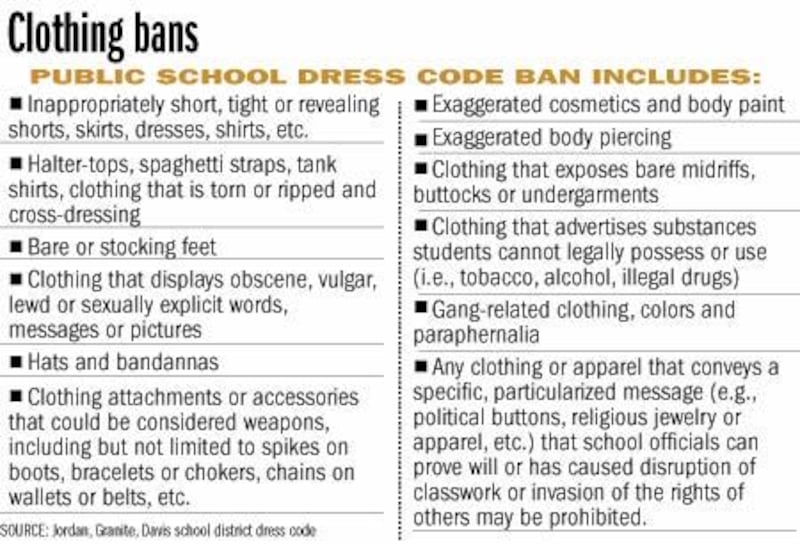
"We have a dress code policy here that's posted in every room. We ask teachers to report to us anyone that really needs to go home and change," but she finds teachers are too busy concentrating on all of their students to spend time being fashion police, she said.
Administrators call students in and ask them to either wear a jacket or go home and change when they violate the rules.
She's seen many of the silky camisoles with lace that Rasband believes look like underwear.
"In high school, I would have died if my bra strap would have shown, but now it seems to be the style," Clark said.
Principal Lynn Boehme at Evergreen Junior High in East Millcreek said officials there have had to deal with the "Britney Spears outfit-type things. Some of the girls, especially, have been a challenge. They see it on TV and go out and buy it."
Tank tops with spaghetti straps and belly shirts have been the biggest culprits. He's called several girls into his office and talked with their parents.
But Boehme may have found a more effective solution.
"We keep a nice set of sweats here that they don't want to wear," he said. "We call their parents, and if it's really bad, we have them change (into the sweats)."
Boys are not immune, and "we occasionally get into the sagging thing," though he and some other administrators have seen less of that style than in years past.
"It's not a terrible problem, but we deal with it. We just hope parents will be cognizant with their kids so they don't come dressed like they're at the beach."
Some may wonder if all schools see the same trends, but Taylorsville High School Principal Jerry Haslam said he's actually noticed more appropriate dress among students this year than in the recent past.
"We're not seeing as much sagging (pants for boys), and young ladies are dressing much more appropriately. The ones that aren't" are asked to cover up with a sweater or jacket, he said.
He attributes the change to parents after he sent a couple of notes to parents letting them know the school has a dress code, explaining what it is and asking them to help their students adhere to it. He also urges teachers in the first class each day to deal directly with any problems, sending a strong message that you can't get halfway through the day wearing something inappropriate.
Rasband would like to see a day when schools would go beyond current dress codes to require more dressy attire. It fits with a concept she's developed called the "personal/professional style scale" that shows the attitudes people communicate when they wear certain clothing.
Those at level four wear suits that communicate authority, credibility and precision, she said. At the other end of the scale, level one clothing is untailored, unstructured, unrefined and has no collar. T-shirts and jeans populate this category, which communicates a message that is casual and easygoing, she said.
"People say 'no child left behind,' but I say 'no child without a shirt with a collar,' " Rasband said. Rather than the rounded neck of most T-shirts, "a straight line communicates stability, sturdiness and uprightness, and an angular collar communicates that this individual is capable and will follow through with whatever the task is. That's for women and men."
For more information about Rasband's "style scale," see www.conselle.com.
E-mail: carrie@desnews.com