

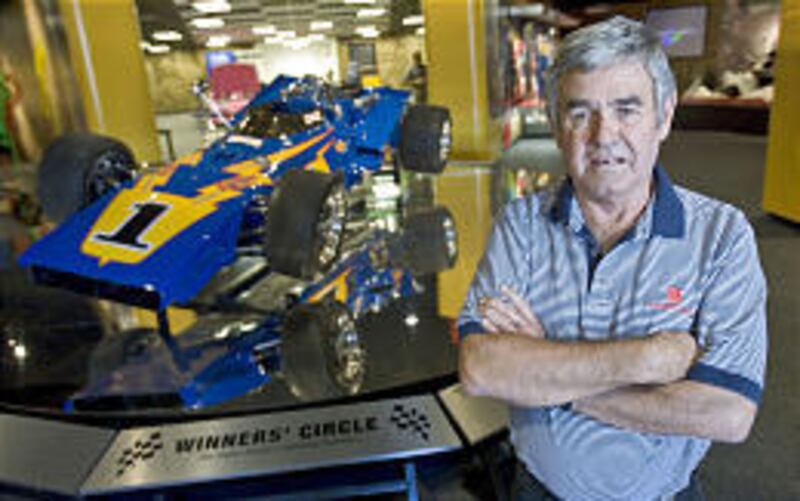
ALBUQUERQUE — When one family wins the Indianapolis 500 a whopping nine times, there's bound to be plenty of souvenirs in the attic.
Now, the Unsers — Al, Bobby, Little Al and a few other relatives — have a place to display all those fast cars, shiny trophies and racing knickknacks.
Even better, they're sharing with fans.
The 13,000-square-foot Unser Racing Museum opens Monday, a five-year project spearheaded by Al Unser Sr. — a.k.a. Big Al, a four-time winner at Indy.
"We've got people coming in from all around to take a look. It sure makes us feel very proud," he said.
The $8 million museum was funded with private donations and $2.8 million from the New Mexico Legislature. It's located in the heart of Albuquerque, hometown of the Unsers.
It's filled with cars, of course. The signature exhibit features the Johnny Lightning Special, which Big Al drove to victory at the Brickyard in 1971.
"We wanted that car to be the first thing that hits you when you walk in," said Clay Gish, lead designer on the exhibits.
The museum also features cars driven by Bobby Unser, a three-time Indy 500 winner and two-time Indy 500 champion Al Unser Jr. Then there are hundreds of trophies, racing suits, helmets and photographs.
"I'm just super-excited to see the thing open," Bobby Unser said. "I've never seen everything of what Al has saved over the years or what Little Al has saved. They haven't had a chance to see everything that I've saved.
"Now, everybody can see a lot of our things together in the same place."
The museum isn't exclusively a shrine to the Unsers' accomplishments at the Brickyard.
There are exhibits on the famed Pike's Peak Hill Climb in Colorado, where 12 members of the Unser family have competed since Louis Unser Jr. won the inaugural race in 1934.
"There are Indy cars, championship dirt cars and sprint cars," Bobby Unser said. "Then there are lots of things are just simple memorabilia."
There's also Jerry's Garage — a tribute to family patriarch Jerry Unser. He opened his first garage in Albuquerque along historic Route 66 in 1936, and the museum wing documents how the Unser boys learned to race dirt cars on the West Mesa.
Visitors also will learn about Jerry Unser Jr., who died in May 1959 after crashing during practice for the Indy 500.
"We put out everything we had to honor my brother's memory," Big Al said. "He was killed just as he got going in racing."
Another wing has a design and engineering gallery, charting the science and evolution of racing, plus a look at the history of open-wheel racing.
In deciding how to present exhibits, museum designers asked the Unser drivers, mechanics and family members to tell their own stories. The result is that exhibits come across with a conversational tone, giving visitors the feeling of an afternoon at the Unser home.
"It's not just a car museum, lined up with cars, cars and more cars," Big Al said. "Heck, I have 15 more race cars at home. We wanted the exhibits to tell the Unser family story."
Gish first met the Unsers last spring when she arrived from New York to research the project. She spent three days with Big Al, Bobby, Little Al and others, listening to tales from decades of racing.
"I wanted to give visitors the same experience I had," Gish said. "I was so amazed by these people, by their drive, their fierce competitiveness. Clearly, they are some of the top racers in the entire world. Yet off the track, they're so nice — really down-to-earth folks."
There's not enough space for all the Unser artifacts, so some exhibits will be rotated. The museum is also something of a living history project. After all, two of Big Al's grandsons — Jason Tanner and Al Unser III — are aspiring racers.
"We left some room to keep adding names," Gish said. "We thought about that a lot. It was meant to be something that can change."