

The Rosetta Stone to decipher Ralph Fiennes just may be, of all things, "Maid in Manhattan," the ghastly movie he made with Jennifer Lopez that came and went like a cold sore in 2002.
The man can deliver a shimmering portrait of Nazi evil in "Schindler's List" or a brilliant Hamlet on Broadway, but what he can't uncork is a guy — an unintrospective, untortured male of the species — and it was a guy he had to play in the Lopez disaster.
"I've always ... I've always ... I don't know ... I've never been part ... of what they call clubable," he says with a fractured elegance. "I distrust being part of a self-conscious group. I mean, the whole thing about the guys going down to the pub together. ... I've always, somehow ... I'd rather go by myself. That's still true today."
Imagine, then, the challenge he faced in playing an orthodox male lead — a handsome, pedestrian American politician — in an orthodox romantic comedy.
"I didn't pull it off, really," he says. "It's a simple enough part. That's probably a challenge for me — to do what someone like Hugh Grant does so well. That sort of effortless, just-being-present-and-let-the-comedy-happen thing. I admire that. I find that hard. I can access inner tension quite quickly as an actor, but to have that guy thing — 'Yeah, yeah, that's fine' — it's not second nature to me."
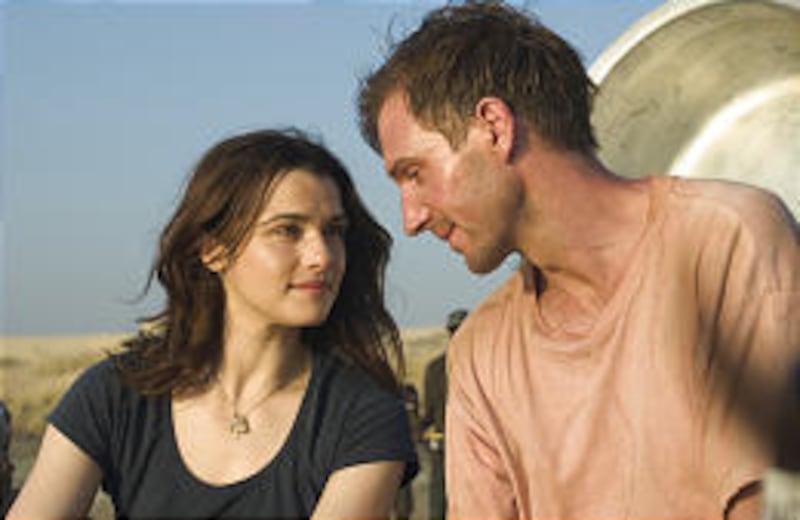
And yet here is Ralph Fiennes (pronounced "rafe fines") playing a guy of sorts in "The Constant Gardener," the big commercial movie for grownups adapted from the John Le Carre novel. In it, Fiennes is an unobtrusive British diplomat stationed in Kenya named Justin Quayle. But this man has depth, and he's going to fool you.
Quayle is married to Tessa, a firebrand who secretly investigates rumors of criminal behavior of a pharmaceutical company testing a drug in Africa. Tessa, played by Rachel Weisz, is murdered, and Quayle abandons his job and gardening avocation to pursue the truth of her life and death. In doing so, he reveals a tensile strength absent to the viewer at the beginning of the film.
The role of Quayle is not a transformative one — he doesn't become someone else — but an emergent one, revealing what had been there all along.
"It was latent in him. He doesn't change character," says Fiennes, a classically trained British actor. "It's not in his nature to be confrontational or create any tension. Good gardeners have to have a very quiet tenacity and insistence about them. This constancy, this determination, is in Justin, but it's not high octane. I like that, that people don't get it all in the beginning."
Fiennes talked to Le Carre about the character. "He said Quayle's the sort who'd be good at rowing or playing rugby," recalls Fiennes. "I know rugby players. They run hard and they tackle hard but then they go off the field and they can be quite gentle."
But Fiennes, 42, would never be credible in a rugby scrum. He is no Daniel Day-Lewis, another reedy Brit who morphed from the scrawny, handicapped Christy Brown in "My Left Foot" into an utterly believable Hawkeye, the echt frontiersman in "The Last of the Mohicans." Fiennes lacks that physicality. He is rigged for other things.
He's rigged for the title character in "Onegin," the film version of the Pushkin classic directed by his sister, Martha, about a tortured Russian aristocrat. He's rigged for the adulterous Maurice Bendrix in the film version of Graham Greene's "The End of the Affair," for Dennis Cleg, the severe schizophrenic in the film version of Patrick McGrath's "Spider," for the driven Count Laszlo Almasy in "The English Patient." He's rigged rather well for Justin Quayle, too.
Fiennes carries a fragile beauty. When he tells J. Lo. in "Maid in Manhattan" that she's beautiful, she replies, "So are you." The great surprise about him is his grin. It's a sweet, seditious thing that reminds you of your kid brother. It's a huge event that shatters all of the gorgeous planes on his face and, for a moment, liberates you from his blue eyes.
Fiennes rolls them when the word "tortured" is used to describe his roster of characters. "I know, I know, I've had this all day," he says at the end of a flood of interviews. "I hate this word. I don't see them as tortured. I see them as people. I suppose I'm drawn to the chance to show the complexity at the center of the drama."
Asked what kind of roles he still wants to play, Fiennes ignites in glee. "I want to play a cowboy. I want to be a cowboy," he says, knowing precisely how absurd the idea is. "I love that myth, out on the horse." Pause. "I've got the wrong genes." Pause. "I've got the wrong jeans."
But why not the challenge of the mundane? "Simple characters are hard," he replies. After "Maid in Manhattan," could he ever shine in a romantic comedy? Under the right circumstances.
"The great romantic comedies — there's quirkiness, a looseness, an eccentricity to them. They're built on neuroses and people who have obsessions — stuff we all recognize. It feeds back into the complicated stuff. The dramas have just shifted over and been made humorous."
He lives under the curse of Steven Spielberg, who once said of him, "If he picks the right roles and doesn't forget the theater, I think he can eventually be Alec Guinness or Laurence Olivier."
What Ralph Fiennes is is a thoroughbred, high-strung and untouchable at the right distance on the right track, haunted and hopeless on the wrong one. (Think "The English Patient" against "The Avengers," for which he received a 1998 Golden Raspberry Award nomination as worst actor.) Acting is an internal pursuit that he takes further than most. Fernando Meirelles, the Brazilian director of "Gardener" and the acclaimed "City of God," in 2002 was struck by his inner process.
"What impressed me most was the way he knows himself, how he works inside," says Meirelles of Fiennes. "I never saw him trying to rehearse a movement or a face or asking 'Where do I put my hands?' or 'Where do I walk?' There's a simplicity, a minimalist aspect to his acting. He doesn't do much. It's all about getting the right mood, to understand the feelings of his character in each moment.
"A few times, we were shooting and he'd stop in the middle of a take and say, 'I'm sorry. I see myself acting. I need to stop.' "Says Fiennes, "You feel yourself working to show something. I've learned to distrust that feeling."But it's not that simple: "Sometimes a scene needs a kind of fizz and an energy and you've got to crash through the barrier." He cites Coriolanus, whom he has played onstage: "You've got to be sitting on this anger, this intense rage. It's got to be explosive for long stretches, but within that you've got to try and find some modulation.
"Anger's very hard to play because it's got to come from a very real place. It's not just a push and raise your voice. It's got to come from that thing inside your gut. It's hard to sustain it."
Nowhere is this more obvious than in the theater, which continues to ground Fiennes. (Earlier this year, he toured Europe as Mark Antony in "Julius Caesar.") He became a major player on the London stage after emerging from the Royal Academy of Dramatic Art and has huge dollops of Shakespeare under his belt, along with Ibsen, Chekhov, and a bunch of modern playwrights.
Is theater more important to him than film? "At the end of the day it might be," he says. "The feeling of a company — that's what I miss doing films. The sense of ensemble. After a couple of years, I'd miss it."It was on the stage that Fiennes first met Francesca Annis, 19 years his senior, with whom he has been involved since she played Gertrude to his Hamlet in 1994. Their relationship is a subject best left alone, but one guesses she might have been waiting for him near Cortona, in Italy's lovely province of Umbria, where he was heading after his last interview.
He'll loom large in cineplex nation this fall as the evil Voldemort in the fourth Harry Potter movie. More intriguing will be the project that begins shooting in October called "Bernard and Doris," about the final days of tobacco heiress Doris Duke, played by Susan Sarandon, and her gay butler, to whom she left her entire estate. Imagine.
He will always go to the pub alone. He'll never be a guy. You'll find him in the corner over by the dartboard. As Oscar's friend Fish told him in "Oscar and Lucinda," "It's just that you do not fit."
Sam Allis can be reached at allisglobe.com.