

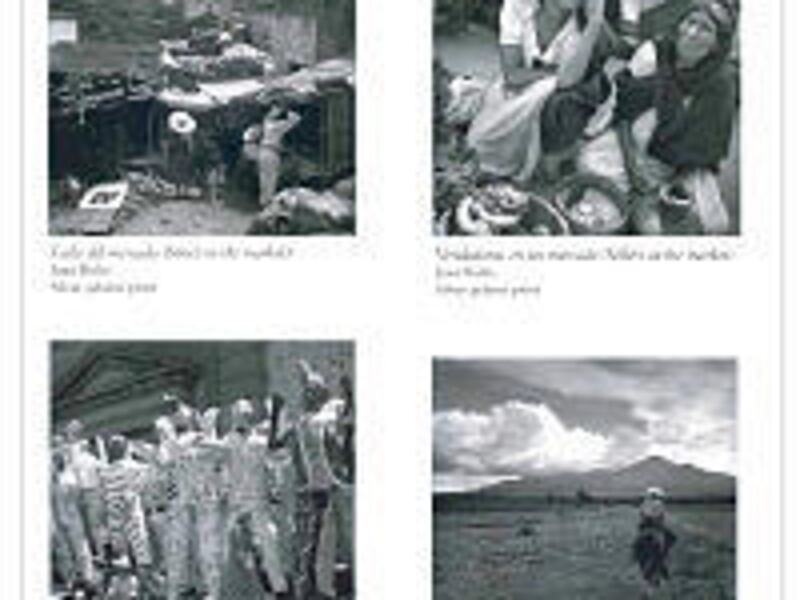
PROVO — Spanish literary buffs recently observed the 50th anniversary of author Juan Rulfo's best-known novel, "Pedro Paramo."
Yet, when he laid down his pen and picked up his camera, that's when he captured the austerity, solitude and resilience of the landscape and people in rural Mexico.
The 62 black-and-white silver gelatin photographs explore the root and character of Mexican identity in the 1940s and 1950s, said Chris Wilson, museum marketing and communications manager.
"Rulfo's photography does not idealize rural life in Mexico but quietly observes and critiques the forces that have shaped that way of life," said Diana Turnbow, curator of photography at BYU Museum of Art. "The integrity and poignancy of his images equitably places Rulfo amongst the distinguished photographers of Mexico."
The Mexican Revolution ended the same year Rulfo was born, 1917, and he was a child during the Cristero Revolt from 1926-1928. He experienced first-hand events that dramatically shaped Mexico. As an adult he documented the remnants of those years — decaying buildings, colonial edifices and vacant towns.
"Amidst the gravity of life and death they communicate a quiet persistence — even resilience — of spirit and activity, as people farm, gather at market and participate in festivals and religious rituals. Ever present in Rulfo's photographs is the landscape.
"At times seemingly harsh and overwhelming, the landscape — which delineates and supersedes human history — has its own soul and beauty," Turnbow said.
Rulfo's writing also explores the themes of death, solitude and devotion. Both his collection of short stories, "El llano en llamas," written in 1953 and the novel "Pedro Paramo" that followed in 1955 have become classics of Mexican literature and are acclaimed internationally.
"To a large extent, Rulfo's literary success eclipsed his significant work in photography, film, and indigenous studies," Turnbow said.
Rulfo chose not to exhibit his photographs until late in life. Yet the opening of his archive revealed a rich and extensive visual record of rural and urban Mexico at a formative period in the 20th century, she said.
Rulfo's youngest son, Juan Carlos Rulfo, and Roberto Rochin Naya, both Mexican film directors, will participate in a film and lecture series related to the author/photographer's life and art that will run concurrent with the exhibition. The series, sponsored by the BYU Department of Spanish and Portuguese, will include 10 film screenings and five lectures and conversations with the two Mexican directors.
The Juan Rulfo Film and Lecture Series was organized to commemorate the 20th anniversary of Rulfo's death — he died in 1986 — by celebrating his life, his literature and his passion for the visual image, said Douglas Weatherford, BYU Spanish professor and series organizer.
Victor Jimenez will present the opening reception and first lecture in the series at 7 p.m., Thursday, Jan. 19, in the Museum of Art Auditorium. Jimenez is an architect, friend of the Rulfo family, and director of the Fundacion Juan Rulfo. Jimenez will discuss Rulfo's passion for photography with special emphasis on the artist's concern for architecture. Admission to the lecture is free; however, seating is limited.
Most lectures and film showings are scheduled for other locations across campus. Details are available from the BYU Spanish and Portuguese Department. For information, e-mail Weatherford at: douglas_weatherford@byu.edu.
Fundacion Juan Rulfo in Mexico City maintains and distributes the photography series, which is the property of Clara Aparicio de Rulfo.
Gallery information is available in both English and Spanish. Tours are conducted during regular museum hours and must be scheduled at least one week in advance.
If you go . . .
What: "Photographing Silence: Juan Rulfo's Mexico"
Where: BYU Museum of Art, Provo campus
When: during regular museum hours from Jan. 20-May 29
How much: free
Phone: 422-1140
E-mail: rodger@desnews.com