

LA PAZ, Bolivia — Evo Morales Aima — a peasant leader born into grueling poverty — assumed Bolivia's presidency Sunday with an emotional speech that laid out the most complete picture yet of his leftist agenda.
The 46-year-old Aymara Indian, his troubled country's first indigenous president, fleshed out controversial proposals he made throughout his historic campaign, including plans to nationalize Bolivia's vast natural gas resources and block U.S.-backed anti-drug efforts.
After tearfully accepting the country's red, green and gold presidential banner, Morales began his wide-ranging, 90-minute address with a minute of silence dedicated to leftist heroes such as revolutionary Ernesto "Che" Guevara, fellow activists and Bolivia's indigenous people, who make up more than 70 percent of the country.
"We are here to change our history," he said standing at the front of the Congressional chamber filled with newly elected representatives, loved ones and world leaders, including 11 heads of state. "This is the conscience of the people, our people, the fight of our people."
With regular promises to be a "nightmare" for the United States, Morales has been a rising star of Latin America's populist left and is closely allied to Venezuelan President Hugo Chavez and Cuban leader Fidel Castro, both ideological foes of the Bush administration. His election marked another significant challenge to U.S. policy in the region.
Morales went on to detail plans to "industrialize" Bolivia's natural gas, hinting the country could take over resource extraction now performed by foreign companies. Bolivia claims Latin America's second largest natural gas reserves.
He also demanded the world community cancel the impoverished Andean country's $6.43 billion in foreign debt, saying, "This money definitely never helped our indigenous people."
Acknowledging those roots, Morales spoke for about three minutes in Aymara and used the Inca language of Quechua to thank Brazilian President Luiz Inacio Lula da Silva and other presidents for coming. The day before, Morales took part in an indigenous purifying ceremony on the site of an ancient temple outside the capital.
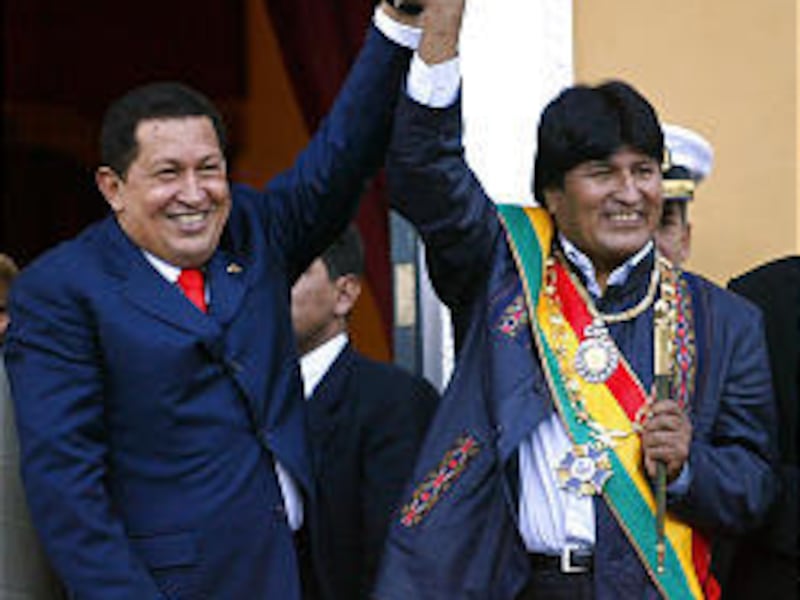
After the inauguration ceremony, Venezuelan President Hugo Chavez appeared beside Morales on the balcony of the presidential palace to view Bolivian troops. They were joined by Prince Felipe of Spain, Slovenia President Janez Dronvsek and other international figures.
Morales regularly condemns U.S.-backed economic policies promoting open markets and privatized state industries. He has also opposed U.S. efforts to end Bolivian cultivation of coca leaf, the prime ingredient in cocaine. The country ranks as the world's third biggest coca grower and a major source of cocaine to Europe and the rest of South America, according to U.S. estimates.
Despite those tensions, U.S. Assistant Secretary of State Thomas Shannon Morales visited with Morales on Saturday night at his home in La Paz for a 45-minute meeting both men said would launch a series of encounters.
Shannon said they did not discuss the coca issue but talked generally about how to continue the dialogue.
"We want the Bolivian people to succeed and for the Bolivian people to succeed, this government needs to succeed," Shannon said. "This is a democratically elected government."
Sunday morning, Morales also tried to mend fences with President Ricardo Lagos of neighboring Chile, which sparked enduring Bolivian animosity during the 19th century by seizing the country's coastline.
Lagos attended Morales' inauguration Sunday, becoming the first Chilean president to pay an official visit to Bolivia in decades. Both leaders said the two countries were dedicated to resolving their historical conflict.
Morales will lead a country of 8.9 million that has been wracked with social conflict over the past three years, during which massive protests and blockades over natural resource management have ousted two presidents.
It is also divided along geographic lines, with the resource-rich eastern Bolivian province of Santa Cruz demanding more independence. Bolivians will decide later this year whether to grant more autonomy to provinces and will also rewrite its constitution.
Yet the peasant leader takes power with enormous political backing, having won the presidency last month with nearly 54 percent of the vote, the first majority won by a presidential candidate since the return of democracy in 1982. His Movement Toward Socialism party controls the Congress.