

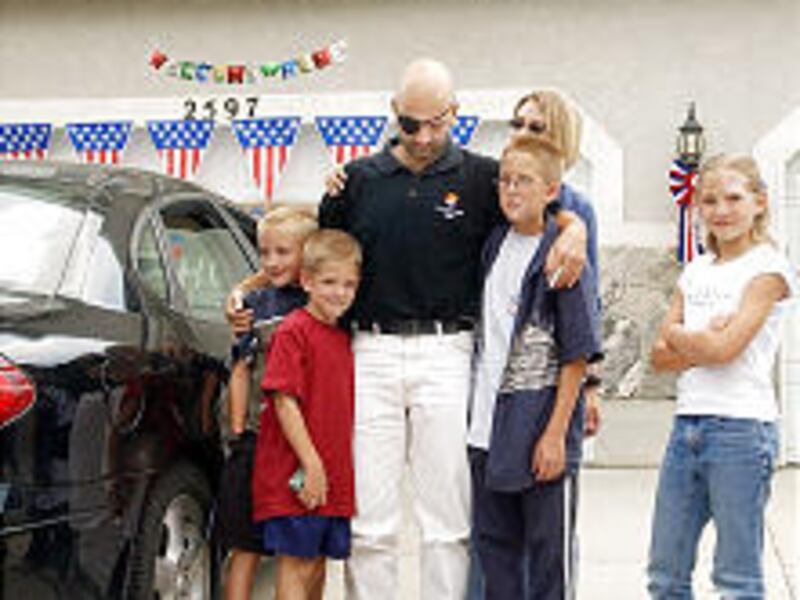
WASHINGTON — On most days, retired Special Forces Sgt. Layne Morris considers himself "one of the luckiest people alive." He is nearing his 20th wedding anniversary, has four children and a good job as the director of a housing authority for low-income families in suburban Salt Lake City.
What Morris doesn't have yet is closure — and the former soldier says that won't come until Canadian teen Omar Khadr is found guilty of trying to murder him on July 27, 2002, in southeastern Afghanistan.
Morris, blinded in one eye by shrapnel from a grenade thrown during the four-hour firefight against al-Qaida combatants, said he is praying Khadr's pretrial hearing will go ahead as planned this week at the U.S. naval base in Guantanamo Bay, Cuba.
"Nobody I know is interested in somebody just being held indefinitely without any kind of charges," Morris said in an interview from his West Valley home. "The families involved all want some type of closure, where this guy's fate is decided. I think we all are thankful that it is finally to the point where facts can be put out there and a decision made."
Khadr, 19, is scheduled to appear Wednesday before a U.S. military commission at Guantanamo to enter a plea on charges of murder, attempted murder, conspiracy and aiding the enemy. American lawyers for the Toronto-born teenager have asked a federal judge in Washington, D.C., to order a stay in proceedings until the U.S. Supreme Court rules on the legality of the commissions, set up by President Bush to prosecute "enemy combatants" following the Sept. 11, 2001, terror attacks. Justice Department lawyers had until today to respond to the motion.
Khadr has been imprisoned at Guantanamo Bay since October 2002, but charges were only filed against him last November. The U.S. alleges Khadr, then 15, tossed a grenade that killed 28-year-old Sgt. Christopher Speer, a Special Forces medic, and that he attempted to kill Morris and other American troops who confronted al-Qaida fighters holed up in a mud-walled compound near the village of Khost in southeastern Afghanistan. He is also accused of conducting surveillance against U.S. forces and planting land mines and roadside bombs in the summer of 2002.
Khadr's hearing is expected to attract substantial U.S. media attention because of claims by his lawyers that the Canadian teen has been tortured during his captivity and because — at 19 — he is believed to be one of the youngest detainees at Guantanamo.
His civilian attorneys, American University law professors Richard Wilson and Muneer Ahmad, have asked the United Nations to intervene in the case and to send observers to the Guantanamo hearing. They say Khadr will be first person in history tried for war crimes allegedly committed while under the age of 18. Khadr's trial by military commission is thus "inconsistent with international legal protections accorded to children in armed conflict," Wilson and Ahmad wrote in a Dec. 27 letter to the United Nations.
"During the more than three years he has been held at Guantanamo, Omar Khadr has never been treated as a child," the letter states. "Omar was kept in isolation for a great deal of the time, has been severely mistreated and has been continuously interrogated."
But Morris says any sympathy for Khadr is misplaced, and he rejects accusations of torture against the U.S. military.
"That is offensive. It is just ridiculous," he says. "I have seen how he lived in Afghanistan. And how he lives in Guantanamo is far and away better than how he lived in Afghanistan."
The U.S. military says Guantanamo prisoners are kept in cells with flushable toilets, metal-framed beds and sinks with running water. Muslim prisoners are allowed to "pray as desired" and fed three "halal-appropriate meals" each day, according to a Pentagon fact sheet on the Guantanamo prison.
"Anything he has gotten now is far and away better than what he wanted for himself and what he could have expected," says Morris.
Khadr was allegedly the lone al-Qaida combatant to survive the July 22, 2002, battle. He was reportedly blinded in one eye and was shot twice in the chest area, only surviving after U.S. medics treated his wounds, says Morris.
"Omar owes his life to our military medical personnel," he says. "To hear him complain about torture (is ironic). He begged U.S. soldiers to kill him. He wanted to die."
Morris and Sgt. Christopher Speer's widow, Tabitha, won a default judgment last year in a lawsuit against the estate of a member of Khadr's family, al-Qaida financier Ahmad Sa'id Khadr, the patriarch of Canada's alleged "first family of terror."
The grenade blast left Morris "completely blind in my right eye, (with) two permanent titanium plates in my skull, a scar around my right eye and no feeling on the right side of my face," according to the suit.
Since recovering from his injuries, Morris says he has closely followed the legal tribulations and political statements of the Khadr clan.
"I think these people have far too much freedom and leeway in Canada," he says. "This entire family has engaged in hate action, and they are still in Canada."
Omar Khadr's older brother, Abdullah, was arrested last month in Toronto and is facing possible extradition to the United States on charges of gun-running for al-Qaida and conspiracy to murder Americans abroad.
Another brother, Abdurahman, is suing Ottawa for refusing to issue him a passport.
Omar's mother, Maha, and sister, Zaynab, have been outspoken critics of the Canadian government.
"I think it is just outrageous that this family is allowed to live in Canada and exist off the largesse of a Canadian welfare system and still be able to rant and rave as they do, and bite the hand that feeds them," says Morris.
"I think it is pathetic."