

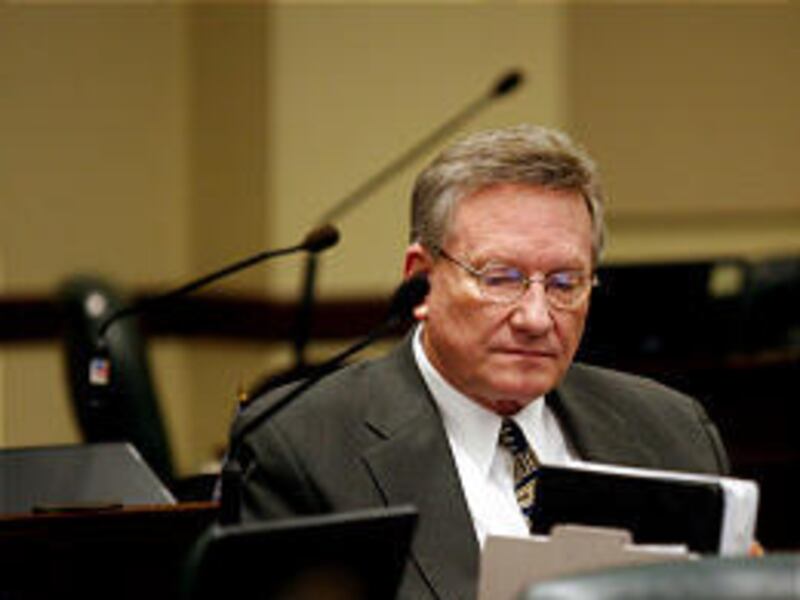
Rep. Mike Morley of Spanish Fork is the reddest of the "red" Republicans in the Utah Legislature. Rep. David Litvack of Salt Lake City is the bluest of all "blue" Democrats.
That's according to a Deseret Morning News analysis of voting scorecards from six interest groups across the political spectrum, where the color red has come to indicate conservatism and blue a more liberal bent.
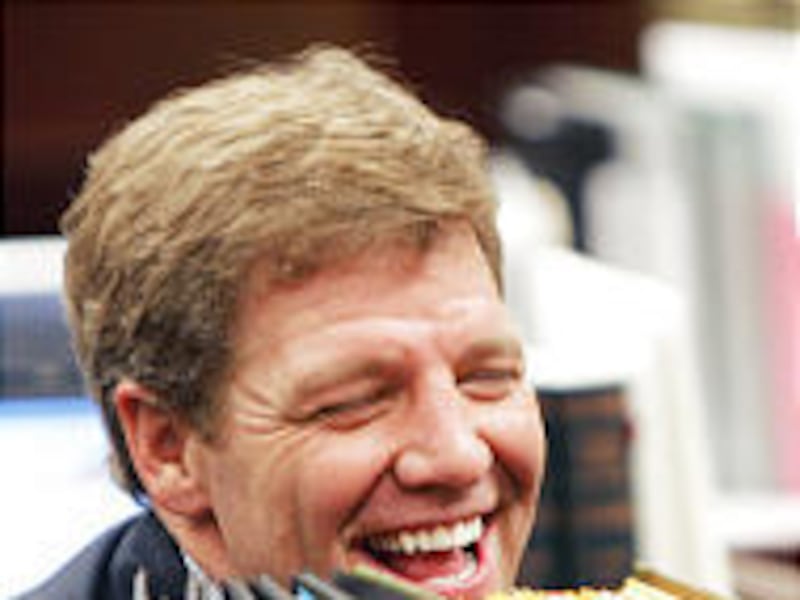
"My dad would be very proud," Litvack said about being the bluest of blue. Still, "I believe I'm not seen by my colleagues to the right — which apparently are all of them — that I am way out there, some kind of wacko, someone who can't work with them."
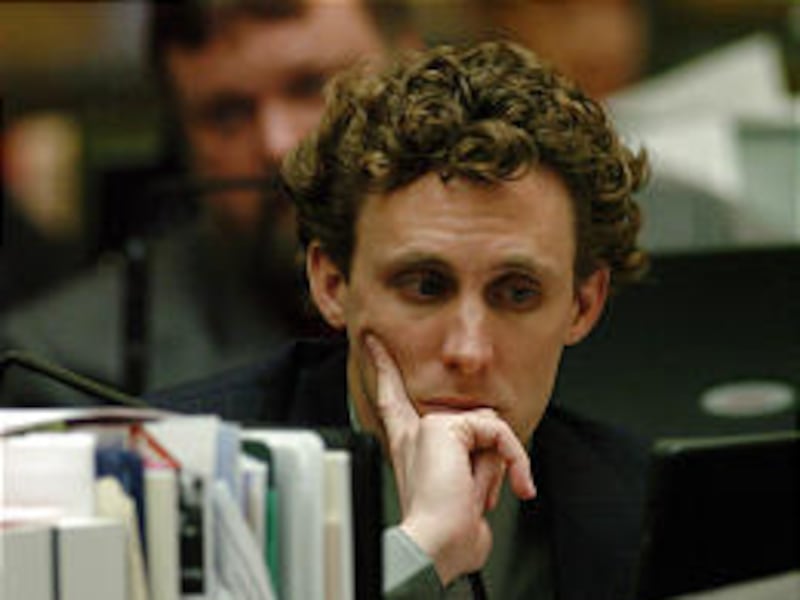
Morley's reaction was more subdued. "I don't care where I rank on these things," he said, as long as he is true to his own conscience and beliefs. "Am I concerned that they think I am the most conservative? No. Do I take any pride in it? No."
Besides showing how blue or red members are, the analysis also reveals a wide ideological divide between Republicans and Democrats in the Legislature, with all Republicans clumped together well onto the conservative side of scores, and all Democrats bunched together on the liberal side with no renegades from either camp.
Also, it shows that conservatives have increasingly big numbers and influence in the Legislature compared to moderates — or the vastly outnumbered liberals.
The index
The Morning News devised an index of how "red" or "blue" legislators are by combining and averaging scores of six interest groups, as collected and reported online by Project Vote Smart. Such groups rate individual legislators according to how often each group feels they vote "correctly" — according to those interest groups — on key issues.
Three groups give the lion's share of their better scores to Republicans: the National Federation of Independent Business (an advocacy group for small businesses), the Utah Taxpayers Association (which opposes most tax increases) and GrassRoots (a conservative group).
Three other groups overwhelmingly give their best scores to Democrats: the Utah Education Association (the largest teacher labor union in Utah), the Sierra Club (an environmental group) and Equality Utah (an advocacy group for lesbian, gay, bisexual and transgender people).
The Morning News standardized and averaged the groups' ratings, so that the higher the scores on a scale from 0 to 100 would show who is deeper red Republican, and the lower the scores would show who is bluer Democrat.
Morley was the reddest, with a score of 88.2. Litvack was the bluest, with a score of 18.7.
An accompanying chart ranks of 103 of 104 members in the last Legislature; newly appointed Rep. Jennifer Seelig, D-Salt Lake, was not ranked by groups.
Personal philosophies
Morley says voting his conscience may have made him the most red. He said he makes decisions on three things: "Does the vote 'grow' state government? If it does, I vote no. Does it raise taxes? How we handle tax dollars is a sacred trust. I vote against taxes. And, finally, does the vote help strengthen the family? If it does, I vote for it."
Litvack is Jewish (as is retiring Sen. Patrice Arent, D-Murray, the most "blue" senator). He says some of that faith's beliefs helped him to be the most blue member of the Legislature.
He said Judaism teaches "tikkun olam."
"It means 'repair the world,"' he said. "As a public official, working with government, we can repair the world.... The Jewish community has a long history of social justice movements, and then tend to vote Democratic as well."
The dividing points between parties overall is wide and well defined.
In both chambers, no Republican rated below a score of 50 (the neutral midpoint of the overall conservative-liberal scale), and no Democrat scored above 50. That is different than the U.S. Congress, where a few Democrats are actually more conservative than some liberal Republicans.
The closest scores to that neutral midpoint in the Senate were 55.2 by Sen. Beverly Evans, R-Altamont (who is retiring this year), and 44 by Minority Leader Mike Dmitrich, D-Price — showing a fairly wide 11-point ideological split between even the closest-ranked members of opposing parties.
In the House, the closest scores to the midpoint were a 53 by Rep. Fred Hunsaker, R-Logan, and a 44.2 by Rep. Karen Morgan, D-Cottonwood Heights — a 9-point ideological split between the closest-ranked members of the parties.
 | Deseret Morning News graphic How interest groups rated legislatorsRequires Adobe Acrobat. How interest groups rated legislatorsRequires Adobe Acrobat. |
The scores make Hunsaker the most moderate member of the Legislature and show that he votes about half the time in ways that please conservative groups and half the time in ways that please liberals.
But he said, "I don't consider myself a moderate. I think philosophically I'm a conservative." He adds, "I don't blindly vote the party line. While I frequently find myself with the party position, I study the issues and vote my conscience."
A conservative tilt
Still, the ratings also statistically point out something that legislative watchers have intuitively known for some time: The Utah Legislature is becoming more conservative. Fewer moderates are found among Republicans than 10 or 20 years ago. And the moderates generally have less influence than in years past.
For example, the House overall (where the current party split is 56-19 for Republicans) scored a median score of 63.4 on the red-blue index, tipping well toward the conservative side.
In the Senate (where the current party split is also a lopsided 21-8 for Republicans), lawmakers overall tipped even further to the conservative side of the scale with a median score of 71.3.
"Yes, the Legislature is more conservative," said Rep. Sheryl Allen, R-Bountiful, who ranks as the sixth most moderate House Republican. One of the most veteran members, she's served in the House since 1994 and has had to fight off intraparty challenges from conservative GOP candidates.
"The delegate (party) system is particularly hard" on moderates, she says. "Passionate people often run to be (GOP state and county) delegates, and often they are not reflective of their general constituency."
Many of the most influential Republicans are true red conservatives, or at least are quite far from the edge of being among the most moderate.
In the Senate, President John Valentine, R-Orem, is the eighth most conservative member out of 29 senators.
House Speaker Greg Curtis, R-Sandy, is in the middle of the GOP pack, though he helped found the so-called "mainstream caucus" a decade ago. He ranks 22nd most conservative out of 56 House Republicans. The House has 75 members.
Several of the most influential movers and shakers in the House — including Reps. Greg Hughes, R-Draper; Wayne Harper, R-West Jordan; and John Dougall, R-Highland — are near the top in the conservative wing of the House.
Ebb and flow
Not surprisingly, some conservatives still think the Legislature is not conservative enough, while some moderates feel the pendulum has swung so far to the right that it is now due to swing more to the middle in the next few elections.
Examples of both views come from a conservative and moderate who faced each other in this year's state GOP convention. Sen. Howard Stephenson, R-Draper, the second-most conservative senator, beat a challenge by Rep. Dave Hogue, R-Riverton, the second-most moderate House member.
Stephenson says, "I just hope the Legislature will enact those issues that conservatives have been supporting for years.... We haven't passed school choice, as many less-red states have. We don't have a comprehensive tax spending limitation law, as many less-red states have."
Hogue, however, says, "There is a general dissatisfaction with the Legislature from citizens," especially with the lack of funding for poor, disabled Utahns. Hogue believes elections over the next several years will actually bring more moderates into the Legislature — that the Legislature is even too conservative for most Utahns.
Ratings among the various interest groups showed that some of them like the currently very "red," heavily GOP Utah Legislature much more than others.
The National Federation of Business, which represents the interests of small business, liked it the most. It said the average legislator voted the way the federation liked 90 percent of the time. It liked the Legislature so much that it gave "perfect" scores of 100 to 53 members — all of whom are Republicans. It did not give a zero to anyone in the Legislature.
The Utah Taxpayers Association said the average legislator voted the way it liked 78 percent of the time. It gave "perfect" scores to 18 lawmakers, all of whom were Republicans.
The percent of the time that the average legislator voted "correctly," according to other groups, was 61 percent by the UEA (which gave "perfect" scores to six members, all Democrats); 48 percent by the Sierra Club (which gave "perfect" scores to nine, all Democrats); and 40 percent by both GrassRoots and Equality Utah.
GrassRoots gave no "perfect" scores to Utah lawmakers. Equality Utah gave 18, all to Democrats.
E-mail: lee@desnews.com; bbjr@desnews.com