

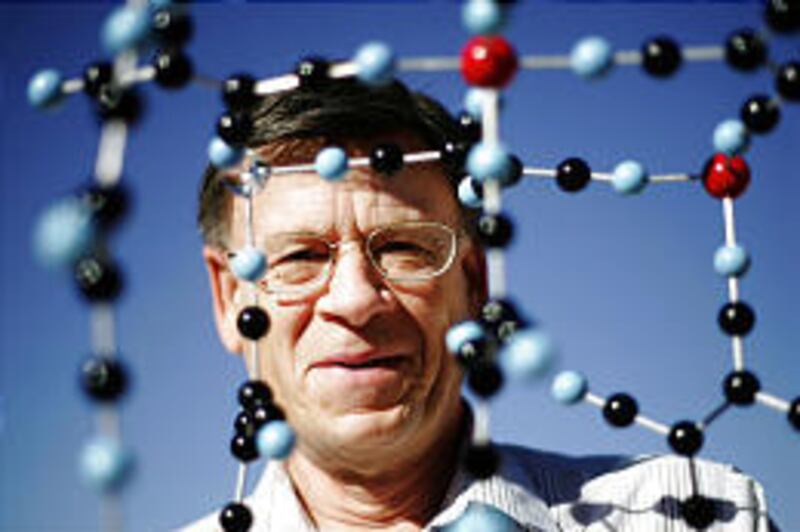

The first two prerequisites one would expect in order to win an important award from the American Physical Society are to be a physicist and to be a member of the society.
Joel S. Miller is neither. His title is distinguished professor of chemistry at the University of Utah. Yet he and a fellow researcher who is a physicist and a member of the society are recipients of the 2007 James C. McGroddy Prize for New Materials, to be presented by the American Physical Society when the group meets in Denver, March 5-9, 2007.
The $5,000 prize is to be shared by Miller and his long-time research collaborator, Arthur J. Epstein of Ohio State University. Epstein is a distinguished university professor in the departments of physics and chemistry.
The society's Web site (www.aps.org) notes that the McGroddy Prize is awarded to "recognize and encourage outstanding achievement in the science and application of new materials."
In this case, the new materials are revolutionary: non-metallic material that are as magnetic as metals. The citation notes Miller and Epstein are honored for "discovery and characterization of organic-based magnets, and for observation and study of predictable and previously unknown magnetic phenomena in these fascinating materials leading to fundamentally new science and the demonstrated potential for creative new technologies."
Before their discoveries, magnetic materials were metals or metal-based materials like iron or magnetite. "It was our idea to think differently and use organic chemistry and the methods of organic chemistry," Miller said in a Deseret Morning News telephone interview.
They tried to find organic material that could be used to make magnets.
"The initial thought was this was a formidable if not impossible challenge, because there was no basis for this," Miller said. Or maybe, he added, thinking in magnetic terms, there was a "negative basis" — an indication that it really could not be done.
But they persevered and discovered ways to manipulate non-metals so their "unpaired electrons" would become magnetic. Some of these can be prepared with solvents, so they are not magnetic when dissolved but become magnetic when the solvent evaporates.
They can be deposited as film that is organic and magnetic. "We can make cast films with it," he said. "We can fabricate it in different ways, because of that."
Eventual applications might include new types of data memory storage on disks. An unusual property that could apply, the researchers found, is that the material's magnetism can be controlled through changes in the color of light shone on it.
Other uses could be for sensors or actuators. They may become part of what is called smart materials "that respond to the environment in a way." In a home, when light shines on an object, the magnet may close a door.
"Who would have ever thought you could do anything with organic magnets?" Miller wonders.
Miller earned his Ph.D. in chemistry from UCLA in 1971. He and the physicist Epstein met when both worked for the Xerox Corp. in the early 1970s. Later, Epstein went to Ohio State while Miller worked for industry, including DuPont. In 1993 he came to the U.
Both continued researching and "published lots of papers together," Miller said. He received the Utah Governor's Medal for Science and Technology in 2004. The citation for that award mentioned that the researchers found the first new class of magnets in more than 400 years of research.
"Known as an excellent lecturer," the governor's citation added, "Prof. Miller has given over 400 seminars in various venues, as well as co-authoring over 400 articles in peer-reviewed publications."
But this new award seems unusual, with physicists honoring a chemist-physicist team. Isn't a rivalry supposed to exist between chemists and physicists?
"I think in today's world, more than before, each side appreciates the other side's breadth and what they bring to the table," Miller replied. Several Nobel Prizes in physics have been given to chemists and vice versa, he said.
Miller added that the distinction some people make between chemistry and physics "is a little bit arbitrary."
E-mail: bau@desnews.com