



Religion is alive and well in Davis County, with more than 210 different church buildings, representing almost two dozen separate faiths.
It's no secret that The Church of Jesus Christ of Latter-day Saints is the dominate faith in the county. An estimated 83 percent of county residents were LDS, according to a year 2000 membership report by the Association of Religion Data Archives.
However, a different 2002 survey estimated Davis County's LDS membership at only 72 percent. Since Davis County was settled by Mormon pioneers, the LDS religion has always been the dominant faith around.
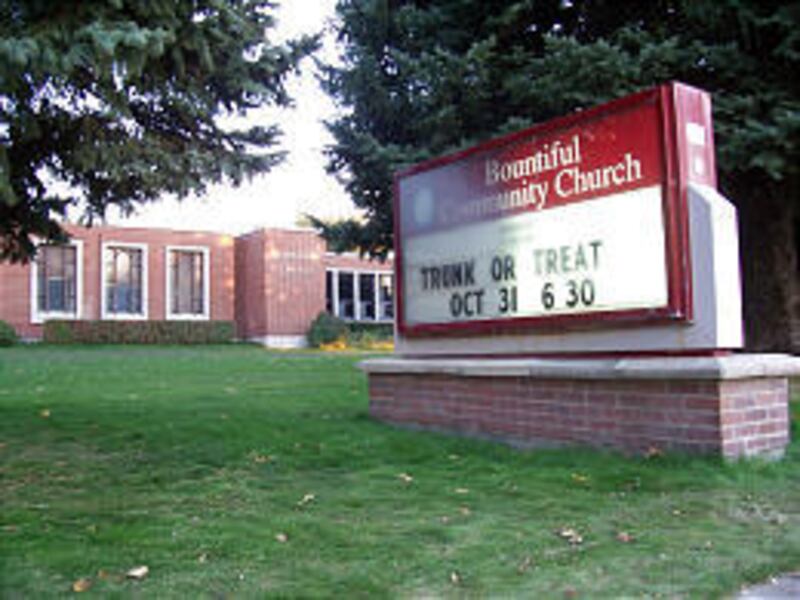
Surprisingly, it wasn't a Catholic church that was the first non-LDS faith in Davis County. Bountiful Community Church was the first non-LDS church, and it arrived in 1881.
This United Church of Christ is located at 100 N. 400 East.
According to Glen M. Leonard in "A History of Davis County," employees attracted to military installations in Davis County brought with them "religious backgrounds not well-served by existing area churches." This began to happen in the early 1940s.
Leonard believes that Davis County's LDS population dropped from 80 percent in 1940 to only 72 percent in 1950.
He wrote that the non-LDS population grew from 20 percent to 28 percent from 1940-50. The LDS population also grew but not was much as the military-fed migration did.
Until 1941, Catholic Church members in Davis County either went to the Cathedral of Madeleine in Salt Lake City or St. Joseph Parish in Ogden. A Paulist mission of the
church was established in Bountiful in the early 1940s, using rented space. St. Rose of Lima Catholic Church in Layton started in 1942, and Saint Olaf's Catholic Church opened in Bountiful in 1959.
Clearfield Community Church originated in 1945, as another of the faiths where demand by military workers figured prominently.
The first Buddhist church in Davis County came to Syracuse in 1925 to serve Japanese farm workers who started coming to Davis County in 1917. That church merged with Ogden's Buddhist church in 1979.
Wat Dhammagunaram Buddhist Temple and Meditation Center came to Layton in 1995 at 844 E. Gordon Ave., to serve 80 families in the area. It started in Ogden in 1975, moved briefly to Layton's Fort Lane and then to its current location.
Five different types of Baptist faiths, two types of Lutheran churches, two types of Presbyterian churches, the Assembly of God, the Episcopal Church, Jehovah's Witnesses, Lutheran Nazarene, Church of Christ, Bible Church and the Baha'i faith, are among the other religions with facilities located inside Davis County.
There are also at least eight nondenominational churches in the county.
The LDS membership composition is different on each side of the county. For example, 51 percent of the Davis County wards of The Church of Jesus Christ of Latter-day Saints are located in the south (Farmington southward), even though this area has only 42 percent of the county's total population. This means there are about 619 people per ward area in north Davis but only 379 people per ward in the south. This may also mean the south end of Davis County is 80-plus percent LDS, while the north end is closer to 55 percent to 60 percent LDS.
The presence of Hill Air Force Base, which has attracted military and employees from outside Utah, might be the largest reason why there are more non-LDS Church members in the north end of Davis County.
In contrast, the south end of Davis County, particularly Bountiful, seems to be a magnet for LDS Church members. Portions of Bountiful might exceed 90 percent in LDS population. "Bountiful" was named after a city mentioned in the Book of Mormon. It also has an LDS temple, opened in 1995 at 640 S. Bountiful Blvd.
In summary, there's more than 172,000 LDS Church members living inside Davis County. There are also at least 58 stakes and 446 wards in the LDS Church found in the county. There are an estimated 170-plus LDS chapels, shared by several or more wards, found in Davis County, too.
Davis County is also home to five members of the Quorum of the Twelve of the LDS Church; an assorted numbers of members of the Seventy and also to one member of the Presiding Bishopric.
Although the LDS Bountiful Utah Temple is that faith's most sacred building in Davis County, there are two other historic LDS structures in the county.
1. The oldest church meetinghouse in Utah today isn't the LDS Salt Lake Tabernacle. The Bountiful Tabernacle, 51 S. Main, is more than three years older, having been dedicated more than 143 years ago, on March 14-15, 1863.
This historic building did undergo an extensive remodeling and expansion in 1976-77, but continues to serve as a meetinghouse for some local wards each week.
Heber C. Kimball, counselor to LDS Church President Brigham Young, dedicated the Bountiful Tabernacle in 1863. President Young had described the building as "the finest meetinghouse in the territory of Utah."
Elder Hugh B. Brown, an apostle, said when he rededicated the Bountiful Tabernacle in 1963 that it was ready "for another 100 years."
It was an adobe brick building, expanded in the 1970s to include a full-size cultural hall, bishop's office and new classrooms. A new church building was basically constructed around the original one. The Bountiful Tabernacle had been recommended for demolition in the mid-1970s. A modern LDS stake center was proposed for the same site. However, some people urged its preservation, and they won out.
2. The 92-year-old Kaysville LDS Tabernacle, 195 W. Center, has always been a meetinghouse for wards of The Church of Jesus Christ of Latter-day Saints in town.
This tabernacle, listed on the State Register of Historic Sites, is a building that combines modern and Greek-revival styling.
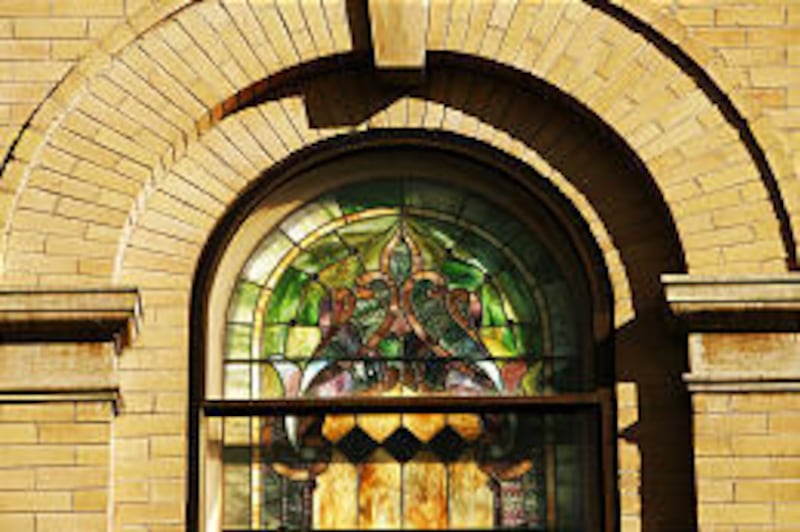
Kind of hidden away a few blocks west of Main Street in a shady residential area of town, the tabernacle's exterior may not be eye-catching. However, its inside has some spectacular features, like stained glass windows.
Ground was broken for the Kaysville Tabernacle on July 24, 1912. It was to replace an old adobe meetinghouse across the street that had been used since 1863. Not only was that original building too small, but its recreation hall was destroyed by fire in 1910. The cornerstone was laid by Bishop Henry H. Blood, who went on to become Utah's governor from 1933 to 1941.
The Kaysville Tabernacle was dedicated May 23-24, 1914. Elder Francis M. Lyman, then-president of the Quorum of the Twelve, offered the dedicatory prayer for the tabernacle because LDS Church President Joseph F. Smith was unable to attend.
William Robert Allen designed the building with a raised basement, which requires a stairway at its entrance. Funds were raised starting in 1943 to build an adjoining recreation hall, and Elder Richard L. Evans of the Quorum of the Twelve broke ground at the site. Elder Evans later returned to offer the dedicatory prayer on the expanded facility, which included not only a cultural hall but a Relief Society room and a kitchen.
A new wing was added in 1973 that featured additional classrooms, office space and a library.
The tabernacle was remodeled in the late 1970s and was rededicated by Elder Robert E. Wells of the First Quorum of the Seventy. This work restored the stained-glass windows, protected them with an exterior shield, upgraded the chapel and improved the sound and cooling systems. Space for offices was added later.
The Bountiful Regional Center, 835 N. 400 East, Bountiful, is the LDS Church's largest single meeting facility in Davis County. It can seat 2,200 people and was formerly the Valley Music Hall.
According to the year 2000 membership report by the Association of Religion Data Archives (the most recent detailed report), the top 10 faiths in Davis County are:
(1) LDS Church, 172,172 members; (2) Catholic, 7,270; (3) Southern Baptist, 2,502; (4) Assembly of God, 1,540; (5) Lutheran, Missouri Synod, 586; (6) American Baptist, 501; (7) Vineyard USA, 356; (8) Episcopal Church, 337; (9) Evangelical Lutheran, 256; and (10) United Church of Christ, 233.
E-mail: lynn@desnews.com