

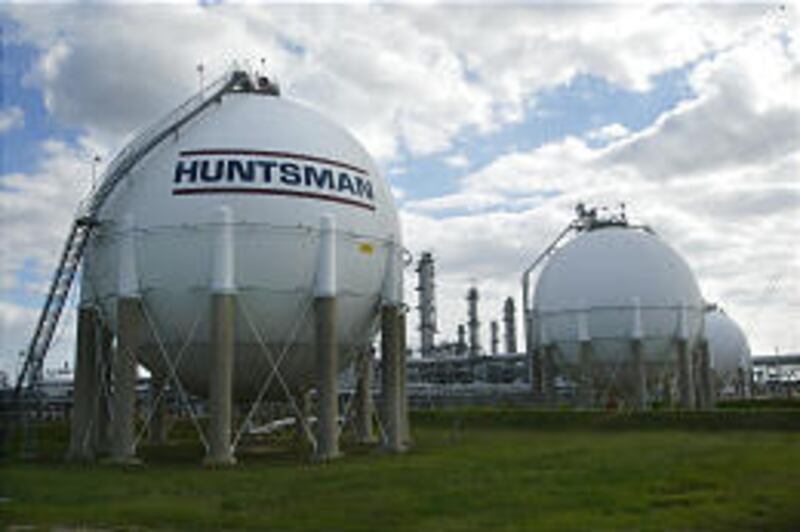
Salt Lake-based Huntsman Corp., the fourth-biggest U.S. chemical maker, plans to spin off its commodity-chemical and polymer units into a new company so investors will place a higher value on the remaining specialty businesses.
An outright sale of some units remains a prospect, Jon Huntsman, chairman and founder of Huntsman Corp., said Friday on a conference call with investors. Huntsman also said Friday its fourth-quarter loss widened to $61 million on hurricane-related costs.
The company's administrative offices are in The Woodlands, Texas, about 30 miles from Houston. Its headquarters remain in Salt Lake City.
"We don't anticipate this announcement today impacting the Salt Lake City office at all," spokesman Don Olsen told the Deseret Morning News on Friday. "When the split occurs, which will be six to nine months, I would think in the best case both of the companies will be Huntsman companies. Whether or not they carry the Huntsman name, they will both be Huntsman companies, so we don't anticipate that there will be any impact on the Salt Lake City office."
Specialty products deliver more stable profits and are affected less by wide fluctuations in energy and raw-material costs, compared with plastics and other commodities, Chief Executive Officer Peter Huntsman, the founder's son, said on the call. Shares in a specialty-chemical company should trade at a higher earnings multiple, he said.
"We are very frustrated with our valuation, and we see this as an opportunity to realize a higher multiple on the differentiated side of the business," Peter Huntsman said on the call.
Shares of Huntsman rose 43 cents, or 2.1 percent, to $20.74 on the New York Stock Exchange. They have dropped 27 percent in the past year.
Huntsman is spending money to expand its specialty businesses and shedding commodity units. The company agreed Friday to sell a Port Neches, Texas, butadiene plant to Houston-based Texas Petrochemicals Inc. for $275 million.
The proceeds will be used to buy a textile-dye business from Ciba Specialty Chemicals AG for $253.9 million in cash and assumed debt, an agreement announced earlier this week.
Huntsman earlier this month ended talks with potential buyers for the entire company after receiving bids that were too low. Huntsman said on Jan. 31 it was considering a sale after receiving an expression of interest from a prospective buyer late last year.
A split into basic and specialty chemical businesses "dramatically adds value for our shareholders," Jon Huntsman said. "That's the principal reason that we didn't proceed with an acquisition at this time."
Shareholders would receive stock in both companies, unless one is purchased by a third party before the planned spinoff, Jon Huntsman said. "We would entertain any legitimate offer that comes in our direction that would enhance or increase shareholder value," he said.
Two smaller companies would attract less interest from institutional investors, and Huntsman would lose savings and other benefits from the integration of commodity and specialty units, said Hassan I. Ahmed, an analyst at HSBC Securities in New York.
"I doubt very much the spinoff will happen," Ahmed said. "This may be just another attempt to sell some commodity assets."
The company has sent mixed signals to investors by considering a sale, then ending talks about a buyout and now planning a spinoff or asset sales, he said.
"All these things just point to a mismanaged sort of company," Ahmed said. "The deeper I dig into Huntsman, the more worried I get." He rates the shares "underweight."
The per-share loss in the fourth quarter was 27 cents, the company said in the statement. A year earlier, the net loss was $1.2 million, or 10 cents a share after payment of preferred dividends. Revenue rose 1.1 percent to $3.15 billion.
Damages from Hurricane Rita at Huntsman's largest site in Texas were largely responsible for slashing profit by $140 million, or 60 cents a share. Profit in base chemicals, the biggest unit, plunged 83 percent. Five of the company's six businesses performed worse than expected, Merrill Lynch analyst Don Carson said in a note to clients.
Carson, the top-rated commodity chemicals analyst in an Institutional Investor magazine survey, said he expected profit excluding some items of 33 cents a share. The average estimate in a Thomson Financial survey of eight analysts was 28 cents.
Excluding costs for early debt repayment, an accounting change and other items, profit from continuing operations was 14 cents a share, Huntsman said.
"The fourth quarter was extremely challenging from an operating perspective as the hurricanes negatively impacted not only our primary manufacturing facilities in the U.S. Gulf Coast but also the operations of many of our customers and suppliers," Peter Huntsman said in the statement.
Demand for specialty products "remains strong," and plant additions for commodity products "appear to be limited" over the next few years, Peter Huntsman said. Margin "weakness" in European petrochemicals will continue into early 2006, he said.
"We are optimistic about our outlook for 2006," the CEO said.
Profit from polyurethanes jumped 51 percent in the fourth quarter to $141.3 million from a year earlier on higher prices for MDI, or diphenylmethane diisocyanate, used to make foam for insulation and furniture padding.
Advanced-materials profit fell 41 percent to $18.6 million. The performance-products unit had a $700,000 loss after a profit of 8.1 million a year earlier, Huntsman said.
Base-chemical profit tumbled to $12.3 million from $71.4 million. Pigment profit rose 22 percent to $28.8 million, and polymer profit dropped 2.8 percent to $31.1 million.
The Port Neches plant can make 900 million pounds of butadiene and 11,000 barrels of methyl tertiary butyl ether, a gasoline additive. The business employs 240 people and had 2005 revenue of $626 million. The sale is expected to close in mid-2006. Huntsman still can make 16,000 barrels of MTBE at a propylene oxide plant in Port Neches, spokesman Olsen said.
Huntsman's revenue in the fourth quarter of 2004 was $3.12 billion.
Contributing: Brice Wallace