

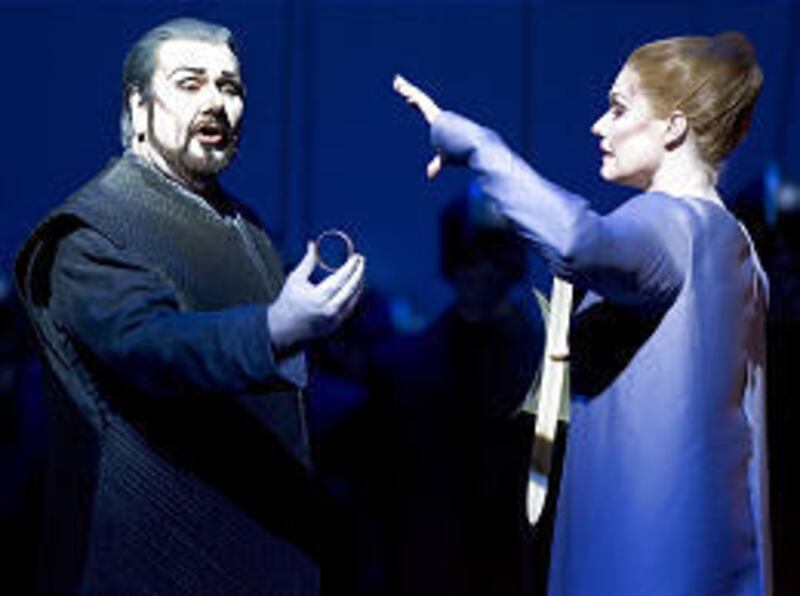
NEW YORK — Near the tragic end of "Lohengrin," the title character is forced to abandon his bride, Elsa, after telling her their story would have ended happily if only she had been able to wait a year before asking his name.
Audiences at the Metropolitan Opera have had to wait far longer — more than seven years — to see the company revive Richard Wagner's romantic masterwork.
But the wait was worth it, judging by Monday night's performance. The company brought back the two leading singers from its last performance in 1998, tenor Ben Heppner and soprano Karita Mattila, and both deserved every decibel of the cheers they received at the final curtain.
Back, too, was the stylized production by Robert Wilson that uses virtually no scenery but relies instead on blue and white backgrounds punctuated at key moments by vertical and horizontal shafts of light. The characters are dressed in black except for Elsa (blue) and the evil Ortrud (dark red.) They move with trance-like deliberation and express emotion mainly through elaborate hand gestures.
The production initially struck many observers, this one included, as bordering on the ridiculous. But time and familiarity have worked in its favor, and now the stark, slow-motion concept seems a fine match for the psychological drama on stage. None of the characters ever touches another during the entire length of the opera, and Elsa's failure to connect with Lohengrin is vividly apparent during the bridal scene in which the two remain far apart during what should be their most intimate encounter.
Vocally, both leads were in prime form. Mattila retains remarkable freshness and purity of tone for a soprano who has been singing leading roles around the world for nearly two decades. Heppner's sound has darkened just a bit with time, and he is less comfortable singing softly in the middle register now. But his high notes were well-supported and rang out with thrilling heft.
Making her Met debut as Ortrud, American mezzo-soprano Luana DeVol displayed a bright, powerful sound marred somewhat by a wobble in the upper register. She has a strong stage presence and joined right in with the spirit of the production.
A second debut was unscheduled, British bass Andrew Greenan in the role of King Henry. He acquitted himself well after some rough passages in the first act that may have been due to nerves. The powerhouse baritone Richard Paul Fink reprised his role as Telramund, Ortrud's easily manipulated husband, and baritone Eike Wilm Schulte again sang the part of the Herald.
The fine French conductor Philippe Auguin led a luminous, energized performance of the score. The orchestra has rarely sounded better.
Heppner is putting on a rare one-man, father-son show at the Met this season. After he finishes with "Lohengrin," he takes on the title role of another Wagner opera, "Parsifal," a character who according to the libretto is Lohengrin's father.
On the net: metopera.org