

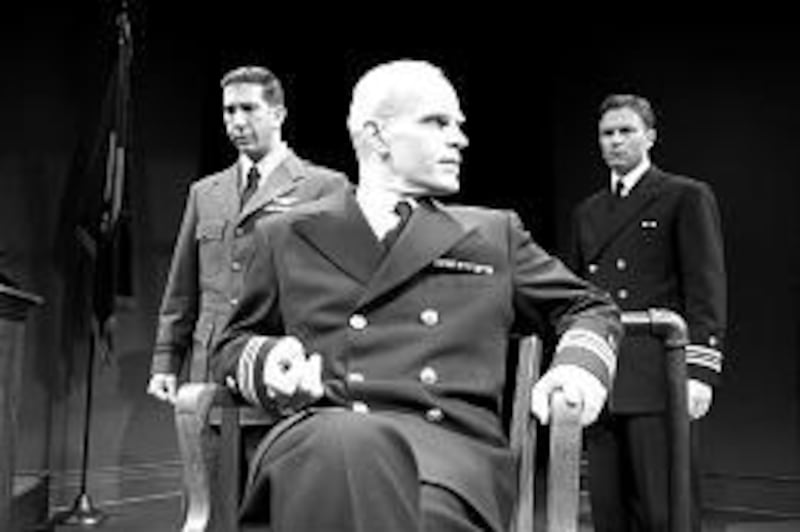
NEW YORK — Zeljko Ivanek does more while bound to a chair than many actors do with a full range of mobility.
Ivanek, who plays Lt. Com. Philip Francis Queeg in the revival of the 1950s courtroom drama "The Caine Mutiny Court-Martial," squirms, fidgets and writhes as his tightly wound character slowly becomes undone under cross-examination.
Queeg's self-destruction is fascinating to watch. Ivanek transforms his character from a blustery Navy veteran who easily shrugs off his underlings' accusations that he is mentally incompetent to a pitiable, shaking shell — a man devoured by his inner demons.
At one point, he rambles almost incomprehensibly for minutes as other characters are rapt with horror, frozen on the stage.
Ivanek, a two-time Tony Award nominee last seen on Broadway in "The Pillowman," is easily the best part of an otherwise dry and tedious restaging of Herman Wouk's play at the Gerald Schoenfeld Theatre. The venue, then known as the Plymouth Theatre, was where "Caine Mutiny" first opened on Broadway in 1954.
The play centers on the court-martial proceedings for Lt. Stephen Maryk, who is accused of relieving Queeg's command on a high-speed mine sweeper during a typhoon in the Philippine Sea toward the end of World War II. Maryk maintains he did so because Queeg became frozen with fear, the latest in a series of episodes that showed he was mentally unfit to lead.
The evidence is laid out rather soporifically during the first act as Lt. Com. John Challee, the judge advocate played capably by Tim Daly, questions witness after witness. Maryk's defense attorney — Lt. Barney Greenwald, played by David Schwimmer of "Friends" fame — doesn't appear to be very engaged in the proceedings, at one point falling asleep, as some in the audience likely may have.
However, the evidence builds to the eventual questioning of Maryk and cross-examination of Queeg in the second act. Maryk cites a litany of questionable decisions and actions on Queeg's part. Queeg then takes the stand and tries to refute each one, his situation becoming more desperate by the second.
Maryk is eventually exonerated, but Schwimmer's character is hardly satisfied — in fact, he believes he has committed a mutinous act of his own by destroying Queeg's career.
Schwimmer is the least believable of the lead actors, which is unfortunate given that he has what should be the play's most powerful scene — a showdown after the court-martial with Lt. Thomas Keefer, Maryk's best friend.
But Schwimmer seems out of his element. He appears wooden at times — even for a military man in a court-martial proceeding — and delivers a few lines with the sarcasm of his television persona Ross from "Friends," which seems incongruous.
Schwimmer also doesn't fully convey the depth of his character's conflicted feelings about representing Maryk, whom he views as a scapegoat for Keefer, a pampered elitist. His rage should be boiling over in the final scene; instead, it feels almost perfunctory.
Wouk's words translate well to contemporary times, particularly given recent military scandals such as the one at Baghdad's Abu Ghraib prison, but this production is too staid. The only characters free to move about, Greenwald and Challee, are often stuck motionless behind their desks, giving emphasis to their words only with raised voices.
The set — two bare walls, a couple of flags and courtroom furniture — also accentuates the dryness of the proceedings. Were it not for Ivanek's portrayal of a tortured man slowly digging his own grave, the entire show would seem as flat as the pea green paint on the courtroom wall.