

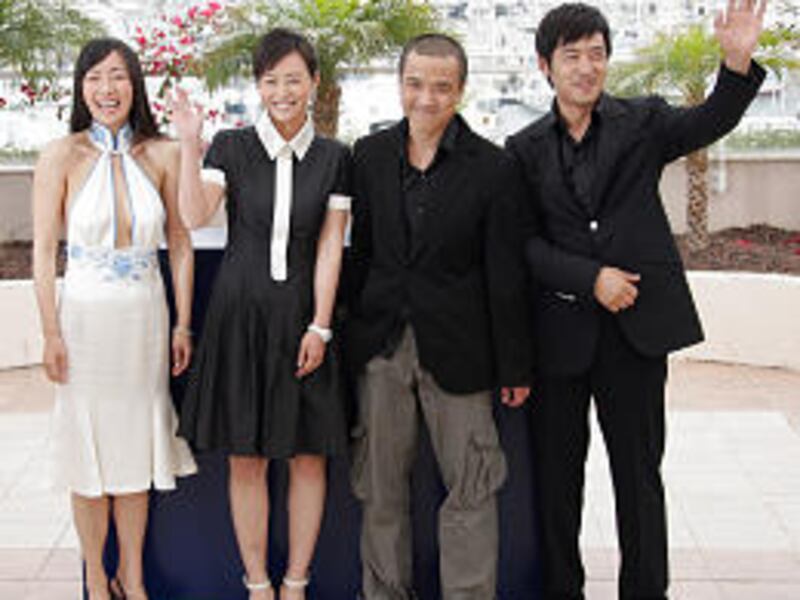
CANNES, France — Chinese director Lou Ye flew to Cannes for the black-tie premiere of his love story set amid the Tiananmen Square protests of 1989, but his movie's producers stayed home. Someone had to deal with the censors.
Lou was still awaiting word Thursday on whether his film, "Summer Palace," would clear the censors and be allowed to screen in China. Despite free-market reforms and greater openness in the communist country, Lou is the latest in a string of Chinese directors who face censorship problems at home while being wooed abroad.
"I would do just about anything so that this film can be seen in China," Lou told reporters before Thursday's premiere. He added: "I would agree to remove any of the scenes they want."
At Cannes, problems like Lou's are familiar. In 1994, Zhang Yimou, director of "To Live," skipped the festival to protest the film's censorship in China, and Cannes left an empty chair for him at his news conference. In 1997, China went so far as to pull Zhang's film "Keep Cool" from the festival competition.
In 2000, when Jiang Wen's "Devils on the Doorstep" showed at Cannes without government approval, censors kept the movie off the Chinese market, angering investors.
"During the shooting of a film I always forget these kinds of issues, what one should do, what one shouldn't, what's banned," Lou said. Two Chinese producers stayed at home to deal with the requirements of the Film Bureau.
Lou's film tells the story of a young girl who leaves her village to study in Beijing, where she has a tortured love affair with another student.
The backdrop is the student-led pro-democracy protests in 1989, which ended in a military crackdown, including at Tiananmen Square, with hundreds or thousands of people killed. The Chinese government still maintains the protests were counterrevolutionary riots, and the issue is largely taboo.
The film has explicit sex scenes and full-frontal nudity, as well as a few protest scenes mixed in with live news footage from the time. There are no shots depicting the military crackdown.
Lou, director of "Suzhou River" and "Purple Butterfly," which played in Cannes in 2003, said the sex and setting in his new film could pose an equal problem for censors.
Calls to the press office of China's Film Bureau on Thursday went unanswered. Phil Symes, a press spokesman with "Summer Palace," said the movie was submitted to the Film Bureau for a second time Monday. The bureau had asked to see it again because the film had been unfinished for the first viewing.
But the Film Bureau told moviemakers this week that the print quality was not good enough and declined to review it — a response Lou said he could not understand.
While Chinese directors have sparred with cultural commissars for two decades, China's rapidly growing consumer market is adding a new dynamic. Multiplexes are sprouting up in cities trying to cater to a burgeoning newly prosperous middle class. Box office sales, flagging for years, hit a record last year, reaching $247 million.
China's entrance into the World Trade Organization in 2001 gave foreign film companies slightly greater access to the potentially giant Chinese market. Limits have been eased to allow 20 foreign films into the country a year, up from 10 four years ago.
Foreign movie studios and production companies are eager for access — which has strengthened the hands of the China Film Bureau and other parts of the censorship apparatus. China's decision this year not to release the U.S. film "Memoirs of A Geisha" — though several stars are Chinese — was a recent example of movie censorship. There was speculation that the government feared the film may whip up anti-Japanese sentiment and hurt China-Japan relations.
While Asian films are often in the running at Cannes, Lou's is the only one this year competing for the Palme d'Or, the top prize, to be announced May 28. Hong Kong director Wong Kar-wai heads the jury, and Chinese actress Ziyi Zhang is a member.
Wong, who won best director at Cannes in 1997 for "Happy Together," said at the festival's opening ceremony Wednesday that he had no predisposition for any country or cause.
But Wong, who enjoys more freedom than most Chinese filmmakers from his base in Hong Kong, added that he was in Cannes "not just for myself but all the filmmakers of China and Asia."