

MISSISSAUGA, Ontario — At least six of the 17 people arrested by Canadian authorities in a sweeping counterterrorism operation over the weekend, including the group's alleged leader, regularly attended the same storefront mosque in this middle-class Toronto suburb of modest brick rental townhouses and well-kept lawns, fellow mosque worshippers said Sunday.
The mosque, the Al-Rahman Islamic Centre for Islamic Education, is one of the few clues that in any way link the 17 suspects — 12 adults and five youths — arrested in one of the biggest anti-terrorism actions in North America since the Sept. 11 attacks.
Members at a mosque prayer meeting on Sunday said the eldest of those arrested, Qayyum Abdul Jamal, 43, was one of six fellow worshippers. Jamal was described by several acquaintances as a school bus driver and an active member of the mosque who frequently led prayers, made fiery speeches and influenced young people who attended the services.
"He spent a lot of time with youth. He'd take them for soccer or bowling, and talk to them," said Faheem Bukhari, a director of the Mississauga Muslim Community Center who sometimes attended prayers at the Al-Rahman mosque. He said that Jamal never openly embraced violence or talked about al-Qaida, but he was "very vocal and I believe could incite these young kids for jihad."
Anser Farooq, the lawyer representing Jamal and three other people from the Al-Rahman Islamic Centre, said he was not a leader of that mosque. "He's one of about a half dozen people who lead prayers at the mosque," he said.
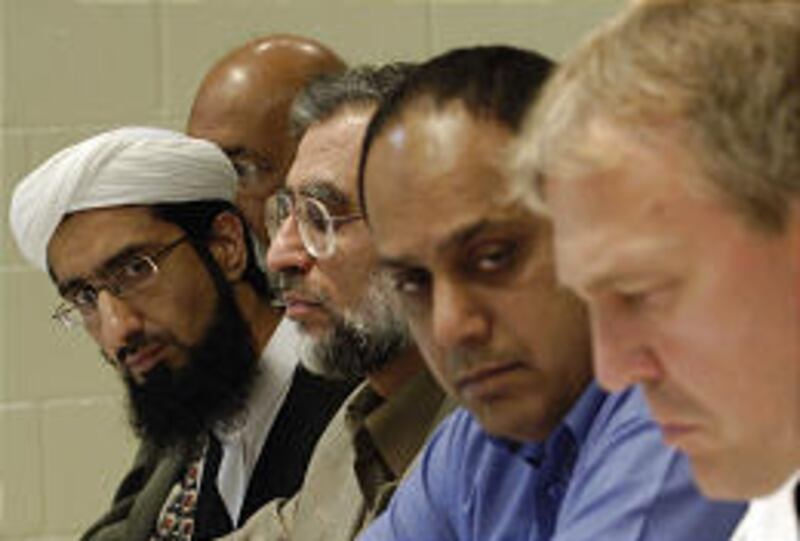
As authorities in Canada and the United States continued to piece together details from the lengthy investigation, a mosque just outside Toronto was vandalized overnight. More than a dozen windows in the building were broken, two panels of the glass front door were smashed and several cars parked in the rear of the building were damaged. Islamic leaders who met with the Toronto police chief on Sunday afternoon demanded a thorough investigation of the vandalism. They also urged calm and expressed hope that the 17 people arrested on Friday night would receive a fair hearing.
The joint counterterrorism action by hundreds of agents of the local police, the Royal Canadian Mounted Police and Canada's spy agency, the Canadian Security Intelligence Service, has so far revealed little about the underground workings of alleged domestic terrorist cells that the authorities say were determined to use homemade bombs against targets in Southern Ontario.
But the lack of detail has started to raise questions here about the credibility of the charges and the actions of police.
While many Canadians expressed relief upon hearing the news that a potentially devastating attack had been averted, some were skeptical about the lack of specific charges. The 12 adults were charged with offenses under the Criminal Code of Canada. Authorities did not even identify the potential targets.
Since Sept. 11, several police investigations against Muslims have unraveled after arrests were made, which has left a bitter legacy among Muslims.
"People are suspicious and there's anger," said Aly Hindy, imam at the Salaheddin Islamic Centre in Scarborough, a town east of Toronto with a sizable Muslim community. "We are being targeted not because of what we've done but because of who we are and what we believe in."
Authorities made no official statements Sunday and offered no additional details of the arrests. Announcing the arrests Saturday morning, officials from the Royal Canadian Mounted Police said the group of men "took steps to acquire" 3 tons of ammonium nitrate and bombmaking electronic components. But they left unclear whether the men had actually taken delivery of the material and had it in their possession when arrested, leading some here to question police tactics.
"Three tons of fertilizer would be delivered to where? These guys are living in townhouses and apartments, in the city," said Hindy. "Now I'm hearing this 3 tons may have been organized by the police. Maybe the police tried to frame them, I don't know. There's a lot of uncertainty and I don't think this evidence, when they get to court, will hold up."
Canadian authorities have refused to provide any details of the alleged plot but they have said they believed that the group represented "a real and serious threat." The extent to which undercover agents had a role in the arrests is unclear.
The Globe and Mail newspaper reported Sunday on its Web site that the alleged conspiracy dated back to March 2005 and that men and youths in the group may have undergone training at sites in Fort Erie, Ont., near the U.S. border, and in Barrie, north of Toronto.
American officials in Washington and New York said they had been aware of the investigation and were informed of the coordinated law enforcement action. American counterterrorism officials said that some of the Canadians arrested might have had limited contact with two men from Georgia arrested earlier this year and charged with supporting terrorism or providing false information.
The 12 adults arrested range in age from 19 to 43. Most live in Toronto or this sprawling suburb of more than 700,000 people just to the northwest of the city. Two reside in Kingston but did not appear in the local courtroom with the others because they were already being detained in a separate terrorism investigation related to the Georgia arrests.
Some Islamic community leaders in the Toronto area have raised concerns that the younger men may have been led to participate in a suspected plot by older, more radical Muslims, such as Jamal.
"I do not think of him as an imam," Tareeq Fatah, the communications director of the Muslim Canadian Congress, said. "People like him are freelancers. I don't fear imams. I fear freelancers who are creating an Islamacist, supremacist cult."
The Al-Rahman Islamic Centre for Islamic Education that Jamal frequented was quiet Sunday morning. A class of Quran studies scheduled for midday Sunday was canceled. Located in a small strip mall between the Hasty Market convenience store and a Pakistani and Indian restaurant, the mosque is one of several Islamic centers that have sprung up in Mississauga in recent years.
Neighbors said the Islamic Centre had grown very popular since it was founded about a decade ago. One said that on Friday nights the entrance is clogged with so many pairs of shoes that it is difficult to walk on the sidewalk.
After midday prayer Sunday, a group of about 10 men came out of the center and spoke to reporters gathered there. "There's no recruitment happening here," said one man, who gave his name as Sam Lel. He said the men from the mosque who were arrested were professionals and were not involved in terrorism. "This is a completely wrong allegation," he said.
At Jamal's home, a one-story rental unit in a large townhouse development a few minutes from the mosque, a man who came to the door refused to answer questions. "Oh no, sorry," he said. A decal on the front door read, "In the name of Allah we enter and in the name of Allah we leave and upon our Lord we place our trust."
Jamal, with short black hair and a short beard, was described by neighbors as a taciturn man who, in the four years or so he has lived in the townhouse complex, rarely spoke to anyone. "I have no complaints about him directly, but I can tell you he never fit in," said Jerry Tavares, who lives a few doors down. "But the thing that concerns me most is that he drives one of the school buses that take our kids to school." Heavily armed police swarmed around the house on Friday night and took Jamal into custody. Neighbors said they saw police removing computer equipment.
In other neighborhoods of Mississauga and the greater Toronto area, neighbors described the men who were arrested as serious professionals or confused youths who were unlikely to have been involved in a conspiracy. In a middle-class section of Toronto's east end, neighbors described another suspect, Steven Vikash Chand, 25, as a quiet man who, with several other Muslim men, kept odd hours.
"They sleep during the day and their activity is at night," said Jack Lovell, 56, who lives two doors down. "Absolutely no trouble whatsoever."
The arrests that shocked Canadians when they were announced Saturday morning did not appear to create much lingering fear. Roads near the Islamic Centre in Mississauga were closed Sunday morning for a road-race. And downtown Toronto was shut down by a charity bicycle ride.
"Everybody is going about their normal business, which is the best way to combat terrorism," said Mayor David Miller. During the months-long investigation the city added some additional security precautions, Miller said. But it has not beefed up security since the arrests were made.