


Stop producing blood right or lose too much and you could die. That's why it's sometimes called the "river of life."
We all know blood is red and really important. But what is it?
Blood is a mix of cells and plasma that carries oxygen and provides nutrients to every cell in the body. The heart pumps it throughout the body to both feed cells and haul away their waste.
The blood cells float in the liquid portion, called plasma, which is rich with electrolytes, nutrients, vitamins, hormones, clotting factors and protein antibodies to fight infection.
The cells are red, white or platelets. The most abundant, red cells have a protein called hemoglobin that binds to oxygen and carries it along, while the white battle infection and platelets clot blood so you don't bleed to death.
The ratio in normal blood is 600 red cells for each white cell and 40 platelets.
Blood cells are made in the bone marrow. In children, all the bones make it, but with age only the bones of the spine, ribs, breastbone, pelvis and segments of the upper arm and legs produce blood cells.
White blood cells are part of the immune system, ready to rush off to the site of an infection or other insult. A high white cell count can indicate an infection. The five types of white cells each have a different job, from eating bacteria to killing parasites or participating in allergic reactions. One type destroys dead cells, while another bosses around the body's immune system.
Plasma is mostly water, with 10 percent dissolved substances, mostly proteins that balance hydrostatic pressure and keep the fluid inside blood vessels. Plasma also contains a variety of electrolytes needed for such body functions as fluid balance, nerve conduction, muscle contraction, blood clotting and more. It is there that glucose, cholesterol, hormones, clotting factors and vitamins reside.
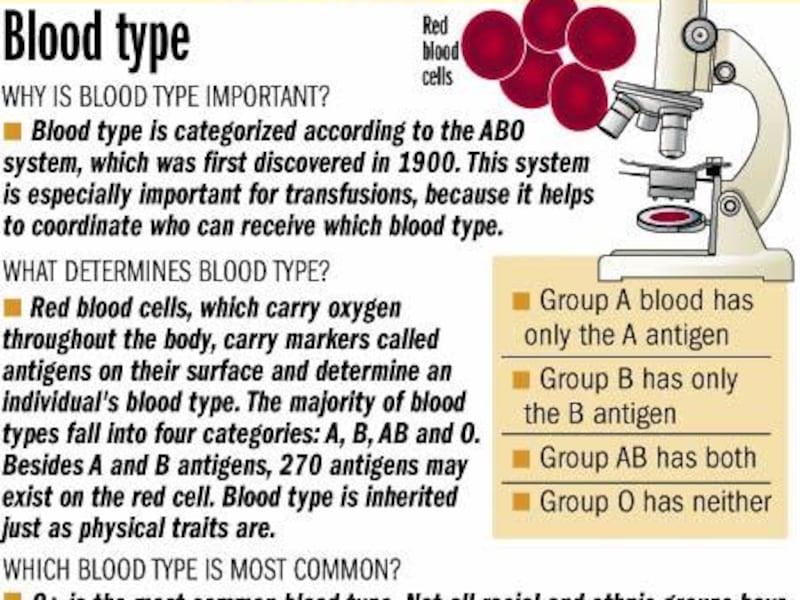
The ABO system of blood typing came from Dr. Karl Landsteiner in 1900, although he missed one of the four blood types, AB.
What type you are hinges on proteins called antigens on the red blood cell surface: either A or B. If you have A antigen, you're type A. If you have B, you're type B. People with AB blood have both types, and those with O have no antigens.
For every antigen on the red blood cell, the opposite antibody is in the plasma, so A blood type has anti-type B antibodies. AB has no antibodies in the plasma and type O has both.
Even less well-known to most people is the Rh factor, which determines whether your blood is positive or negative. Although many Rh antigens may live on the red cell's surface, D's the one that matters for typing. If you have the D antigen, your blood is positive — true of 85 percent of Americans. The others have "negative" blood.
The antibody to the Rh factor antigen only develops if there's exposure through blood transfusion or during pregnancy and delivery when a mom can be exposed to the baby's blood. That's why when an Rh-negative mom is expecting an Rh-positive baby, she is given Rh immune globulin so she won't develop antibodies that can cross the placenta and cause a disease in the next baby.
Without previous blood exposure, says Dr. Annie Strupp, medical director of the American Red Cross' blood services division, an Rh-negative person can receive Rh-positive blood in an emergency. The first transfusion is a "freebie" that still should be avoided, since a second occurrence could cause a serious reaction.
E-mail: lois@desnews.com