

BONN, Germany — Highlights from the Guggenheim Foundation's worldwide collection have been brought together in Germany for a show that spreads over two museums and feels like a who's-who of 20th century art.
"The Guggenheim Collection," which opened July 21, is expected to attract at least 600,000 visitors by the time it closes on Jan. 7, 2007. Organizers said more than 35,000 people have viewed the exhibition so far.
Among the roughly 200 artworks on display, Vasily Kandinsky's "Composition 8" faces Pablo Picasso's "Woman With Yellow Hair," while Andy Warhol's "150 Multicolored Marilyns" stare at Roy Lichtenstein's "Interior With Mirrored Wall."
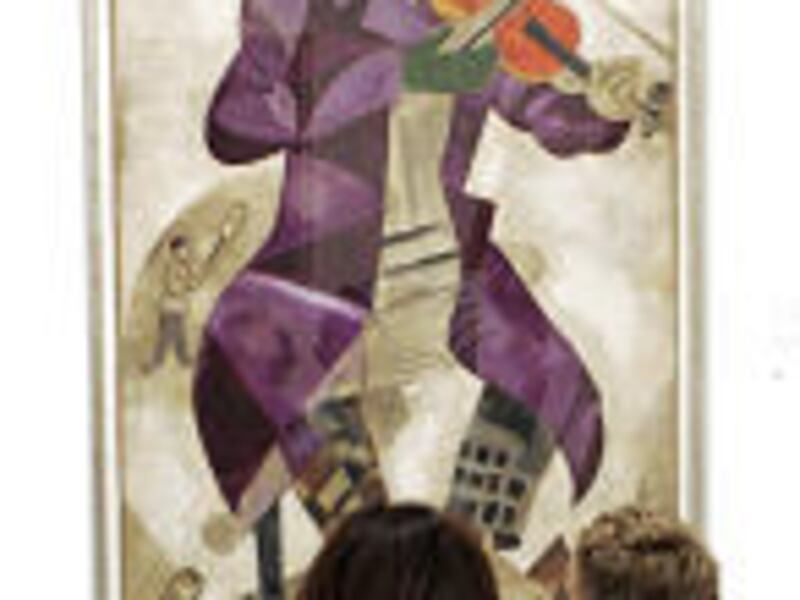
Some of the works are rubbing frames for the first time as the Guggenheim museums in New York, Bilbao, Spain, Venice, Italy and Berlin join forces for the show, which ranges from Edouard Manet and Marc Chagall to Paul Auguste Renoir, Jackson Pollock and Mark Rothko.
While it features only 4 percent of the foundation's total works, the scale of the show is such that it is housed at two museums, the Art and Exhibition Hall and the Kunstmuseum Bonn, which stand opposite each other in the former German capital.
The visitor's walk starts with some of the first Kandinsky works bought by museum founder Solomon R. Guggenheim.
Focusing mainly on painting, the exhibition moves from the emotionally inspired expressionist period to playful surrealist works by Max Ernst and Salvador Dali. A staircase constructed specially for the exhibit offers a panoramic view of huge, minimalist installations by Bruce Nauman and Carl Andre.
Pop Art works round off the display, and Lichtenstein's image of a growling dog leads the way to the exit.
Next door at the Kunstmuseum, the "Guggenheim Contemporary" exhibit includes works by such figures as Rachel Whiteread or Roni Horn. Massive installations include Matthew Ritchie's "The Hierarchy Problem," which consists of a canvas, paintings on the floor and the wall, a sculpture and a light box, spread through an entire room.