

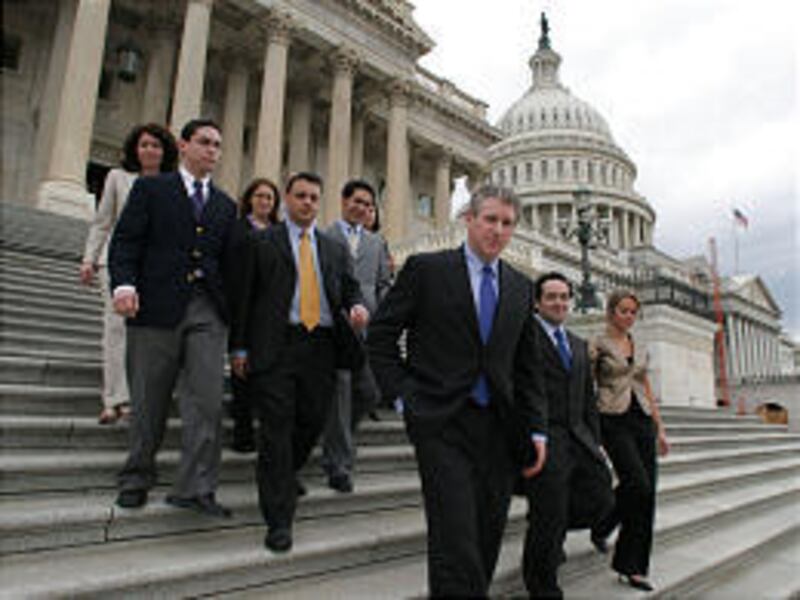
I was watching an episode of the "The Hill" with my politics-obsessed teenage son when he commented, "There's a 'West Wing' moment."' And he was right — the interplay between the staffers in the Capitol Hill office of a U.S. congressman did seem a lot like what we used to see between the staffers in the fictional Bartlet administration.
With one big difference — "The Hill" is not fiction. It's the Sundance Channel's six-part documentary series that features real-life Congressman Robert Wexler, D-Fla., and his real-life staff.
Wexler; his chief of staff, Eric Johnson; communications director, Lale Mamaux; legislative director Jonathan Katz; and legislative assistant Halie Soifer gave filmmaker Ivy Meeropol total access. Cameras follow them not only in the congressman's office, but into their personal lives, where we see how all-consuming their jobs are. (Wexler is running unopposed in his district — Florida's 19th — so there are no problems with granting an opponent equal TV time.)
It's a fascinating look that's not always pretty. These are strong-willed, opinionated people who aren't afraid to express their sometimes divergent opinions, and some of their arguments are pretty intense. So what would possess them to agree to the documentary?
"We argued about that, too — whether to do the documentary," Johnson said. "It definitely took a lot of discussion for everyone and had to be one of those things that everybody agreed to."
And it took spending some time with filmmaker Meeropol to convince everyone to come on board. But Wexler was one of the first to agree to the project.
"I think I was maybe the most supportive person of doing it," he said. "My view from the beginning was the House of Representatives is arguably the most open institution of government in the world. But even so, the workings of Congress for most Americans are largely a mystery, and I thought it would be a fascinating piece of work if done properly, that could actually expose Congress in a real way so that more Americans would understand how it works."
And a chance to see the people who do most of the work that goes on beneath the Capitol dome. "Of course, most of the focus on Congress, more often than not, is on members of Congress. The fact is that people who work in the Congress — the staff of the Congress — play a very important role," Wexler said. "And what I hope this series will show is that both in Republican and Democratic audiences there are just dozens and dozens of young people in their 20s and 30s that are extremely patriotic, extremely hard-working, driven, a lot of idealism. They come to Capitol Hill for all of the right reasons, and that's where they work.
"And I didn't know this at the time, but given the light in which Congress has been portrayed of late as a result of different negative personal behavior at times, I think it will be a very refreshing reflection on what the United States government is."
It's a partisan office. This is, after all, a Democratic congressman, and his staff does not consist of President Bush fans.
But Republicans can take heart — the staff isn't really fond of the Democratic leadership in the House, either, as quickly becomes apparent in Episode 2.
Unlike a lot of so-called "reality" shows, "The Hill" really is one. And, unlike a lot of those other shows, the participants in this one aren't complaining that they were unfairly portrayed.
"I think we all come across as exactly who we are," Soifer said. "It really accurately reflected our office and all of us as individuals. Nothing is contrived."
Still, it's hard to see yourself on TV.
"After seeing the show, I felt that I came off as fat and angry, and before the show, I only knew that I was angry," Johnson said.
E-mail: pierce@desnews.com