

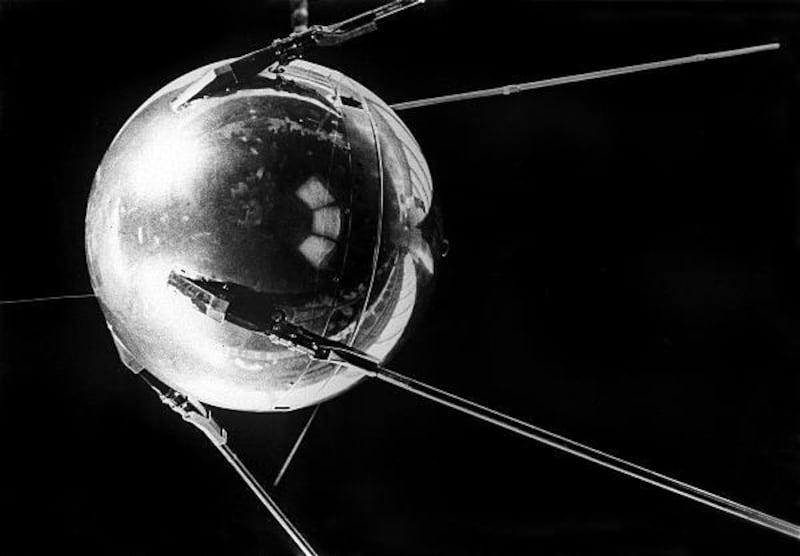

The launch of the Sputnik satellite by the Soviet Union in October 1957 had a huge impact on space-minded boys throughout the world.
While many people are aware of that sledgehammer impact it had on American youths through the movie "October Skies" or the book on which it was based, "Rocket Boys", there was a similar impact on youths in the Soviet Union.
While author and scientist Homer Hickam wrote eloquently in "Rocket Boys" about how the challenge of Sputnik woke him to the thrill and the value of science that eventually led him out of the coal town of Coalwood, W.Va., and into a career with NASA, there was another version of that story playing out in the Soviet Union.
Like Hickam, Alexander Boldyrev was born in a coal town. His was Novokuznetsk, in Siberia, USSR. He was only 5 when Sputnik launched, and he does not remember it. But ramifications beeping out from the first satellite and the early Soviet space program hit him just as hard as they did Hickam.
"I grew up, of course, influenced by this space exploration," said Boldyrev, who today is a chemistry professor at Utah State University. "It was a great excitement at that time."
His whole country was proud that the USSR was able to send up a satellite before the Americans, he said. "Also we thought this was a great advancement of space, ahead of America; we hoped maybe they could convert this technological success to a better life."
He began reading by about age six, and soon he was collecting articles published in the newspapers by the Soviet news agency TASS concerning space exploration. "I was collecting these articles, just watching how this space exploration developed," he said.
Every article about walking in space, landing a probe on the moon and another on Venus, all of it was extremely exciting, he said. His hero was Yuri Gagarin, who in 1961 became the first person in space.
"I was reading the newspapers and collecting them as people were collecting stamps."
When the first space-walking cosmonaut, Alexi Leonov, spoke at a local theater, Boldyrev and other kids hung around outside until he left. "I had an opportunity to see his face, and in fact I even touched him."
The youth decided he should join the space race. He might become a cosmonaut. Perhaps he could get into the program if he were a scientist. He chose chemistry, because space exploration needed new fuels.
Boldyrev, his three brothers and friends built and launched small rockets from the time he was 8 until he was about 13. They were made of paper, he said. The paper was coated with glue and dried until the cylinders were rigid.
"But in order to make rocket fuel, we needed the charcoal made out of wood," he said. This was mixed with nitrate and sulfur. "I was responsible for that because I was a chemist," he said.
A couple of times the rockets exploded. "At one point I lost all my brows and I got a bloody hand and leg," he laughed.
Successful rockets would soar high into the air. "I don't know exactly how far they fly. But I would say about 100 meters (325 feet), maybe."
That was an impressive achievement for boys fiddling with paper, glue, charcoal, sulfur and nitrate.
As he progressed through the local high school, his scientific insights were noticed and he was admitted to the special science and math school in Novosibirsk, the "Science City" in Siberia. "We had very intense math and physics and chemistry programs," he recalled.
After graduation, he studied chemistry at Novobisk University. After graduation he moved to Moscow and earned a Ph.D. at Moscow State University. At the Institute of Chemical Physics USSR Academy of Sciences in Moscow, he was awarded an even more advanced degree, the doctor of science. He worked as a chemist at the Soviet Academy of Sciences.
By then he was disillusioned with the Soviet system. The turning point was in 1969, when the United States won the space race by safely landing astronauts on the moon and returning them to Earth.
"From my personal point of view, when Americans landed on the moon, that was the end of socialism," Boldyrev said.
Not only he but many in the country realized the falsity of the Soviet propaganda machine. The pronouncements "tried to convince us that socialistic system is superior," he said, but they now understood that it "in fact is not."
With the fall of the Soviet Union and a drying up of science funding, he emigrated first to Germany, then to Utah. In 1999 he accepted a position at USU.
Sputnik left two legacies, he says:
• "It started the space exploration. For the first time, people realized we could take something made by humans and send it into space."
• "The launch of the Sputnik made a great impact on science education in Russia and in the United States, too. That was very important."
Boldyrev would like the United States and Russia to collaborate on sending people to Mars. "I hope that again will generate a lot of interest in science education here and in Russia and around the world."
E-mail: bau@desnews.com