

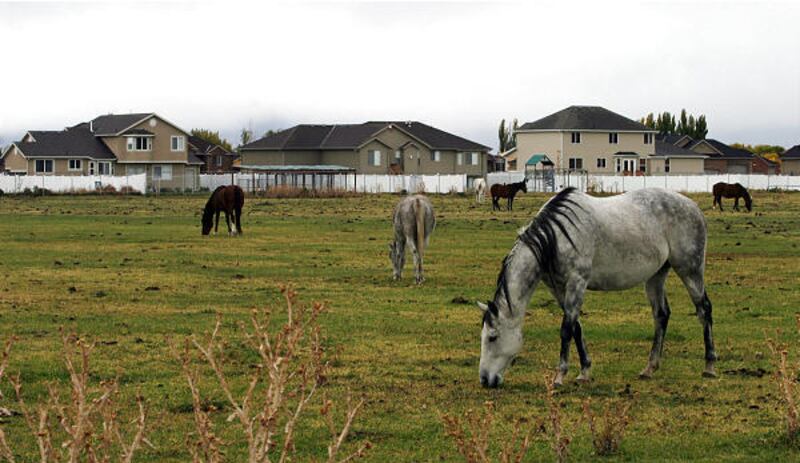

HOOPER — When La Grande Belnap used to gaze southwest of his home, he'd enjoy the view of a large dairy farm, a green-grass reminder of his hometown, a rural burg that at one time counted as many cows and horses as residents.
But the small-town charm of this formerly quiet, picket-fence community that borders the Great Salt Lake is beginning to fade as acres of former farmland are rapidly being turned into rows of large stone-and-stucco homes.
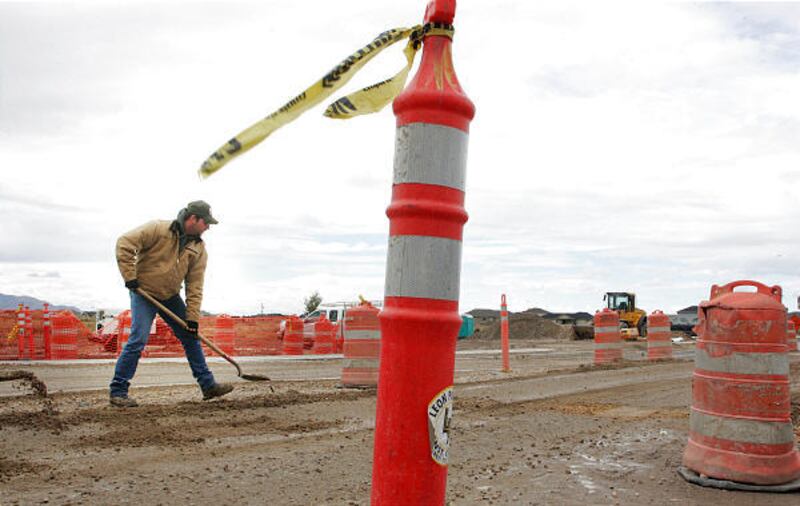
A $12 million sewer system is being installed through the east side of town, replacing septic tanks. Installation of those lines could lead to rapid construction and more-houses-per-acre building in Hooper, largely because the high water table won't be such a limiting factor. Until work started, Hooper, which is surrounded by wetlands on three sides, had been the largest unsewered city in Utah.
To some of the residents, one of the signs that the face of Hooper had started to change was when the dairy farm, operated by The Church of Jesus Christ of Latter-day Saints and a fixture along the town's 5900 West since the 1940s, shut down.
The farm had been rented by a local farmer for a while, but in 2005 was replaced by an LDS chapel and a large residential subdivision.
"It bothered me when the church gave up the stake farm," said Belnap, 82, a Hooper resident since 1933. "All the hard work and labor that went into that. To see it go for housing, that was shocking to me."
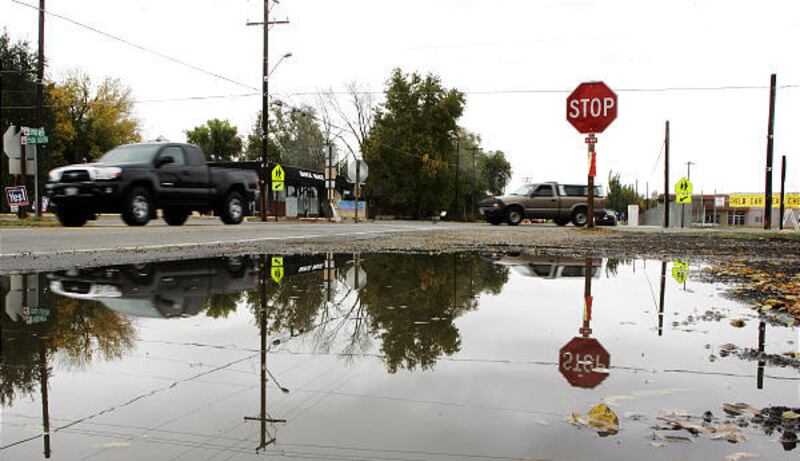
He said the roads are busier these days, especially during rush hours. And there is more noise, the kind that comes with more homes, more people, more cars.
"I guess it's just a sign of the times," he said. "We knew the growth was coming."
In pioneer days, Hooper was known as Muskrat Springs for an artesian well where the critters were plentiful. The area was also used as part of the Weber Herd Ground for cattle, and herdsmen built Hooper's first house, a two-story abode, back in 1854.
Many homes have been built since, and many more are planned.
So fearful was a vandal of Hooper's continuing growth that he caused $50,000 damage to sewer pipes last year to try to halt their installation.
Others joke that the "Hooper sewer sucks," since Hooper's sewer will be Utah's first vacuum sewer system. The fee to hook up for each resident, if paid on time, was $809.
However, now the impact fee is $2,333 through the Central Weber Sewer System. (That doesn't include the cost for also taking a sewer line from the street to a household). Residents will pay $38 a month for sewer service.
Hooper's population is estimated to be almost 6,000, according to the Wasatch Front Regional Council. That's up from an estimated 4,700 when Hooper incorporated seven years ago.
Estimates from the regional council have Hooper growing to 13,000 residents by 2030, or just over double what it is now.
And if people come, they will want a grocer closer than the stores in Roy.
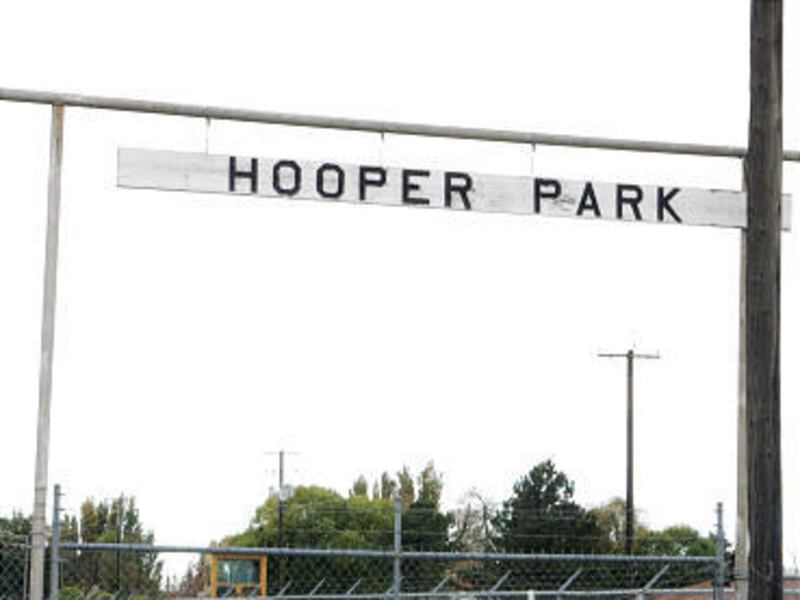
A large tract of land in the center of town, near Hooper Elementary School and a block from the Hooper Park, which is renowned for President Ronald Reagan's visit there in 1982, is now zoned commercial and is expected to attract a major grocery store, signaling a start to a cluster of retail development there.
Today, the city has one gas station/convenience store, a dance studio and some auto body/repair and construction businesses, among others.
Wayne L. Widdison grew up in Hooper and then moved away for a time. He now serves on the Hooper Planning Commission.
"I've enjoyed returning to Hooper — even with the obvious changes from when I was young. ... The sounds of tractors and farm machinery are still as likely to be heard as those of sedans and pickup trucks," he said.
"At night, the stars still shine as bright and the mosquitoes still bite as hard as they always have."
Widdison said there's nothing that can be done to halt Hooper's growth.
"Our hope is that somehow this growth can be managed in such a way as to not overwhelm the capabilities of the city to keep up and, more importantly, to maintain some of that rural feel that draws folks here in the first place," he said.
He believes that the vision drafted into new city ordinances can set Hooper apart from the surrounding communities — and always keep a slice of the small-town feel and flavor.
Widdison's wife, Andrea, grew up in rural central Massachusetts and has lived in Southern California, Hawaii and Boise. She appreciates Hooper's agricultural feel and the availability of horse property, which is disappearing along the Wasatch Front.
"Although commercial development is certainly welcomed as a boost to Hooper's tax base," she said, "the city is proceeding with caution."
Hooper has two elementary schools in its boundaries and Hooper Elementary, re-built in the early 1970s, is currently being extensively expanded/remodeled. Hooper teens go to Fremont High in Plain City.
About one-fourth of Hooper is actually in Davis County and that section remains unincorporated, though addresses there still say Hooper and mail is delivered by the Hooper post office.
Barry Burton, assistant community development director of Davis County, said Hooper City, West Point and Clinton all have hopes of annexing this unincorporated Hooper into their boundaries someday. Burton's certain that one day this area will be annexed to one ore some of those three entities.
How Hooper came to straddle the Davis County line was also a mystery until recent years.
South Weber was originally in Weber County, as the county line then was not the Weber River at the mouth of Weber Canyon, but the top of the hillside to the south, near where the Weber Basin Water complex now sits.
The South Weber area's first bishop, Thomas Kingston, had some sort of ecclesiastical disagreement with Lorin Farr, Weber Stake president in Ogden. As a result, Kingston somehow got the state to move the county line north to the Weber River, so that South Weber was in Davis County and not under President Farr's administration.
It is believed that as a result of that boundary change, that part of the Hooper area ended up in Davis County, when the Weber County line moved north.
E-mail: lynn@desnews.com