

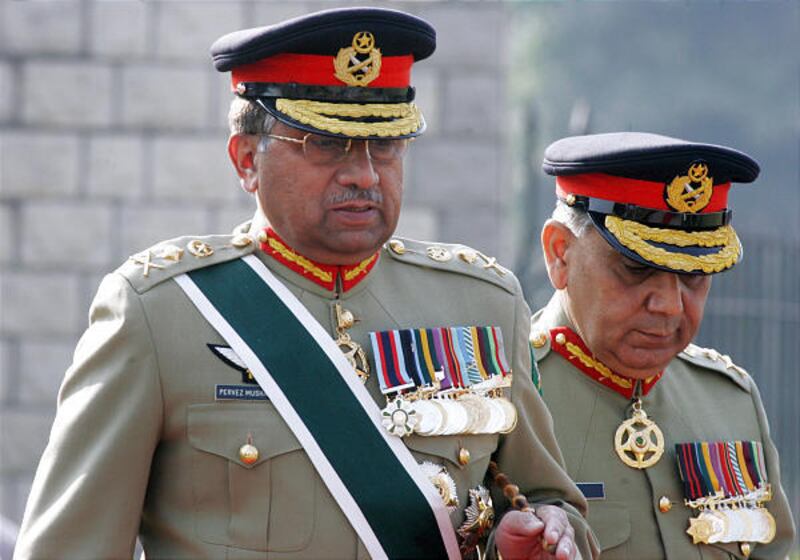
Pervez Musharraf, Pakistan's ruler since seizing power in a 1999 military coup, stepped down as army chief today, resisting opposition calls to also quit as president.
Musharraf, 64, handed over responsibility for the army to Ashfaq Parvez Kayani, 52, former chief of Pakistan's spy agency, at a ceremony in Rawalpindi. Kayani was a military aide to opposition leader Benazir Bhutto when she was prime minister in the 1980s.
"I have the confidence that the army in his command will perform better," Musharraf said. "I hope the army will be loyal to him as it was loyal to me."
The military is Pakistan's most powerful institution, and Musharraf kept control to prevent any challenges from rival generals. Kayani, a graduate of a U.S. military academy, is considered loyal to Musharraf, non-political and a proponent of Pakistan's support for the U.S. war on terrorism, for which it has received $10 billion in aid since 2001.
Kayani "has served under Musharraf at different posts and he has his confidence," Talat Masood, a retired general, said in a telephone interview in Islamabad. "He is a professional soldier and has the commitment to fight the country's war against terrorism on the instruction of a civilian government."
Musharraf plans to take a presidential oath for a second five-year term Thursday after the Supreme Court rejected challenges to his eligibility last week.
Opposition politicians demanded Musharraf resign as head of the military to comply with a provision in the constitution that prohibits officials from holding two jobs simultaneously. Bhutto agreed to a power-sharing agreement with Musharraf in which he would remain as president if he let go of the military and allowed elections in January. She abandoned that agreement after Musharraf imposed emergency rule on Nov. 3 and put her under house arrest twice in a week.
The opposition now says that Musharraf should quit as president because his Oct. 6 re-election by the National Assembly and state legislatures was flawed. Legal challenges to the election were dismissed by the top court Nov. 22, after Musharraf dismissed 18 Supreme Court justices and replaced them.
President Bush's administration has been pressing Musharraf to lift emergency rule before general elections on Jan. 8. Bhutto has been leading the campaign against the decree since she returned from eight years in exile Oct. 18 and survived Pakistan's worst terrorism attack, a suicide bombing on her homecoming rally in Karachi that killed 136 people.
Former prime minister Nawaz Sharif also returned from exile on Nov. 25 and has said he won't boycott the ballot if Musharraf restores the constitution.
Musharraf imposed emergency rule as an 11-member panel of judges was about to rule on the legality of his re-election. He won a majority vote in the presidential ballot by assemblies.
He fired the nation's top judge, saying the judiciary was undermining his government's fight against terrorism. The government banned public gatherings and amended the 1952 Army Act to enable authorities to try civilians in military courts.
The resignation ends Musharraf's four-decade career in uniform that included fighting two wars with India and directing a 1999 incursion across the border that brought the nuclear- armed neighbors to the brink of a fourth conflict.
The president, born in New Delhi four years before the partition of British India, became Pakistan's first head of state in three decades to hold talks with his Indian counterpart, Atal Bihari Vajpayee in 2001.
A former special forces commando, Musharraf ousted Sharif in 1999 after a dispute over support for Pakistan-backed militants occupying Indian-controlled territory in the Kargil region of Kashmir.
Two years later, Musharraf backed the U.S. war on terrorism following the Sept. 11 terrorist attacks on the U.S. He withdrew Pakistan's support for Afghanistan's Taliban regime, which harbored Osama bin Laden and his al-Qaeda network.
After Musharraf imposed emergency rule, the U.S. said it was reconsidering financial aid. Bhutto on Nov. 16 called that assistance "wasted" because the general was arresting supporters of democracy and not militants fighting on the border with Afghanistan.
Kayani, who was promoted by Musharraf last month to general and appointed army chief-designate, is a native of Jhelum in the province of Punjab, an area famed for its soldiers.
He studied at the Military College in Jhelum and joined the army in 1971. He is a graduate of Command Staff College in Quetta, Command and General Staff College at Fort Leavenworth in the U.S. and National Defence College Islamabad, according to the army's Web site.
As a lieutenant, Kayani fought in the 1971 war against India. In 1988, he was deputy military secretary to Bhutto. In 2001, Kayani served as the army's chief operational commander. He oversaw troops during the standoff with India after the attack on the Indian parliament.
Kayani was then promoted to command the army's elite 10 Corps in the garrison town of Rawalpindi.
Kayani headed investigations into two failed assassination attempts on Musharraf in Dec. 2003.
Five bombs were remotely detonated on Dec. 14 near a bridge in Rawalpindi less than a minute after Musharraf passed. Two suicide bombers crashed their car into the president's motorcade 11 days later, killing 14 people and wounding 46 others.
Kayani went on in 2004 to head the Inter-Services Intelligence, Pakistan's spy agency. He is the first spy chief to be appointed head of the army.