

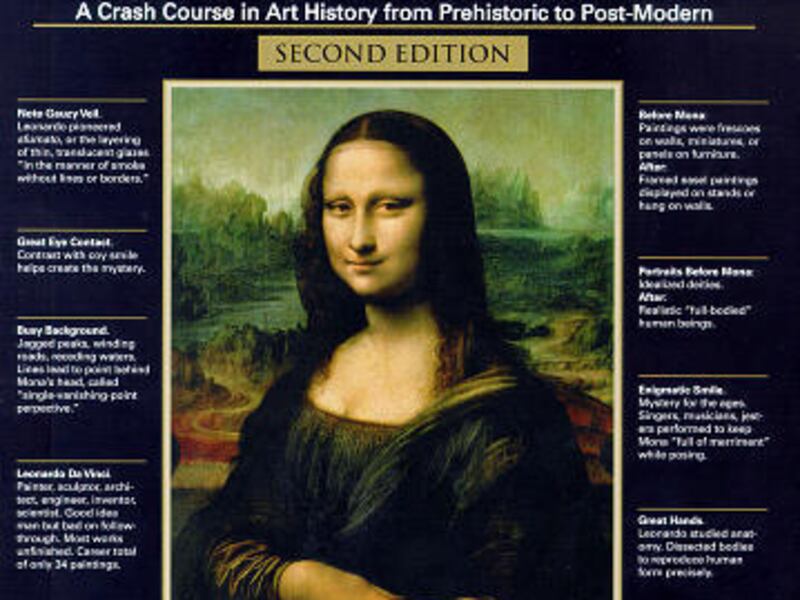
THE ANNOTATED MONA LISA: A CRASH COURSE IN ART HISTORY FROM PREHISTORIC TO POST-MODERN, Carol Strickland, Andrews McMeel Publishing, 216 pages, $22.95
Why do we have such difficulty discussing the aesthetic qualities of paintings or sculptures while visiting an art museum?
It often seems the best statement we can manage when standing in front of art is, "I like that" or "I don't like that" or some other inane declaration. Why can't we come up with anything more intelligent or analytical to say?
Christian Science Monitor art critic, Carol Strickland, tells us why in the first few lines of her "The Annotated Mona Lisa: A Crash Course in Art History from Prehistoric to Post-Modern."
"Although looking at works of art is a pleasurable enough experience," she writes, "to appreciate them fully requires certain skills and knowledge."
According to Strickland, most people are overwhelmed by art. Feeling insecure about their lack of expertise, they condemn art as being inaccessible and they simply walk away from it, or in some cases, never return to the museum again.
Strickland, who has a doctorate in American culture from the University of Michigan, would have us choose another alternative. Her "Annotated Mona Lisa" gives readers a basic working knowledge of art, which, she believes, would then allow them to converse on the art objects they encounter.
Because her book is unlike any other art textbook — employing dynamic design, succinct page-length essays and instructive sidebars — readers will soon grasp the basics of such diverse topics as mediums, art movements and styles.
Each of the book's five sections, which effortlessly escorts readers through 25,000 years of art in a mere 216 pages, offers ideas on the relevance of the artwork depicted and discussed.
Incorporating more than 300 illustrations, many in full-color, "The Annotated Mona Lisa" also covers composition, movement, unity, balance, color design and mood, all art elements that will help readers develop the needed vocabulary to express their own opinions.
Here's an example of one of Strickland's enlightening sidebars:
"Mannerists deliberately cultivated eccentricity in their work. Some were equally odd in their private lives. Rosso, who lived with a baboon, was said to have dug up corpses, fascinated with the process of decomposition. His canvases often had a sinister quality, as when he painted St. Anne like a haggard witch. On seeing one of his macabre works, a priest ran from the room shrieking the painter was possessed by the devil."
Such fascinating insights are found throughout the book.
One of the most refreshing aspects of "The Annotated Mona Lisa" is Strickland's effort to not speak down to us. She doesn't assume a prior art education and she never bores us with tedious facts or complicated jargon.
After perusing this book, anyone can feel better about discussing art on his or her next visit to the art museum.
E-mail: gag@desnews.com