

When Leah Coleman was 14 months old, her parents cried. She was the oldest child of Rachel and Aaron Coleman, and the news that she was deaf turned their world upside down.
"We just thought about all the things she wouldn't be able to do," Rachel said.
But a decade later, Leah, now 10 years old, not only lives life like a normal child but has become a celebrity, helping other children and families communicate through sign language on public television programs and DVDs.
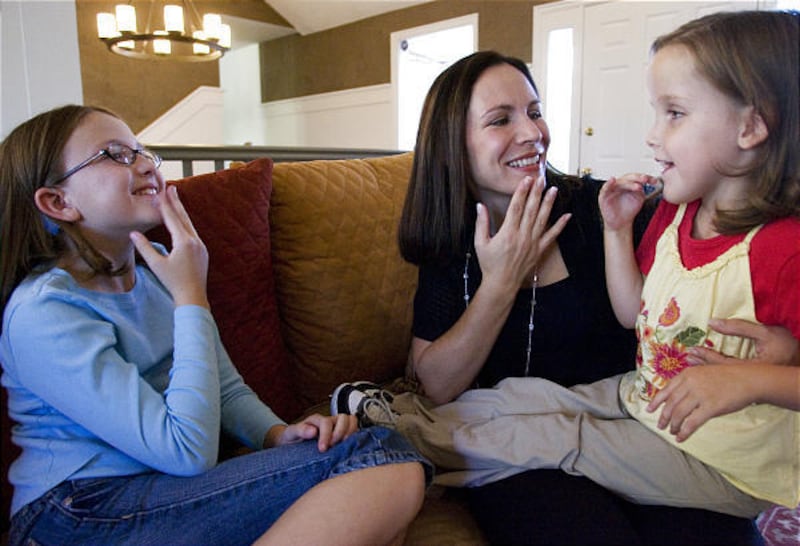
The minute Leah's parents learned she was deaf, they began learning sign language. But it was tough.
All of the sign language tutorials and DVDs were pretty bland, and there wasn't a lot out there. That, coupled with Rachel's frustration with other children not being able to talk to Leah, spurred the Colemans into action.
"When Leah was about 4 years old I was frustrated with how few people could communicate with her in the community," Rachel said. "She was being left out and it was frustrating — kids were intimidated and scared because they didn't know how to communicate with her."
She said the turning point was when a boy on Leah's soccer team said that he didn't want to be paired up with Leah for drills because she couldn't communicate with him.
"We just decided that this isn't going to get any better unless we do something about it," Rachel said.
From there Rachel started going to Leah's preschools and holding sign language story time. After just one time, she said, she had broken the barrier, getting through their fear and seeing Leah as unapproachable.
"Right away kids started coming up to her signing 'play' and 'friend,"' Rachel said.
Meanwhile, Leah's cousin, Alex Brown, who is two years younger, started signing at 10 months old.
Soon after that Rachel and her sister, Emilie, Alex's mom, decided to team up to create fun videos to teach sign language to hearing children. The initial plan was to make a short DVD to give friends and family that would be a fun and easy way to learn a second language while learning to communicate with Leah.
But after the completion of the first volume of "Signing Time," the response was overwhelming, Rachel said.
Word spread. And in addition to friends and family, other parents, educators and even health professionals were requesting copies of "Signing Time." Thus, Rachel and Emilie's company, Two Little Hands Productions, was born.
A few years earlier, Rachel's second daughter, Lucy, had been born. She arrived eight weeks premature with spina bifida and cerebral palsy. Doctors worried that Lucy would never be able to speak, let alone use her rigid fingers to sign with her deaf sister.
Rachel said had they not already been a signing family, she probably would not have even attempted to communicate through sign with Lucy.
Nonetheless, Lucy began to sign along with "Signing Time," despite her physical challenges. Shortly thereafter, Lucy started talking, something the family and doctors never imagined was possible.
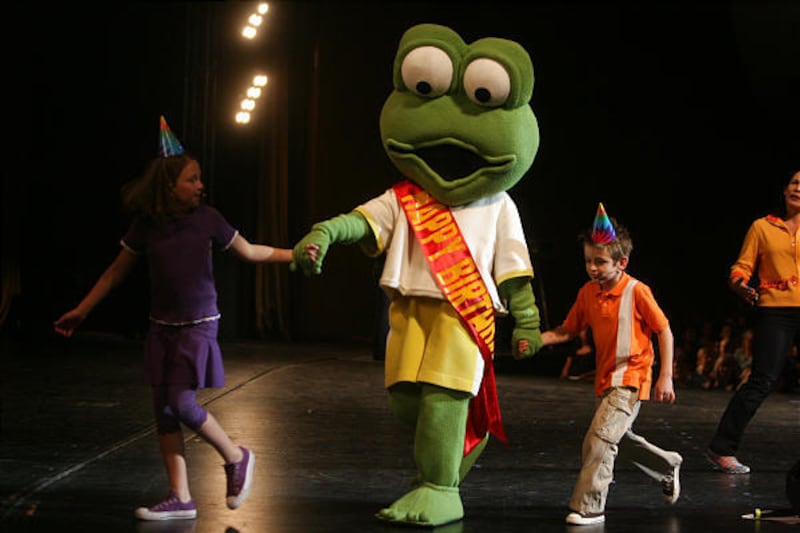
Since the first volume was produced in 2002, the pair have produced 26 DVD volumes of "Signing Time" as well as the "Baby Signing Time" series for children 3 months to 3 years old. They also have their own show on PBS.
And Alex and Leah are the stars. Leah can hear now. She was expert at reading lips early on, but at 7 years old she received a cochlear implant that has given her some ability to hear.
"I like the acting part and when we get to dress up, but it's hard to smile all the time," Leah said.
As for the fame and seeing herself on TV, Leah said it just feels normal. "I'm used to it," she said.
Rachel attributes the swift popularity of "Signing Time" to the fact that it works for every child, both hearing and deaf. Many families opt to teach hearing children basic sign language from infancy to jump start communication.
"Kids are communicating long before they are able to verbalize, and motor skills develop long before speech," Rachel said. So even though they are unable to talk, they can still sign what they want, curbing fits and crying.
"If terrible twos and tantrums are an issue that we can basically get rid of, why not?" she said. "The reason they're having tantrums is they know what they want and we don't understand them."
Research has also indicated that introducing sign language to children early improves literacy in hearing children.
Leah said the program also aims to provide hope and support to families who have a child with some hearing impairment. Plus it helps kids become comfortable around hearing-impaired people.
"Kids (who watch the DVDs) feel they have a deaf friend in Leah — they grow up with a deaf friend," Rachel said. "So there isn't that intimidation when they meet someone who is deaf — it's changing how it is to be a deaf child."
• The "Signing Time" program airs Mondays at 12:30 p.m. and Fridays at 4 p.m. on PBS. For more information visit www.signingtime.com.
E-mail: terickson@desnews.com