



PROVO — Writing a song's not so hard. You jot down some lyrics and add some music.
Writing a good song's a bit harder. Lyrics and music have to work together in pleasing, harmonious ways. But most songwriters can come up with good songs.
Writing a great song? That's something else altogether. Writing a song that not only works musically but also has the power to reach people emotionally — that's the elusive goal, says Pat Alger. "Good songs sit around. Great songs get recorded."
Not only that, but great songs "touch hearts and change lives," Alger says
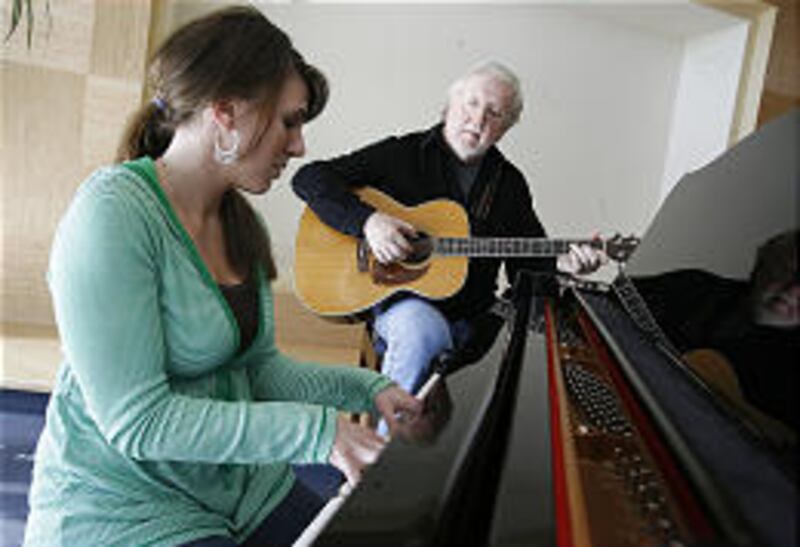
A songwriter out of Nashville, Alger was one of the instructors at a songwriting workshop that was held in Provo last weekend, sponsored by Nashville West and its organizers Tyler Castleton and Staci Peters.
Castleton and Peters are both well-known on the local-music scene. Together and singly, they've written more than a hundred songs that have been recorded by Gladys Knight, Donny Osmond, David Osmond, Julie de Azevedo, Eclipse, Jericho Road, April Meservy, Jenny Frogley and others. They've produced and arranged countless albums and have won multiple Pearl Awards.
They've also had success nationally. Castleton recently spent two years in Nashville, and he and Peters have had a song, "For the Love of a Woman," recorded by country superstar Martina McBride.
Since working in Nashville, Castleton said, "We've had a desire to bring the people here together with some of the people from there. They both can learn from each other."
The workshop offered what Castleton calls "tough love" for the songwriters. In addition to general instruction from songwriters Alger, Bat McGrath and Rachel Thibodeau, participants also had a chance to present a song for one-on-one critique and pitch their best songs to a representative from the music industry, Dan Hodges of Nashville's Murrah Music.
Castleton and Peters experienced some of that "tough love" the first time they went to Nashville. In 1996, while at Brigham Young University, they were accepted to a songwriting camp there. "We went with all our best songs and thought we were pretty neat. But we got trashed right and left," Castleton said.
In fact, after the first day they were ready to leave. "We went to the coordinator and told her we didn't think this was for us, but she convinced us to stay. Our songs got shredded. But it was the best thing that ever happened to us. We hope to bring a little of that experience out here."
"Nashville is truly the songwriting capital of the country," said Peters, and not just for country music. "There's not anyone who cares more about songwriting, people who love the craft any more than the people there."
· · · · ·
The conference instructors offered a great deal of music-business experience.
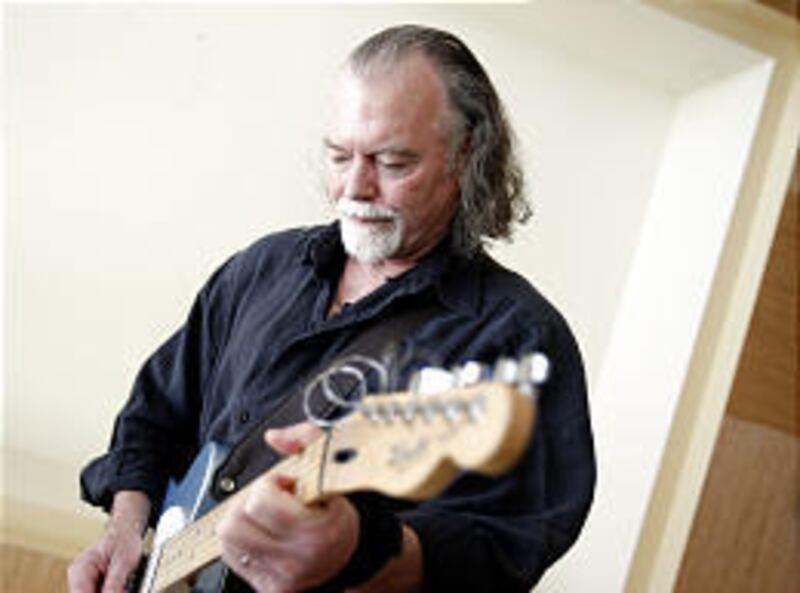
BAT MCGRATH started out with a rock band in upstate New York. He became part of the folk era, then migrated to Los Angeles. As a martial-arts specialist, he became the bodyguard for the rock group Van Halen. "Dumbest thing I ever did," he says now.
Eventually, he found his way to Nashville, and "fell in love with that scene, and I got a publishing deal." His "breakout hit" was "Come Some Rainy Day," recorded by Wynonna Judd.
PAT ALGER grew up in a Mayberry-like town in Georgia. He, too, was part of the "big folk scare of the '60s, when anyone with a banjo could get on radio."
He started in folk clubs, did a stint at Woodstock, tried out New York, and through naivete as much as anything got some songs recorded by James Taylor, then ended up in Nashville. Since then he's written for Mickey Gilley, Dolly Parton, Brenda Lee, the Everly Brothers, Kathy Mattea, Nanci Griffith, Trisha Yearwood and others.
One of his most successful efforts was a collaboration with Garth Brooks, which yielded four No. 1 hits, including "The Thunder Rolls" and "Unanswered Prayers."
RACHEL THIBODEAU is a rising songwriting star. A native of Minnesota, she bounced back and forth between her home and Nashville until moving there permanently in 2004, when she signed on with Murrah Music.
Her recent successes include "Loveland," recorded by Martina McBride; "Good Directions," Billy Currington; and "I Can Do This," Lila McCann.
DAN HODGES shared his experience of 15 years in the music publishing business. He was happy to report that "the market is exciting right now. There's a lot of growth, a lot of opportunity." But it still takes both patience and hard work to get anywhere.
"And there has to be a passion for what you do. The hardest part of songwriting is instilling emotion in the listener. Everything else you can learn. But you can't learn heart. That's what we always look for."
The four offered insights into the music world. They shared tips on writing songs, both lyrics and music. They talked about the importance of honesty and passion in songwriting. They talked about the challenges and fun of writing with other people.
They admitted that songwriting is sometimes hard to teach. "It's an abstract thing you try to talk about in concrete terms," said Alger. "We can't teach anyone to be great, we can only teach them to be better. But maybe one little thing might open a window to the creative soul."
McGrath came to Utah "to learn something and to bring something. I'm really blown away by some of the talent you have here." He, too, recognizes the difficulty of the task. "Art is a hard thing to speak about. If you break it down and analyze it, you lose the art. There has to be some magic." Some people have a gift for it, he says. "I still believe it is God's gift. You have to have an inkling and a passion."
Workshops such as this can be "an incredible experience for writers," added Thibodeau. "It's a chance to pick the brains and learn from people in the business. I'd have loved to have something like this when I was starting out."
· · · · ·
It can be a crazy business, the songwriters said. You can write a song that an artist puts a "hold" on so you can't pitch it to anyone else. And it may sit on hold for years. You may have a song that is certain to be cut — until two hours before the recording session. You may have a song that you feel passionate about but can't get anyone else to care.
So, they said, songwriting is not a profession for wimps. At some point, says McGrath, "you have to decide if you are writing to be 'successful.' And that has nothing to do with big bucks. If you can play your song to a complete stranger and move him, if you can bring a bit of moisture to an eye or a laugh or a chill, that's successful.
"You'd better not make money your god. I look back and don't know how I survived to this day. But something always seems to come up. That's how you know you're supposed to be in the music business."
E-mail: carma@desnews.com