

SULPHURDALE, Beaver County — Smoke and dirt are smudged on the clothing of the gang of 21 — certain proof they were near a fire Sunday afternoon.
But their attempts to start a fire weren't exactly successful: They got caught.
Not by police, mind you, but by wind, which escorted flames from another fire in their direction.
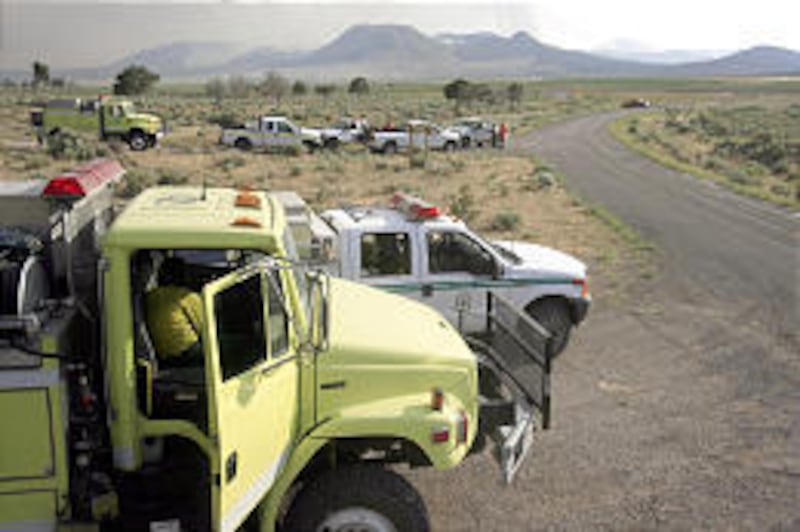
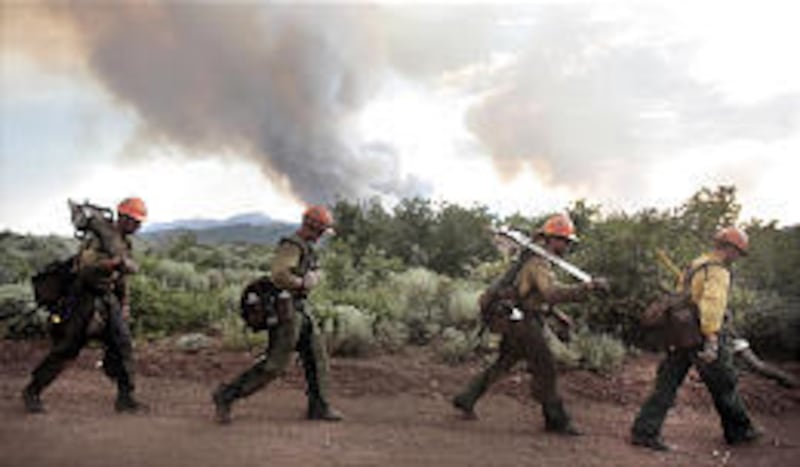
The gang is actually a crew of professional firefighters — mostly younger than 30 — who are normally based at Fishlake National Forest.
Since Sunday afternoon, they have monitored land around Sulphurdale
in nearly 100-degree temperatures and on just a wink of sleep, trying to keep the state's largest wildfire in history at bay.
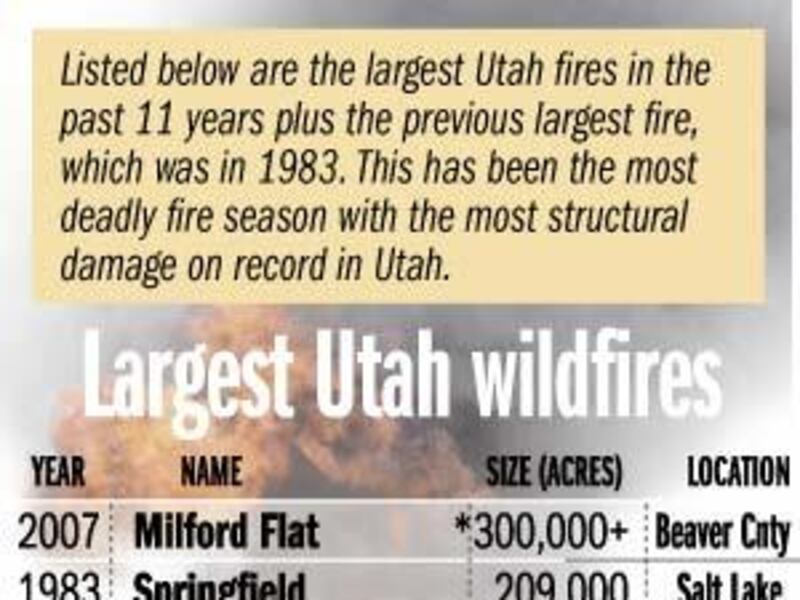
By Monday night the wildfire, known as the Milford Flat fire, amassed 311,102 acres.
Ten percent of the fire was contained on the north and west flanks, said Vince Mazzier, a fire information officer from the Great Basin Type 1 National Incident Management Team, which took over the firefighting efforts Monday morning.
The fire spans about 80 miles from Beaver in the south to Fillmore in the north, and 20 miles from I-15 in the east to Milford in the west.
By Monday night, 361 firefighters and personnel were fighting the blaze, which was sparked by lightning east of Milford on Friday. More crews were en route to the fire.
The 21-person Fishlake crew is led by Eddie Taylor. By Sunday afternoon, the Milford Flat fire had jumped over I-15 in nearby Cove Fort. So, with a bulldozer, Taylor's crew decided to start a backfire near the freeway and Sulphurdale.
The theory was that if the land was charred, the Milford Flat fire would stop before having an opportunity to jump the freeway again.
Shortly after the Fishlake crew ignited the controlled blaze, the Milford Flat fire came roaring down the Mineral Mountains into the controlled fire's direction.
"We knew it was coming down, but we didn't think it would be so fast," Taylor said.
The Fishlake crew jumped into action, trying to keep the Milford Flat fire behind about a half-mile of service road. The fire jumped the service road and a bulldozer-created fire line. It became too hot for firefighters to safely handle, and an air tanker was called to douse flames with retardant before it approached I-15.
So much for the controlled burn. But the Fishlake crew didn't have much time to lament.
"It's part of the job because we really have no control over the fire," said 21-year-old Nick Schneck. "We try to stop it and we try to control it, but it does what it wants."
"You try to have a good attitude about it," said Shauntae Duffin, 20.
The crew slept for 6 1/2 hours, then was back in Sulphurdale on Monday morning watching the fire and debating whether to start another controlled burn.
"It's hard to stay sleepy when you're getting physical" because adrenaline kicks in, said Tyler Hunt, 19.
On Monday, four single-engine air tankers sprayed retardant over the Milford Flat fire. Two heavy helicopters poured water over the fire, and one light helicopter transported firefighting managers over the blaze for mapping purposes.
Firefighting costs so far have totaled $800,000, mostly in personnel and aviation, Mazzier said.
Seventy-five percent of the state's costs will be footed by the Federal Emergency Management Agency, after Gov. Jon Huntsman Jr. successfully applied for a FEMA grant Saturday.
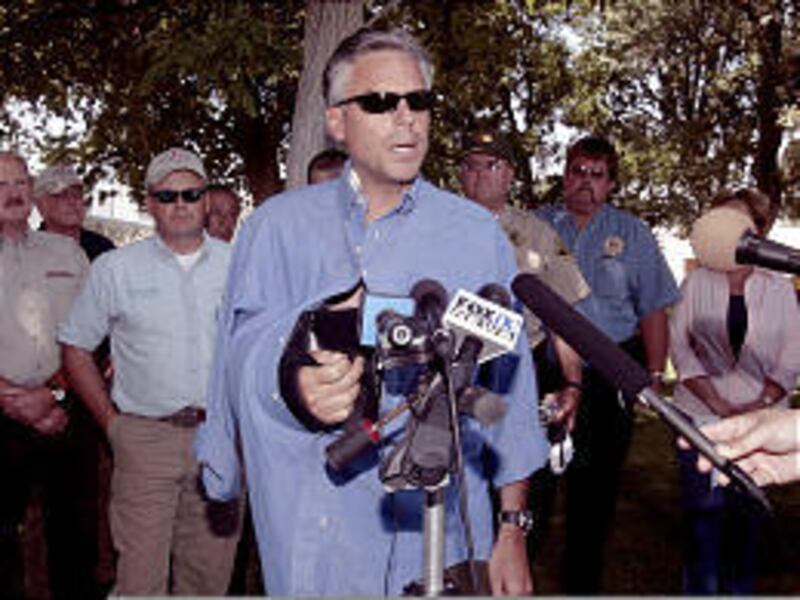
Huntsman visited the fire Monday, saying he would work with the federal agriculture and interior departments to reseed the burned-out areas with native grasses and to provide financial assistance to farmers who have lost cattle and crops.
"If we do nothing, we'll see the re-emergence of cheat grass, which is a primary fuel in this fire," Huntsman said.
Cove Fort rancher Alan Peacock, who believes federal government grazing policies contributed to the fire (which almost consumed his house), said it will take at least two years for native grasses to grow. And, in the meantime, cheat grass will fill in and become fuel for another fire.
"The governor is talking about stuff that seems politically pleasing to people but it's not accurate," Peacock said.
Rowdy Muir, the Type 1 team's commander, believes the cheat grass played an unusual role in the fire.
"I think it's a combination of a lot of things," he said. "First, you don't have a good winter. Two, we had good spring rains that brought cheat grass," followed by 30 days of no precipitation, which dried the cheat grass and other plants.
Muir told reporters Monday afternoon it was difficult to estimate a 100 percent containment date.
"You're asking me to go way out on a limb," he said. "I would predict we'd have containment 10 days from now."
The firefighters and personnel are staying in the Kanosh city park, which has about 250 tents. Food is catered by a government contractor. Tent buildings equipped with electricity for computers, fax machines and air conditioning are also contracted. Portable bathrooms and showers are provided through government contractors.
Jaki Nordrum, the fire's logistical section chief, has about 40 people working for her to ensure firefighters are fed three daily meals, heavy with carbohydrates, and operations managers have their office needs met.
She's done this type of work for 28 years.
"Everything falls into place," she said. "I have my gear ready, and I throw it in my vehicle."
Also Monday, several other fires scorched land throughout Utah and northern Arizona.
In eastern Utah, the Neola North Fire burned more than 43,700 acres and was about 75 percent contained late Monday.
During a community meeting in Roosevelt, officials announced the fire would be handed over to a Type III firefighting team on Wednesday. At that time, about 100 firefighters will take over efforts in the rugged, mountainous terrain of Ashley National Park. They plan to focus on containment rather than suppression, due to concerns about firefighter safety.
The fire, which started late last month, has killed three people and destroyed a dozen homes.
The Mathis Fire had scorched more than 1,300 acres in the Carbon County town of Kenilworth. Mines and other economic resources in the area were being threatened, fire officials said. The fire was 10 percent contained late Monday.
On the Utah-Arizona border, the Black Rock Gulch Fire had burned more than 13,700 acres. Approximately 200 firefighters worked the blaze, which was about 10 percent contained Monday night.
The Slide Fire, burning near Fredonia, Ariz., burned 6,000 acres but was 40 percent contained Monday, fire officials said.
Contributing: Rebecca Palmer, Ben Winslow and Geoff Liesik
E-mail: lhancock@desnews.com