



The current debate about new buildings in Sugar House brings back memories of the years our family lived there back in the 1920s. Our home was a red-brick bungalow on McClelland street, halfway between Hollywood Avenue and 2100 South. If you wanted diversity, we had it on our street.
In a big house on the Hollywood corner was a prosperous Jewish family.
Three doors away was a German family where the parents spoke little English but the children were fluent in both German and English.
Across the street was a Dutch family whose pride and joy was their Model-T Ford, which they had to start with a hand crank.
In a smaller house was a young couple whose little-red haired girl was the darling of the neighborhood. Her father drove a city truck that was equipped to sprinkle dusty unpaved streets in the summer and plow snow in the winter. Thanks to him our street was always well-sprinkled in the summer and clear of snow in the winter.
The largest house on the street belonged to the Matson family, owners of the Sugarhouse Mercantile grocery and meat market, which was located a few doors past 2100 South on Highland drive. The "Merc" had a busy home-delivery service with a small horse-drawn buggy-type wagon. Two horses were kept in a small barn in a nearby vacant field.
Some of the boys in the neighborhood would watch for the drivers to bring their horses into the barn at midday and take off an hour for lunch. Then the brave boys would get the horses and ride them bareback around the yard. Those antics ended when the mother of one of the riders made an anonymous phone call to the store.
The convenience of living close to your business was not lost on Willard Richards, the owner of Granite Furniture. The family home on McClelland was just across the street from the store on 2100 South.
Our next-door neighbors were a retired couple with two sons, one of whom was a doctor and the other a Catholic priest. Adding to the diversity of the neighborhood was a veteran state-prison guard who had the best-looking front yard on the street, thanks to his carefully tended flowerbeds.
The firefighters at the Sugar House station on 2100 South were always willing to show the kids around the station and let them slide down the firemen's pole from the second to the ground floor. Sometimes they would glue a nickel or dime to the sidewalk in front and watch as a passerby would try to pick it up.
Saturday matinees at the Hyland theater on 2100 South cost a nickel and starred the cowboy heroes of the day — Tom Mix, Hoot Gibson, Harry Carey. The girls' heroine was Ruth Roland.
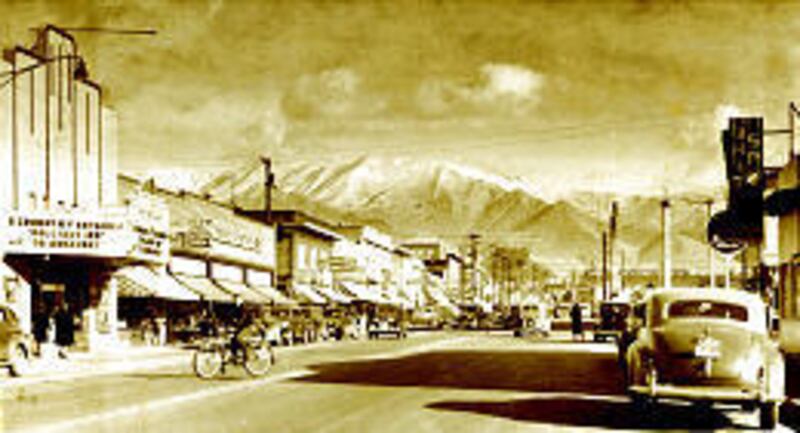
The busiest part of Sugar House was the half block between McClelland and 1100 East. On the west corner was the Eddington Funeral parlor. Next was Dalebout's bakery — where you could get three fresh-baked loaves for a quarter — and then a Piggly Wiggly grocery store. A Snelgrove ice-cream store with nickel cones came along a few years later.
The Sugar House Library and the Sugar House bank were side by side on the north side of the street, along with Brent Peterson's meat market and a Schramm Johnson Drug store. On the south side of the street were Granite Hardware, Apex Electric, a photo studio, Rockwood Furniture, Burt's barber shop and Granite Furniture.
Three out of every four street cars from Salt Lake City ended their run from downtown at 2100 South. Every fourth car continued down Highland Drive to 4500 South in Holladay but it cost another fare — 7 cents. There came a day when Utah Light & Traction Co. raised the fare to a dime, but you could save a few pennies by buying three tokens for a quarter. Students, including those in college, could buy a book of 50 tickets for $2.
Parleys Creek used to be dammed up enough in the summer to make a swimming hole for kids brave enough to jump in. (I watched others dive in but never tried it myself.)
It's hard to believe there used to be a small grass park in the middle of 2100 South between McClelland and 1100 East. That's where John Held's band played a free concert every Saturday in the summer. At the east end of the park you could buy a nickel bag of popcorn from a man who brought his four-wheel popper to the spot every summer day. The grass park eventually became just a strip of concrete that divides the three additional lanes built to handle the 2100 South traffic.
The D&RG railroad used to make a run to Park City every day on its tracks, which ran a few yards south of the Forest School grounds. A few daredevil students would try to grab a two-block ride on the train as it slowed down to cross 900 East and then at Highland Drive. But these rides came to a halt when a student missed his grip on a freight car handhold and was killed.
There was another tragedy when a veteran police officer, whom everyone knew as "Mr. Lund," was struck and killed by an errant driver. Businesss owners and residents contributed generously to a memorial fund for his family.
After school you could find a half-dozen of us in the doorway of the Davidson Blacksmith Shop watching red-hot horseshoes being nailed to the feet of husky work horses. A McDonald's restaurant now stands where the blacksmith shop used to be. And across the street is the Smith's supermarket that replaced the Forest School ... a long time ago.
A big change and boost to the whole area came in the 1950s when the old state prison with its 20-foot stone walls was torn down and the new one was built at the Point of the Mountain. The grounds and the prison farm, which stretched from 1300 to 1700 East, became Sugar House Park and the Highland High School campus.
If there were any boundaries for Sugar House in those days they would start at 900 East and run up 2100 South past Irving Junior high to the state prison. The north-south boundary would run from 2100 South to the Curtis Coal yard a block or so down Highland Drive.
As for any boundary today, just take your choice.
Parry Sorensen is a professor emeritus of communications at the University of Utah. E-mail: pdsorensen@aol.com