

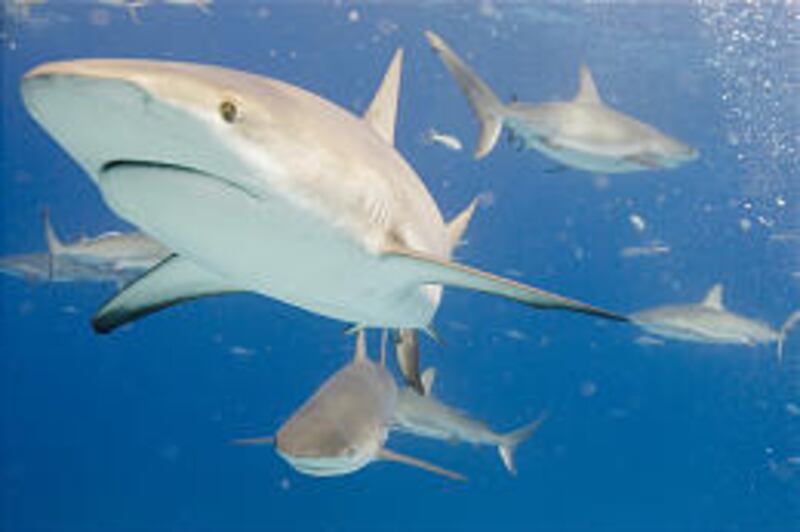
BEVERLY HILLS, Calif. — The Discovery Channel begins its 20th annual "Shark Week" with the ultimate shark story — the sinking of the USS Indianapolis and what is believed to be the worst shark attack in history.
"Ocean of Fear: Worst Shark Attack Ever" (Sunday, 10 p.m., Discovery) recounts the real-life events. On July 30, 1945, the Indianapolis was torpedoed by a Japanese submarine in the Philippine Sea and sank in 12 minutes. Of the 1,196 crew members, about 300 went down with the ship. Of the approximately 900 who survived the sinking, only 316 were alive four days later when rescue ships finally found them.
In the interim, sharks took a lot of men, but perhaps fewer than has become a popular myth since the story of the Indianapolis was included in the narrative of the 1975 blockbuster "Jaws."
"One of the things that ... our expert discovered in the work he did to reinvestigate the story is that actually, although an awful lot of the men were attacked by sharks, and a lot of them were eaten by sharks, (there) may only be a couple of dozen (that) were actually killed by sharks," said executive producer Phil Craig. "A lot of these men were in the water for four or five days with serious injuries, facing thirst, exposure, dehydration. That took more lives than the sharks."
And one of the 316 men who survived the sinking agreed."I think a lot of the men died from exposure and giving up," said Michael Kuryla, who was 19 when the ship went down. "The sharks took a lot of men, but I don't think they took them all. A lot of men gave up and just died out there. They were gone already, and they let their bodies go. And I guess the sharks feasted on them.
"The men out there, some of them would give up. They didn't think that they would survive."
Kuryla, on the other hand, had no doubts.
"I knew I was going to come out. I said, 'I'm going to make it.' Now, if you have a negative view like some of them had, they were going to die. They're not going to make it. Well, I didn't think that way," he said.
Kuryla, and Harlan Twible, who was 23 when the Indianapolis was sunk, were full of praise for "Ocean of Fear: Worst Shark Attack Ever."
"I think it's a fabulous film," Twible said. "It's very accurate. I can find no fault with it at all. There's been a lot of research done on this. ... There was no romanticizing of the story. They more or less stayed with all the facts that they could get a hold of."
"It's very accurate," Kuryla agreed. "It portrays the men in the water the way they were."
Twible held onto the wallet he had in his pocket when the Indianapolis went down.
"In my wallet I had a picture of my lovely wife and a four-leaf clover from my mother," he said. "We are of Irish extraction. She said, 'This will keep you through the war.' And that stayed with me until I just donated it (to a museum in Indianapolis) about two months ago."
"I had something in my wallet," Kuryla said. "The men were throwing money away. I was picking it up.
"I told them, 'When they pick me up, I'm going to go to church first and pray for all of them. And then I'm going to go to the tavern to get drunk.' That's what I did."
And he's not holding a grudge. "Yeah, well, the sharks did a lot of attacking, but I got nothing against sharks," Kuryla said. "We were in their territory. And that's where a shark belongs, not us."
E-mail: pierce@desnews.com