

Conservative Utah is home to more school gay-straight alliances than 15 other states, Washington, D.C., and Puerto Rico, according to a national group that registers the organizations.
But it's uncertain whether GSAs will continue cropping up in Utah under a new state law regulating student clubs.
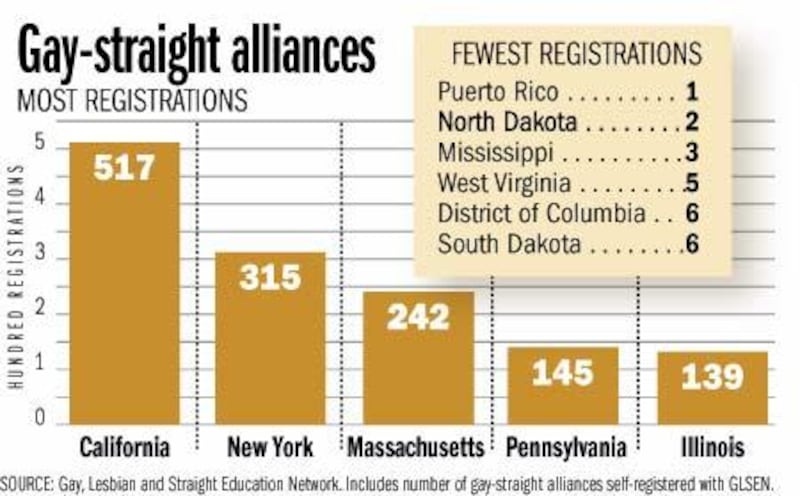
In all, 3,577 GSAs nationwide have registered with Gay, Lesbian and Straight Education Network, including at least one from every state, Washington, D.C., and Puerto Rico, reports the national group. California has the most, with 517, followed by New York's 315 and Massachusetts' 242.
On the other end is Puerto Rico, which has one registered GSA, the group reports.
Utah has 17 GSAs registered with the network, outnumbering those in Alaska, Tennessee, Hawaii, Louisiana, South Carolina, Delaware, Alabama, Arkansas, Idaho, Montana, Wyoming, the District of Columbia, South Dakota and West Virginia, Mississippi, North Dakota and Puerto Rico, according to the report.
But the registry is outdated. At least six — Bountiful, Skyline, Brighton, Hillcrest, Layton, Northridge — on the list were defunct last school year, and some for several years, school leaders said. But Equality Utah and the Utah Pride Center say that last school year, they were working with groups at 15 schools, several of which are not on network's registry: Logan, Park City, East, West, Copper Hills, West Jordan, Hunter, Sky View, Highland, Granite, Bingham, Jordan and Cottonwood high schools, and Oakley School and Rowland Hall-St. Mark's School.
That number would rank Utah ahead of 15 other places on the registry.
"Each year, some fall away and some start up ... depending on the support they receive from their schools," said Rachel McNeil, director of youth programs for the Utah Pride Center. "It's hard to keep up on (their status)."
GSAs provide a safe and supportive place for gay, lesbian, bisexual, transgender, questioning and straight students, and those who may have gay parents, to talk about issues they and those close to them face, including bullying and vandalism, supporters say.
"If there's a GSA at the school, and they say, 'Come on in ... how was your day, let's talk about it,' that's good for kids," said Bountiful High social studies teacher Joel Briscoe, who helped advise the now-disbanded GSA. "Every kid in our community has got to be able to go to a public school and be safe there. Period."
But GSAs are controversial in Utah.
In 1995, students' requests to set up a GSA in Salt Lake City's East High School resulted in community uproar, national media attention, an extracurricular clubs ban (since rescinded) and a federal lawsuit.
In 2006, legislators debated a bill banning gay-straight alliances, just months after a gay-straight alliance started meeting at Provo High in conservative Utah County. The bill failed.
But earlier this year, a less strident bill became law. Now, teens must get parental permission to join extracurricular clubs such as GSAs, and school leaders can deny clubs to "protect the physical, emotional and moral well-being of students" or those that involve human sexuality. Clubs also cannot form if students can't find a faculty sponsor.
The American Civil Liberties Union of Utah had feared that would allow schools to violate the Federal Equal Access Act, which prohibits schools from discriminating against clubs based on "political, philosophical or other content of the speech" at student meetings.
But sponsoring Rep. Aaron Tilton, R-Springville, said the law upholds parental rights.
"It won't prohibit them from forming a GSA ... it sets a standard for parental involvement," Tilton said. "If the true intent for the clubs is to provide tolerance and safety and all those other things, it would be the parents who would make the decisions as to how that would be done and if their kids need it."
But McNeil says the parental permission issue isn't the problem. Rather, it's lack of understanding of what came out of the much publicized Capitol Hill debates on the bill, which was substituted seven times.
"Often, I have educators calling me to see if it's still legal to have GSAs," McNeil said. "All the controversy, it sent a ... negative message, that maybe there's something wrong with having a GSA — why would there be all this legislation if there's not something wrong with it? Some students may be too uncomfortable to start one."
E-mail: jtcook@desnews.com