




RAPID CITY, S.D. — When she heard I was headed to South Dakota's Black Hills with family, my friend Barbara, who regularly heads that way with her husband and kids, emphatically recommended that we find time to see Custer State Park.
Iconic Mount Rushmore was already at the top of our list of places to visit. The towering memorial-in-stone to presidents Washington, Jefferson, Lincoln and Theodore Roosevelt was, in fact, intended all along to be the long-range target of our summer cross-country trip, which in the end included huge swaths of Wyoming and bits of Montana, Idaho and Utah.
Also on the proposed itinerary in South Dakota were the still-in-progress Crazy Horse memorial near Rushmore, Badlands National Park east of Rapid City, fabled Wall Drug in the tiny town of Wall (just for kicks) and the historic gold-and-gambling center of Deadwood. Oh, and Custer State Park, subject like the others to last-minute decisions and the weather.
Barbara's enthusiasm vaulted Custer State Park into the top tier.
When we got back home, I couldn't thank her enough.
Simply put, Custer is the heart of the Black Hills. Rushmore, Rapid City and the Hills themselves are a tourist magnet, deservedly so in many respects, but the result is also a forest of roadside billboards urging visitors to do this or see that, many of the "attractions" having more to do with $$$ than the area's beauty and history.
Its size (71,000 acres), varied scenery (from grasslands and lakes to mountaintop granite spires) and wildlife (including one of the largest bison herds anywhere) make Custer as close to a national park as a state park could hope to be.
· · · · ·
"We do hear 'wow' a lot. We do hear that we're the 'best-kept secret,"' says Custer State Park Superintendent Richard Miller.
Not that the park really is a secret anymore — or that South Dakota wants it to be considered as such.
"We host over 1.5 million visitors a year," Miller says. "And no, we are not a secret. We market extensively, doing our darndest to attract people. And we're centrally located" among other national parks, national monuments, forests, famous caves and other Black Hills attractions.
Originally organized as the 48,000-acre Custer State Forest in 1912, and soon to include a state game preserve, the park itself was created in 1919, due in large part to the foresight of Peter Norbeck, at the time South Dakota's governor and subsequently a U.S. senator.
"He's generally known as the father of Custer State Park," Miller says. "It was his vision and his hard work that brought it together."
Today the Peter Norbeck National Scenic Byway carves a serpentine 68-mile route through Black Hills National Forest and neighboring Custer State Park. The primary visitor center in the park is named for him as well, as is the Norbeck Wildlife Preserve.
The park, of course, derives its name from fabled Gen. George Armstrong Custer, whose troops in 1874 probed the Black Hills — sacred to the Sioux — and discovered gold. Two years later Custer and his command were wiped out during the Battle of the Little Big Horn in Montana.
Besides its size (it is said to be the largest state park in the Lower 48 states), Custer has other features and amenities that make one think "national park":
It has four lodges/resorts, owned by the state but managed by a concessionaire.
The park is open year round. Only one road is closed in winter, the route to the mountaintop Needles, which is then dedicated to cross-country skiing and snowmobiling.
Within the park are nine campgrounds, with about 350 campsites.
The park and neighboring Black Hills National Forest and Black Elk Wilderness host a variety of hiking, mountain biking and horseback trails, including routes to the top of South Dakota's highest summit, 7,242-foot Harney Peak.
The park also has been home to the Black Hills Playhouse since 1946. This year's summer season includes five productions.
As on Utah's Antelope Island, each fall Custer's sizeable bison herd — 1,450 animals — is rounded up for health checks, branding and culling for an annual auction. An arts festival coincides with the event, to be held this year Sept. 29-Oct. 1.
· · · · ·
Our summer day trip into Custer State Park began to the north in Rapid City. We followed the route toward Mount Rushmore National Memorial Park but turned southeast outside the Western-themed town of Keystone, heading toward the park on U.S. 16A, the Iron Mountain Road — and the Peter Norbeck National Scenic Byway.
The rewards were virtually instantaneous.
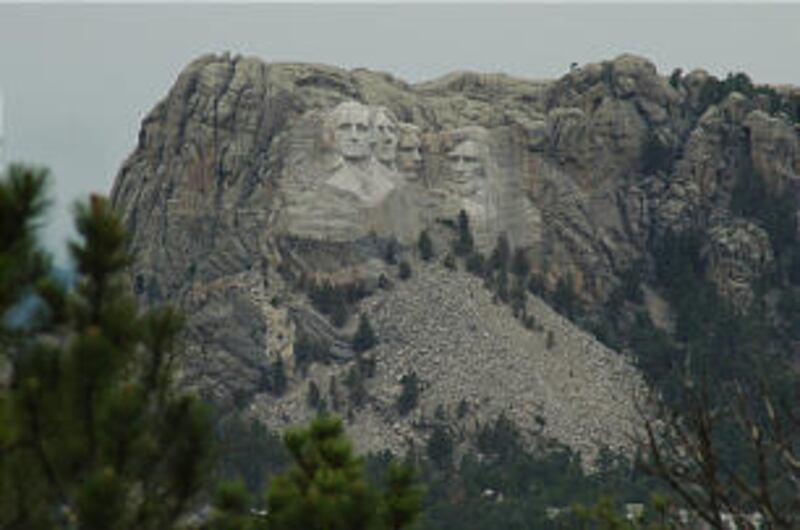
The route here includes six narrow tunnels and several remarkable curved "pig-tail" bridges that help the road wind up the pine-forested mountainside. And there are spectacular distant views of Rushmore's Washington, Jefferson, Lincoln and Roosevelt.
Then came a placid stop beside Lakota Lake and soon our first glimpse of the area's bison, or buffalo.
Several dozen were grazing right beside the road. A ranger was parked nearby, to make sure passers-by didn't get too close. Several calves, a lighter shade of brown compared to their dark, shaggy parents, followed one another playfully through a tangle of bushes. Others suckled. One bull decided to wallow in a dusty spot in the middle of the herd.
Bison, of course, once ruled the North American Plains, roaming in the millions. By the late 19th century, however, they had been driven to near extinction. In the early 1900s, about three-dozen head were purchased from a herd near Fort Pierre, S.D., to re-establish them in the Black Hills, Miller says.
"They brought them over to a small town close to the park, Hermosa, and then ox-carted them over here. Now we have one of the largest publicly owned free-roaming herds," the superintendent says.
The park's official published guide also takes its name from the buffalo: Tatanka. (You may remember the scene in the movie "Dances with Wolves" when Kevin Costner's Lt. John Dunbar and Graham Greene's Kicking Bird "connect" when trying to share English and Lakota words for the animal.)
Down the road we came upon what looked to be a group of small donkeys, mostly mares (or jennys) and foals, a mottled crew in shades of tan, gray and white. Vehicles stopped and the animals eagerly approached for handouts of crackers.
"Those are our burros, the little moochers," a ranger explained a little while later. Their ancestors carried tourists to the top of Harney Peak, according to Tatanka; today's burros roam free, but the creatures are not native to the area.
We stopped at the Peter Norbeck Visitor Center to get a few postcards and our bearings, picked up picnic lunchboxes at the State Game Lodge's restaurant nearby (FYI, the lodge was the "Summer White House" for President Calvin Coolidge in 1927), then headed for the park's enticingly named Wildlife Loop Road.
Besides the buffalo, many other animals were reintroduced as part of the state game preserve that preceded establishment of the state park, Miller says, including elk, pronghorn antelope, mountain goats, bighorn sheep and turkeys.
Every curve of the loop seemed to produce another animal. We saw antelope, solo and does with fawns; a wild turkey; meadowlarks and bluebirds; a white-tailed deer and its fawn; more bison; and a town of frisky prairie dogs in a green but mound-pocked meadow.
Though the skies had turned gray, we headed up the park's high Needles Road — and were caught in a downpour that continued though the granite pinnacles and down to picturesque Sylvan Lake.
The rain kept us from exploring farther on foot — but by then we'd already seen a lot, and left Custer State Park thinking we'd truly experienced the natural beauty and wonders of South Dakota's Black Hills.
E-mail: rayb@desnews.com