

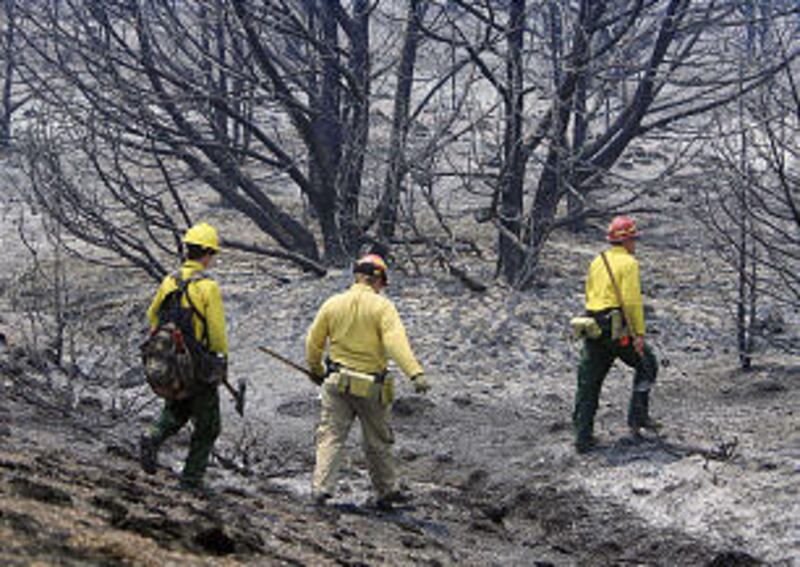
COVE FORT — The owner of a service station spared in this summer's Milford Flat Fire says that he's lost possibly half his business.
"It hurt us big time," said Jimmy Hodges, owner of the Chevron station at Cove Fort.
The July wildfire burned 363,000 acres. It was the largest fire in Utah history.
Business at Hodges' towing and repair shop is down by 50 percent. He hasn't yet calculated losses at the gas station and convenience store but expects they are equally dismal.
On July 8, winds shifted and flames jumped across I-15 from the west side to the east side. Fire consumed a historic building that was being used as a gift shop. It shared a parking lot with the Chevron.
Hodges' business was saved, thanks to family members hosing down buildings with water.
"People don't want to pull into a place that's ugly and all burnt up," Hodges said. "This used to be a pretty place, a scenic view. Now it looks like a nuclear bomb hit it."
Hodges spoke Friday to members of the Natural Resources Coordinating Committee, which includes state and federal employees who work on environmental issues. They were on a bus tour of the area.
About 1.5 million pounds of seed are needed to revegetate the areas that were burned out. The government wants to seed the area before flammable cheat grass fills in and creates fuel for future fires.
"We've purchased everything available," said Rory Reynolds, coordinator of the Division of Natural Resources' Watershed Program.
The seed has been arriving in shipments every few weeks. The state has ordered several dozen kinds of seed of native and nonnative plant species and it is shipped to a facility in Ephraim.
There, rehabilitation crews mix together the different species to promote a diversity of plant life after the seeds are spread over the charred earth.
But not all plants survive in the same types of terrain. Rehab crews use a variety of seed mixtures for different types of elevation, precipitation and soil.
High elevations that are likely to get snow first will be among the first to get seeded, beginning Oct. 1. The goal, Reynolds said, is for plants to take root and fill in the burned-out areas in two to three years. But in that time, cheat grass still could invade.
To eliminate the cheat grass threat, the rehabilitation team will chemically treat areas with the heaviest cheat grass infestations, Reynolds said.
The rehabilitation team will also create buffer areas beyond cheat grass-infested areas, Reynolds said.
Rehabilitation is expected to cost about $4 million, the same amount as fire suppression.
Wildfires have scarred millions of acres throughout the West this summer, and obtaining seed has become difficult. In Utah, a rehabilitation team has hustled to buy all available seed, said Don Banks of the Bureau of Land Management.
"We are in a far better position than most states," Banks said.
E-mail: lhancock@desnews.com