

MURRAY — The starship Enterprise explores strange new worlds in the "Star Trek" TV shows and movies.
The new "Enterprise" high-tech air-pressure chamber in Intermountain Medical Center's hyperbaric medicine unit not only will offer better ways to treat some patients, but also will explore high-altitude medicine on a research basis.
The Salt Lake Valley is some 625 miles from the ocean. So a "diving chamber" like the one at Intermountain — best-known for treating the bends in deep-sea divers — may seem out of place here. However, such hyperbaric treatment chambers also can help treat troublesome wounds or infections, radiation-damaged tissues and even carbon monoxide poisoning.
And, yes, Intermountain does occasionally treat some scuba divers who return from tropical areas with the bends.
After months of preparation, fine-tuning and testing, the Intermountain Medical Center unveiled the hyperbaric treatment chamber Tuesday.
The chamber, one of the most sophisticated in the world, has been years in the making. In fact, the massive $1.3 million, 25-ton unit was put in place in the lower level patient tower, 5121 S. Cottonwood St., before the walls even went up at the nearly one-year-old IMC.
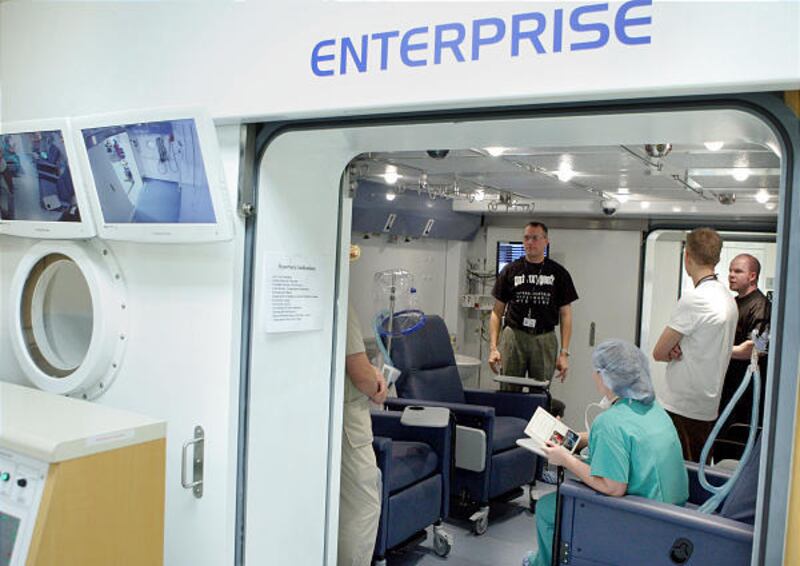
The state-of-the art unit — unique to the Intermountain area — allows patients to move about inside. Manufactured in Australia, it was among the first of its kind to be delivered to the United States.
And, yes, it is named after the "Star Trek" icon. According to Dr. Lindell K. Weaver of Intermountain Healthcare's hyperbaric medicine department, staff started using "Star Trek" names for some equipment back in 1987, since most of them really liked the shows.
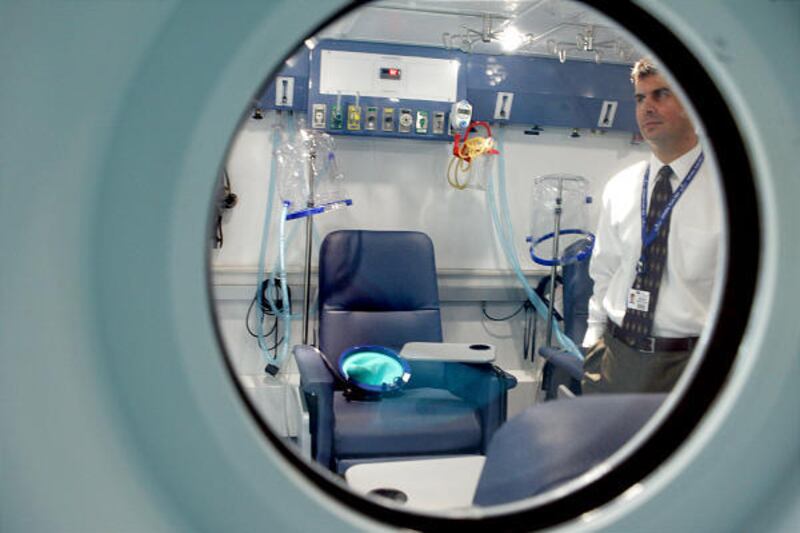
Given the chamber's massive doors, three thick glass portal windows and futuristic computer monitors, the name Enterprise does seem appropriate.
Fall is also the perfect time to have this equipment. Each year, more than 40,000 Americans — including more than 400 Utahns — are treated for carbon monoxide poisoning. Weaver said the chamber can cut brain damage in half for CO poisoning. "It can also save limbs," he said.
Normally, the air humans breathe contains only 21 percent oxygen. During hyperbaric oxygen therapy, a patient breathes 100 percent oxygen in an environment where the air pressure is two to three times greater than the atmospheric pressure at sea level. This dissolves more oxygen in the bloodstream, sending it to every part of the body, stimulating blood vessel growth and enhancing the immune system's ability to fight infection.
The chamber also has research potential. It has both hypo- and hyperbaric capabilities, meaning the air pressure can be changed to simulate conditions at altitudes of up to 40,000 feet — higher than Mount Everest — or up to 99 feet below sea level for treating patients.
"Patients are never left alone (in the chamber)," Weaver said.
Most patients will stay in the chamber only about two hours at a time, but it can be used for overnight sleep studies at simulated high elevation. Pilots also could use it to see what high altitude really feels like, but under controlled, safe conditions.
"It gives us a lot of flexibility," Weaver said.
Traditionally, patients are treated in a monoplace chamber — a clear cylindrical unit that can accommodate only one person. The new unit at IMC can hold up to eight patients and several staff members at a time.
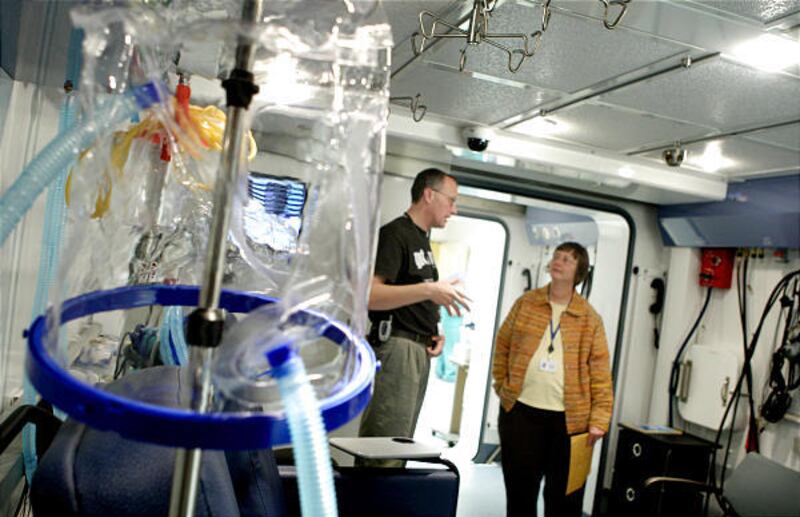
The chamber's rectangular shape — rare for such a device worldwide — allows patients and staff to feel they are in a regular room. It also has two rooms that can be pressurized separately, one of which is a bathroom — a rarity in such devices. Besides a toilet, the chamber also has two sinks. It even has a TV monitor.
Reclining chairs in the chamber will add to patient comfort, and beds can be brought in for sleep studies. But everything brought into the chamber must be carefully evaluated for how air pressure may affect it and for safety. Even the slightest spark could pose extreme hazards.
Such chambers are governed by strict federal regulations to lessen fire dangers and other potential problems. A special fire sprinkling system can dump 540 gallons of water in the chamber in 100 seconds, if needed.
These large air chambers are rare because they require extensive structural planning and are expensive to purchase and maintain. Besides the special water reservoir for fire safety, Intermountain had to add a fifth air compressor to utilize the chamber.
Weaver said doctors and health insurance providers have only gained an appreciation for the benefits of these devices during the past decade or less.
"This has been quite a journey," Weaver said of Intermountain's hyperbaric medicine department, which started in the early 1980s. "There aren't many in the world that have the capabilities of this chamber."
Only Sweden, Australia, the Mayo Clinic and Duke University have chamber facilities that probably equal or exceed what Intermountain now has, according to Weaver.
Intermountain's Hyperbaric Department will operate at two locations: IMC, which has both the new multiplace chamber and a monoplace unit; and LDS hospital, which will continue to provide treatments in several monoplace chambers. Only a few hyperbaric departments in the country — all of them back East — run both types of chambers.
E-mail: lynn@desnews.com