

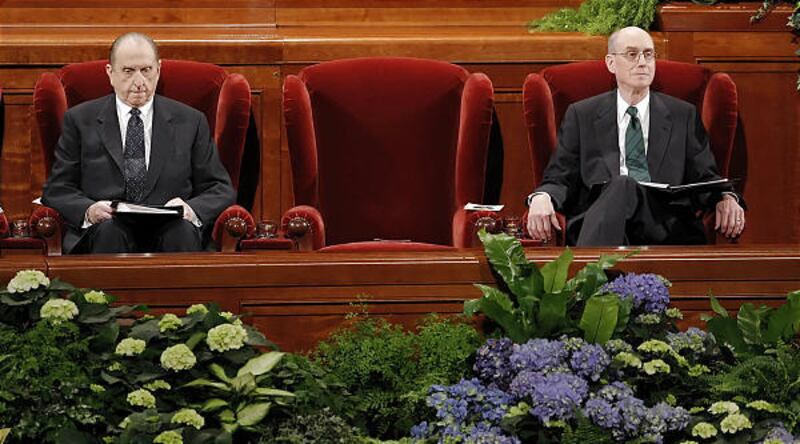
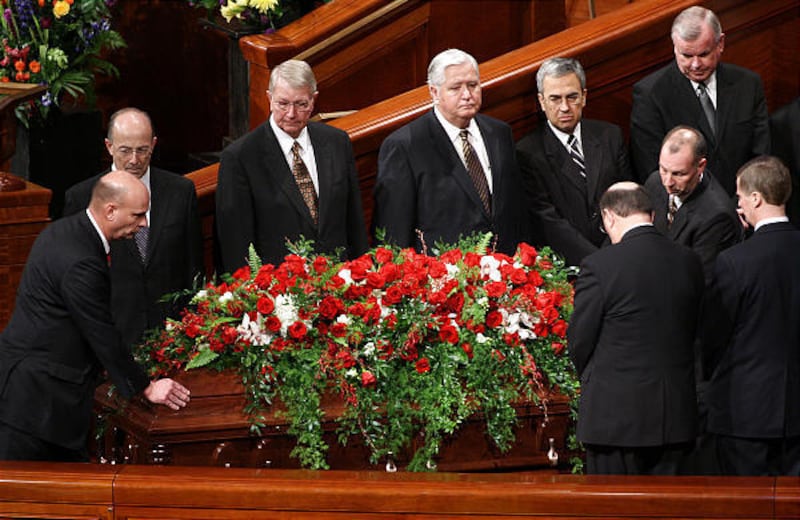
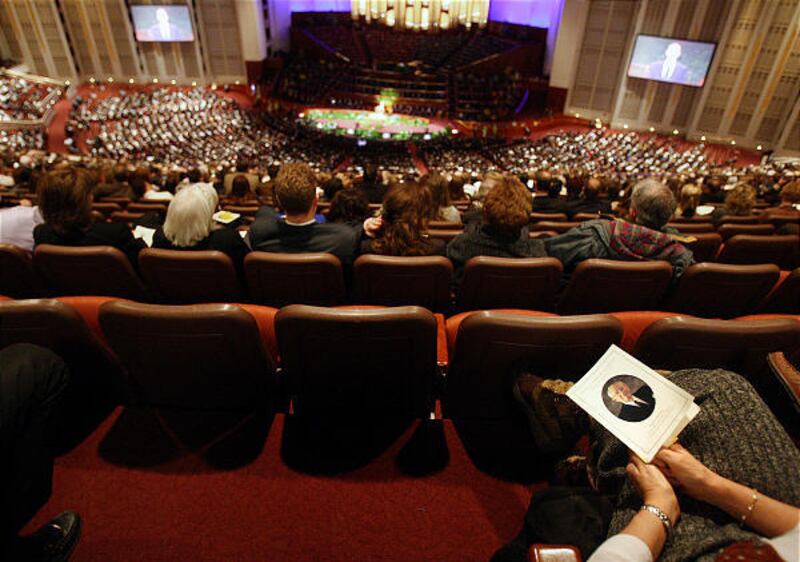
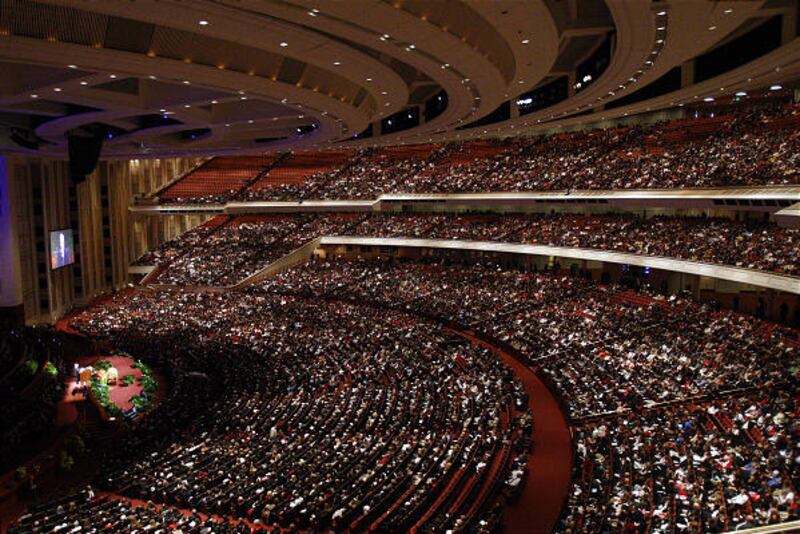
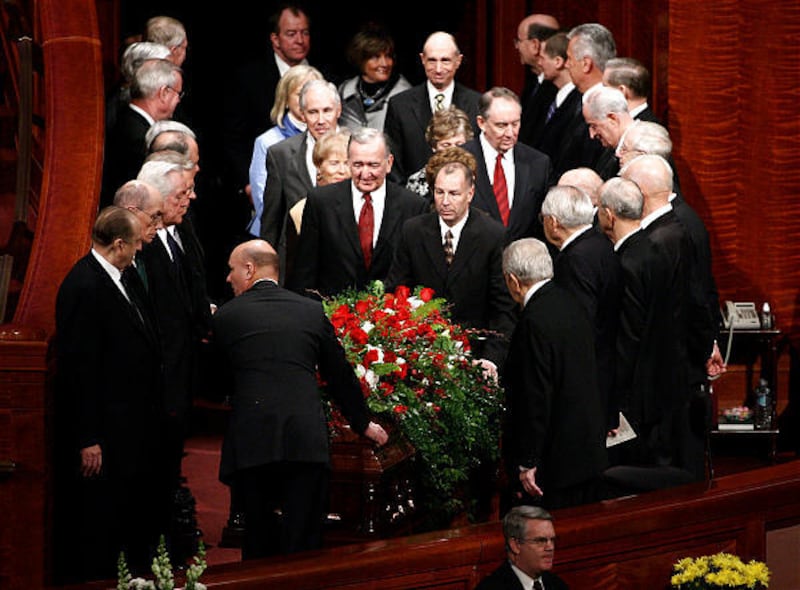
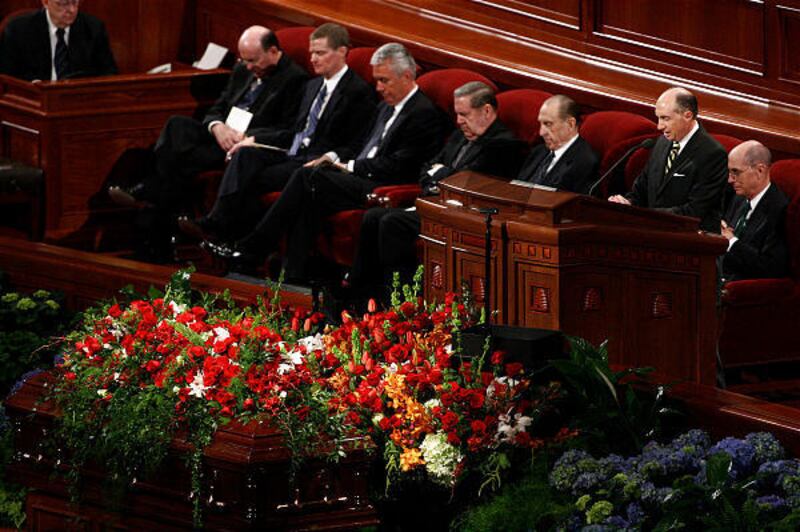
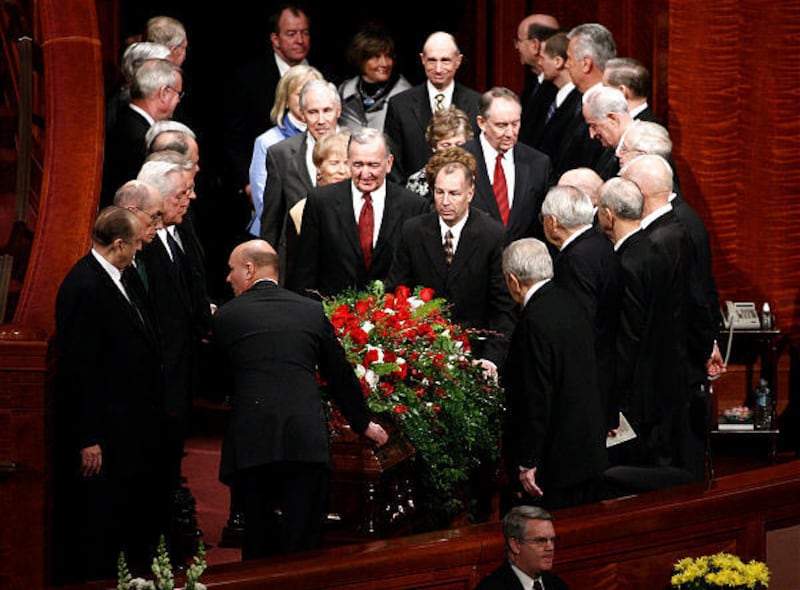
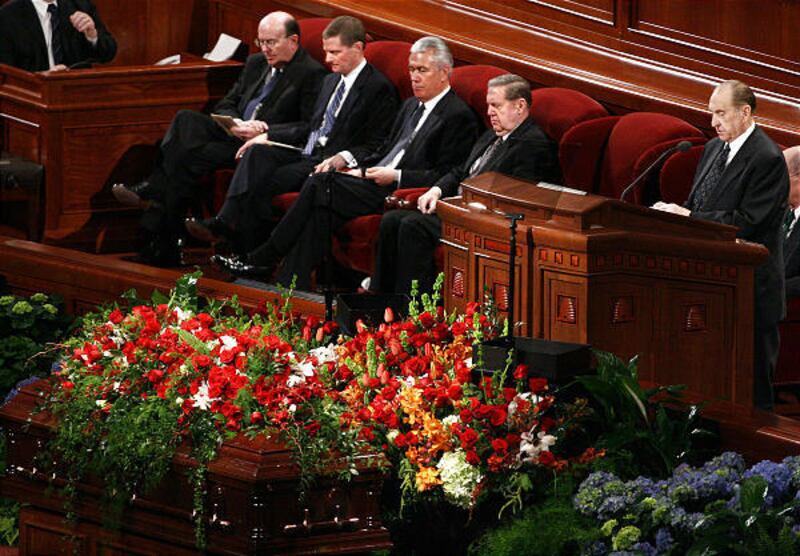
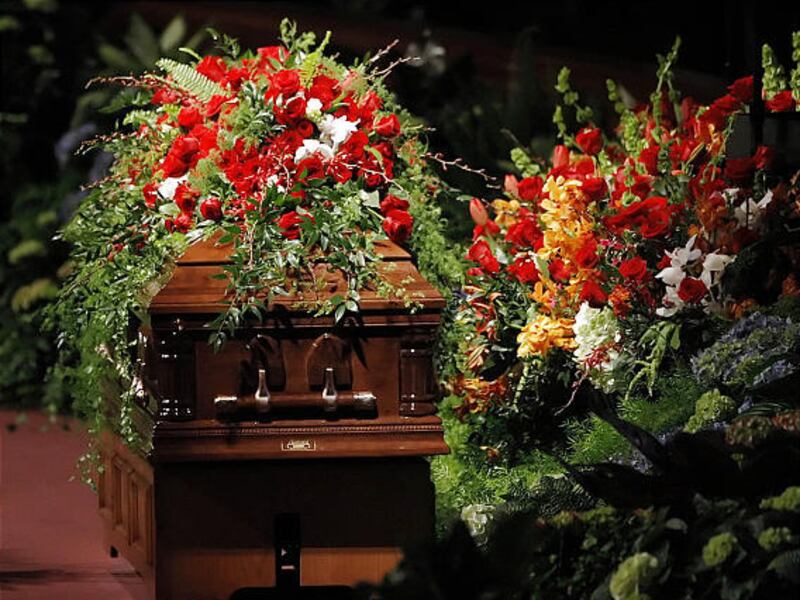
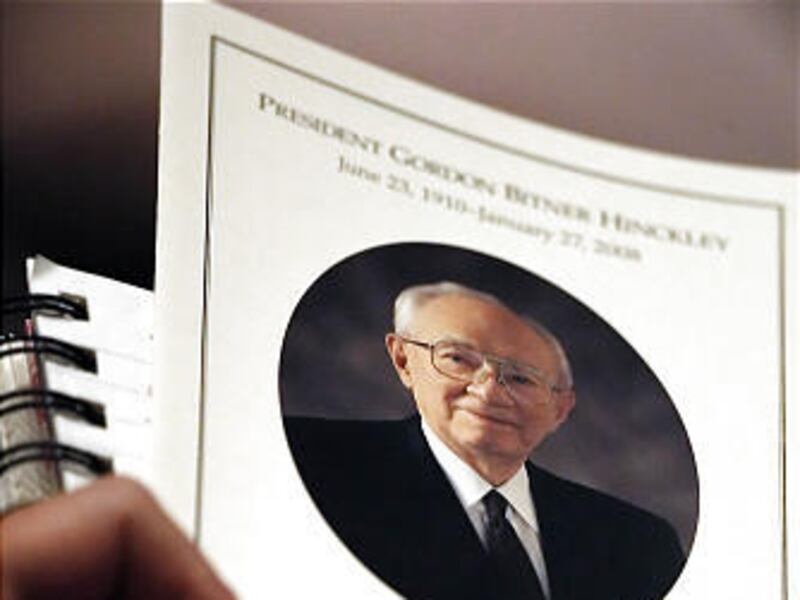
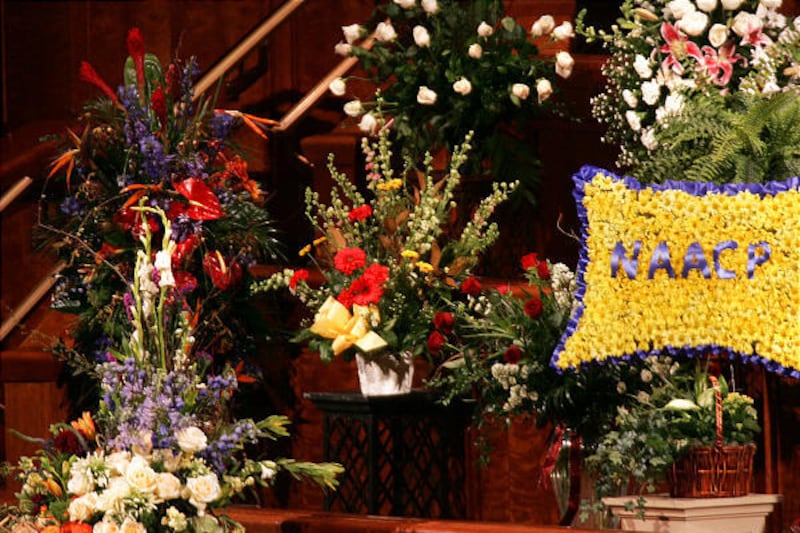
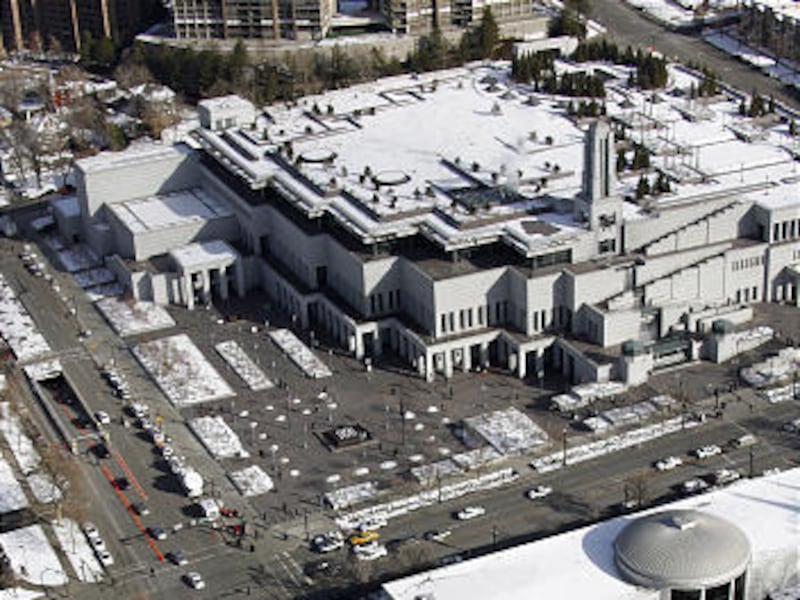
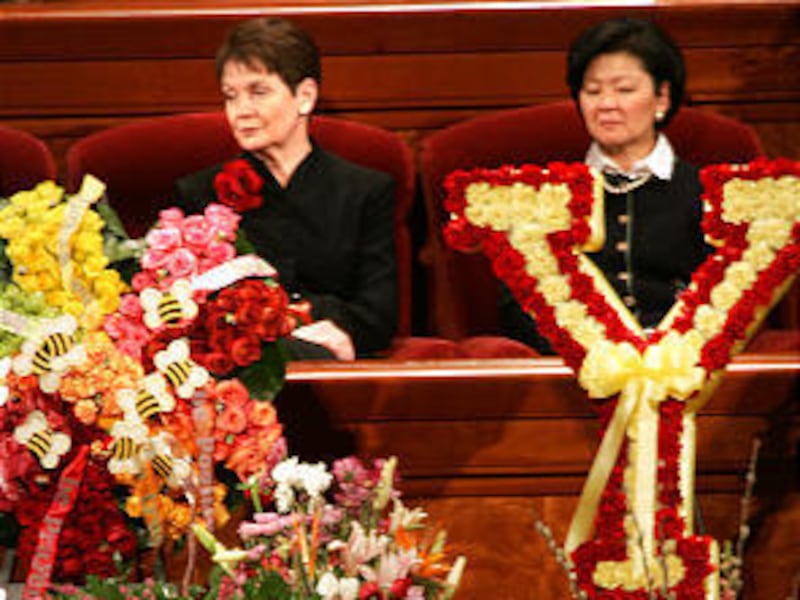
With millions of Latter-day Saints worldwide watching and listening live, LDS Church President Gordon B. Hinckley was eulogized Saturday — his red chair on the Conference Center dais empty and his casket resting in front of the pulpit handcrafted from a tree he planted decades ago.
To members of The Church of Jesus Christ of Latter-day Saints, it seemed only fitting that the "house President Hinckley built" was the site for his funeral, the first to be held there since its completion in 2000. He was remembered by his daughter and fellow general authorities as a giant of a man who built large on a legacy of faith that spans generations for his family.
Thousands braved the cold downtown before 9 a.m. to get tickets for the service after a two-day viewing in which nearly 58,000 people filed through the Conference Center's Hall of the Prophets. The last person in line passed the casket at 11:25 p.m. Friday, waiting between four to five hours to say farewell.
Virginia Hinckley Pearce told those assembled her father felt deeply the hand of ancestral faith, with three generations of forbears who had sacrificed and lived for their faith, and three generations now living who look to his legacy as part of their own.
Quoting him, she said he realized "the tremendous obligation that was mine to pass on all that I had received as an inheritance from my forbears to the generations who have now come after me."
With five children, 25 grandchildren and 62 great-grandchildren, President Hinckley realized his love and legacy "wasn't just about our little family," she said. "Because, as President Hinckley often told us, we are all one great family — some 13 million strong — sharing an inheritance of faith and enjoying a covenant relationship with God the Father and His son Jesus Christ, with responsibilities to help one another along the way."
Underscoring the feeling church members have for him, she said, "Our father was adorable. And he was a marvel to watch. Disciplined and courageous, with an unbelievable capacity for work, he believed in growth."
Such continual growth "is the story of The Church of Jesus Christ of Latter-day Saints that he loved to tell, as well as the story of his own life. That kind of growth requires faith, courage, discipline and hard work — partnered with the gracious hand of the Lord."
The family watched that growth deepen for him during the past four years, "the capstone years of his life. Following the death of mother, his grief was almost overwhelming. Characteristically he acknowledged it — felt it, wept and mourned deeply. He went to the Lord with his tears, thus allowing the loss to carve out an even deeper place in his heart for compassion and dig an even deeper well of faith and trust in God.
"Then, with that increase in compassion and faith, he put on his shoes and went back to work — in every sense of the word."
After a cancer diagnosis two years ago, "he repeated the pattern," she said. After mourning the loss of good health and feeling the fear of how the disease would progress, "he said that he felt compelled to do his part," knowing he was in the Lord's hands and the prayers of millions were with him.
"And with the wonderful help of medical friends, he did just that — with courage and good humor. The result was a miraculous two-year extension of his life, when he could get up each morning, put on his shoes and go to work."
She thanked church members, fellow general authorities, medical personnel and his staff and personal secretary, Don Staheli, for making it possible for him to fulfill his responsibilities as president.
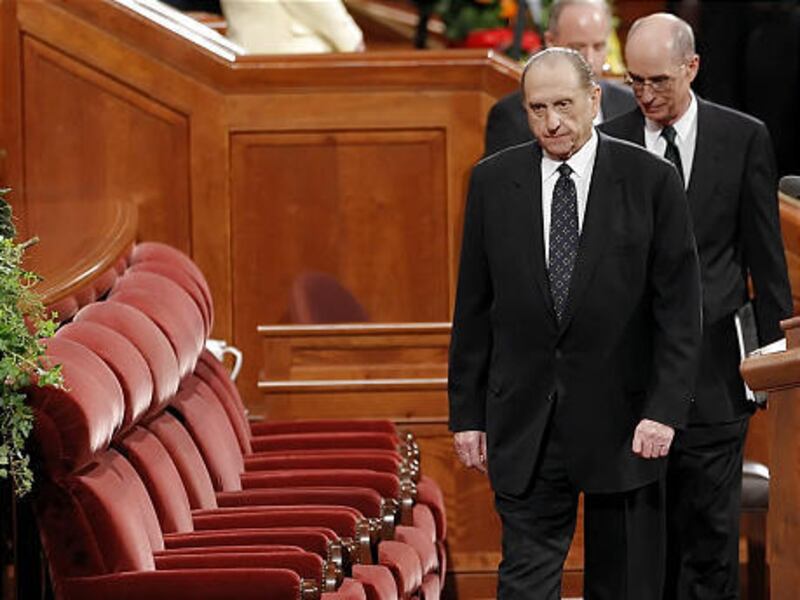
President Thomas S. Monson, who presided at the service, said it was difficult to recall a time when he and President Hinckley had not known each other, having served side by side in the Quorum of the Twelve and First Presidency for more than 44 years.
When traveling together once on an assignment in southern Utah, he noticed that President Hinckley was wearing paper clips as cuff links. Realizing the situation, President Monson complimented him and they laughed, then he offered his extra set to his colleague.
Latter-day Saints had enjoyed watching President Hinckley with his cane in recent years, waving it to them or using it to tap someone on the shoulder. When urged by President Hinckley's doctor to push him to use it to steady himself, President Monson said, "Doctor, I am President Hinckley's counselor. You are his doctor. You tell him."
President Hinckley's determination and his own humor never derided his sense of the sacred, he said, recounting a simple act of reverence and respect that often occurred as the two of them were transported regularly through the underground tunnels on Temple Square.
As the cart passed under Main Street during winter, when President Hinckley was wearing his coat and hat, he seemed to know instinctively when they were beneath the Salt Lake Temple, and "without a word, he would remove his hat and place it in his lap. It was such a simple yet profound expression of reverence and respect for the House of the Lord, and it made a deep impression on me."
As a "man for all seasons," President Hinckley was "our prophet, seer and revelator. He was an island of calm in a sea of storm. He was as a lighthouse to the lost mariner. He was your friend and my friend. He comforted and calmed us when conditions in the world were frightening."
President Hinckley "still lives," he said. "All that we knew about him continues. His spirit has simply gone home to that God who gave him life. Wherever I go in this beautiful world, a part of this cherished friend will always go with me."
On behalf of church members everywhere, "I offer our final farewell to our beloved prophet. ... God be with you till we meet again."
President Henry B. Eyring, who was named in October as second counselor in the First Presidency following the death of long-time counselor President James E. Faust, said in the past few days, he has remembered President Hinckley's voice when a difficult problem was brought to him.
"Time after time, he would quietly say something like this, with a pleasant smile, 'Oh, things will work out."'
His accomplishments all had one thing in common, President Eyring said: "Always they were to bless individuals with opportunity. And always he thought of those with the least opportunity, the ordinary person struggling to cope with the difficulties of everyday life and the challenge of living the gospel of Jesus Christ."
His optimism stemmed from unwavering faith in Christ and the power of his atonement, and he recognized that "all God asks of us is that we give our best," something President Hinckley did all his life. "He more than hoped that things would work out, he knew they would if he would go forward in faith."
President Hinckley loved young people, knew their weakness and the opposition they would face. He "knew that God will steel and fortify us all as we choose to take the gospel down into our hearts. ... He knew it was best to make that choice early, in the days of youth."
Those who followed his example are better for it, because he was "a true witness of Jesus Christ and a prophet of God."
President Boyd K. Packer, who served as acting president of the Quorum of the Twelve during President Hinckley's administration, said he first met President Hinckley more than 50 years ago. He remembered his colleague's ability to communicate, saying he began writing as a young man and never quit doing so.
Many times as he met with him in his office, President Hinckley was writing a talk in longhand.
He also remembered a time then-Elder Hinckley watched his son, as a young missionary, walk away from a meeting he had had during a trip on church business. "He said that to watch Richard walk away was the hardest thing he ever had to do. He wept as he told me about it. ... I had seen inside of Elder Gordon B. Hinckley," and such an occasion was rare, because "he has always been a very private person."
His ability to communicate was legendary, he said, remembering a visit by an Islamic cleric named Abdurrahman Wahid, who was later elected as president of Indonesia. The two formed a friendship, and President Hinckley was later a guest of honor at a dinner given by the Indonesian president.
"I have regarded this power of communication and charm in President Hinckley as brotherly love and humility. It was always apparent whether he was with laborers on a dusty road, or a banquet in a presidential palace."
He attributed much of the growth he saw in President Hinckley to Marjorie Hinckley, who was patient with a man always on the go who knew that the doctrines of Jesus Christ are synonymous with family.
That was one of the things President Hinckley understood best, he said. Paying tribute to his family, "they can be described as ideal. They, like their father, are unassuming. Whatever prominence has come to them does not show anymore than it was visible in him."
Elder Earl C. Tingey, of the Presidency of the Seventy, spoke of the church leader's "footprints in the sand," as an example to all of personality traits they can follow.
He recalled how he once held the elevator in the Church Administration Building for the president, who was approaching with his cane. As he came to the door, he looked at Elder Tingey and said, "Earl, go ahead and ride the elevator. I'm taking the stairs." Feeling rather small, he rode the elevator while "the prophet of the Lord climbed the stairs to his office."
At one meeting with general authorities, dressed in dark suits, white shirts and conservative ties, his trademark humor was evident: "You all look like a bunch of penguins," he quipped.
Educational and cultural opportunities for Latter-day Saints grew exponentially under his leadership, particularly for more than 30,000 members in developing nations who have had been educated through the Perpetual Education Fund he established seven years ago.
Perhaps his most important footprint was his love of people. "Thank you for letting us know you loved us. We are better because of you."
Bishop H. David Burton said President Hinckley was the only prophet young Latter-day Saints have ever known, and lauded their love for him when they used text messages after his death on Sunday urging each other to wear Sunday best to school on Monday as a tribute uniquely their own.
"To use their vernacular, he was awesome! He connected! Because of him, they know what it means to 'stand a little taller,' 'do your best,' 'raise the bar,' and what the 'six B's' are: be grateful, be smart, be clean, be true, be humble, be prayerful."
Such expressions of love and respect from young Latter-day Saints continue, he said. "Thank you, dear young people. You have led the way in honoring and eulogizing our dear prophet."
President Hinckley's daughter, Kathleen H. Walker, closed the meeting with prayer, remembering that her father "has worn out his life in Thy service. ... May the things we have learned remain with us forever ... as we continue to move forward in every way to bring honor to his life and to his name."
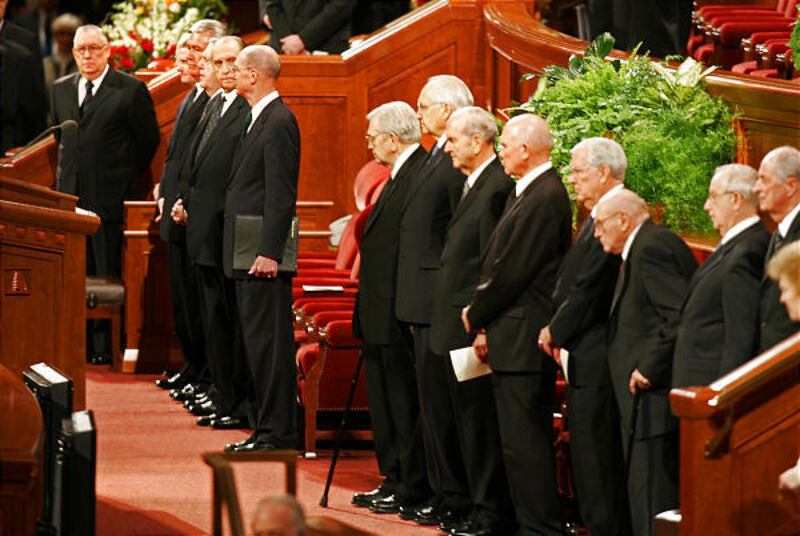
Formality and decorum were evident during the services for those gathered in the Conference Center, who watched on the large monitors as members of the Quorum of the Twelve lined the entryway into the huge auditorium as the casket was wheeled in and moved out following the service.
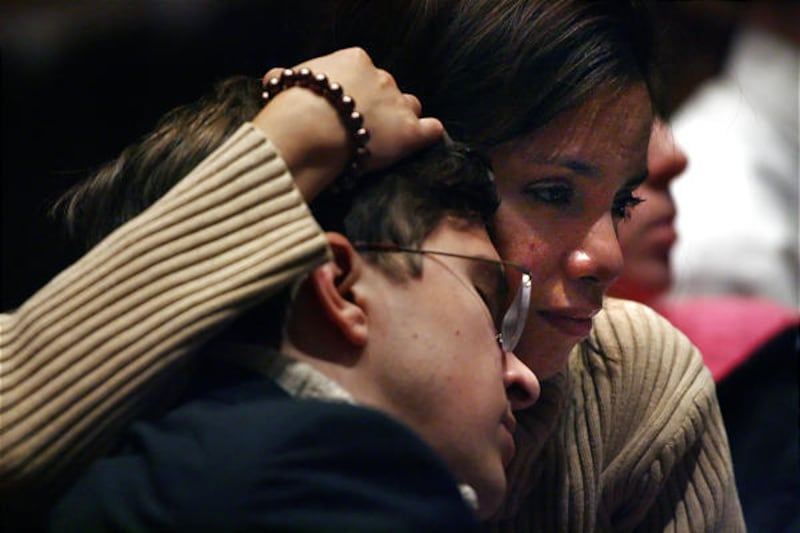
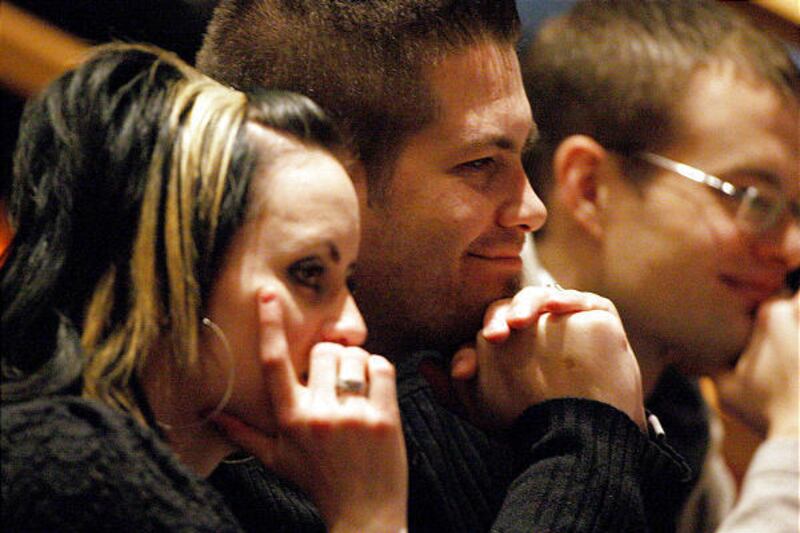
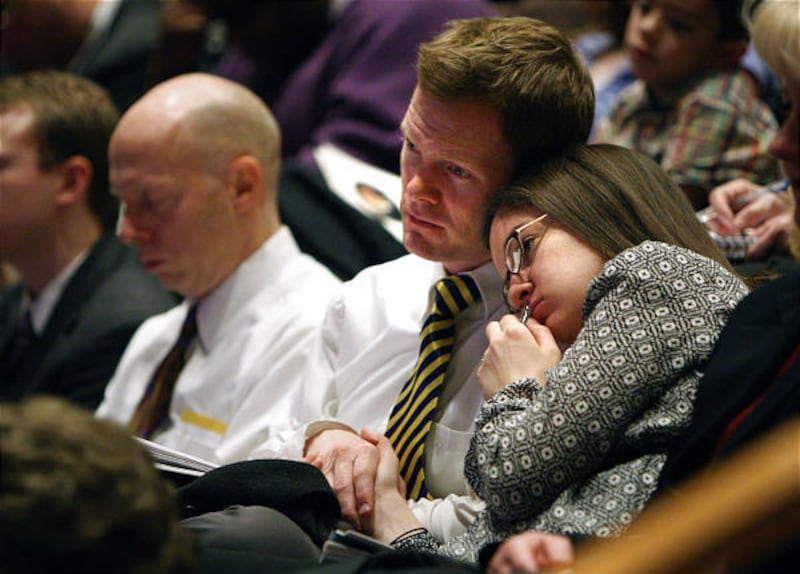
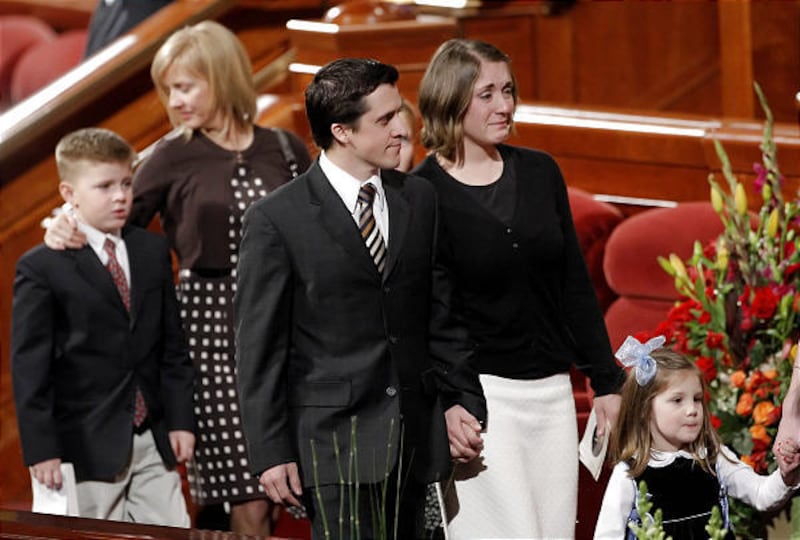
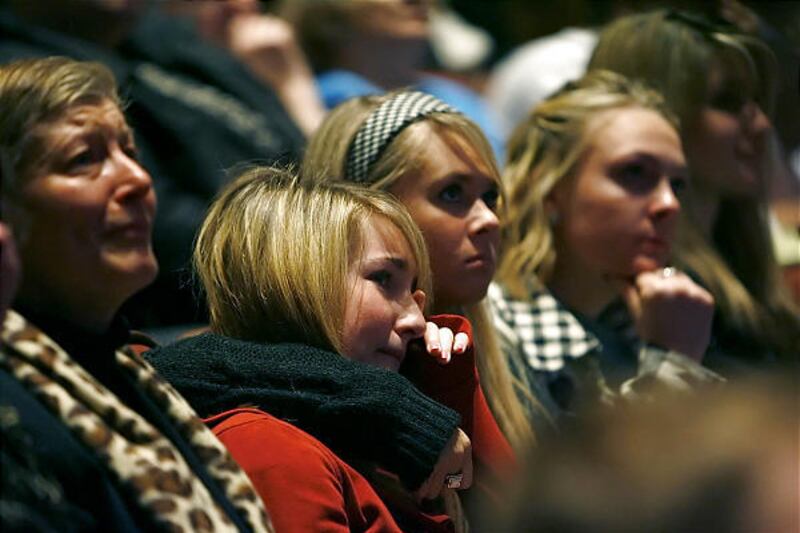
Usually smiling and animated as they enter during general conference, his fellow general authorities and family members were solemn, some dabbing at tears, as his casket was set in place for the service.
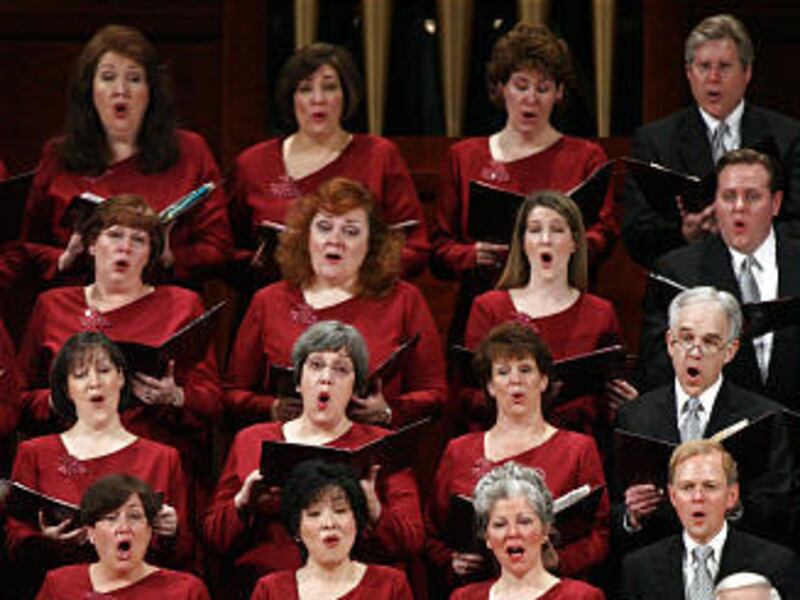
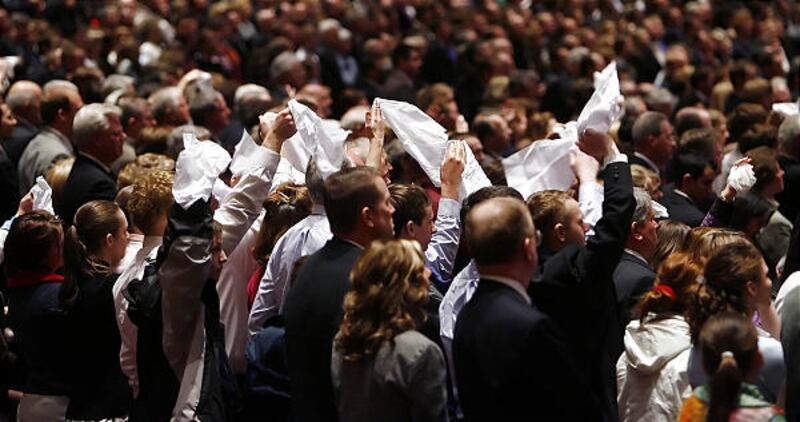
Following the service, the congregation stood as President Monson and President Eyring left the dais first, followed by President Packer and the rest of the Quorum of the Twelve in order of seniority. Members of the Mormon Tabernacle Choir, as well as those in the congregation, waved white handkerchiefs as President Hinckley's casket was wheeled from the building, then used them to dab at tears in a final farewell to the leader they loved.
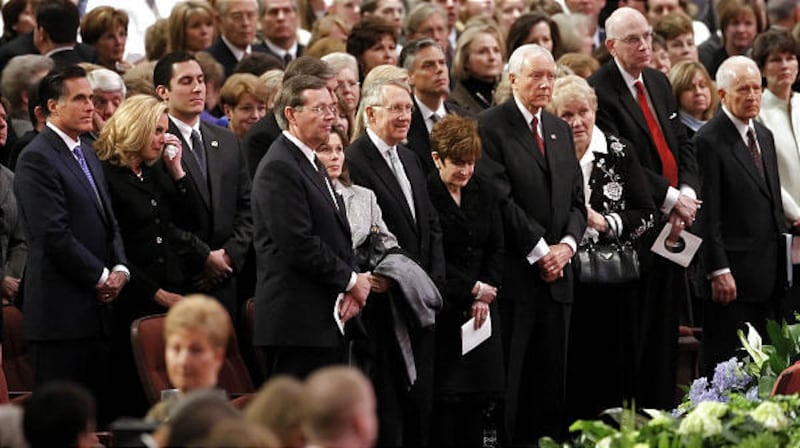
President Monson acknowledged the technological presence of millions via satellite, and noted the presence of government and civic leaders, in particular Mike Leavitt — former Utah governor and secretary of Health and Human Services as a representative of President and Mrs. Bush. He read the Bush's message of sympathy to open the service.
As the service ended, family members and general authorities followed the casket out of the Conference Center, as those assembled stood in tribute.
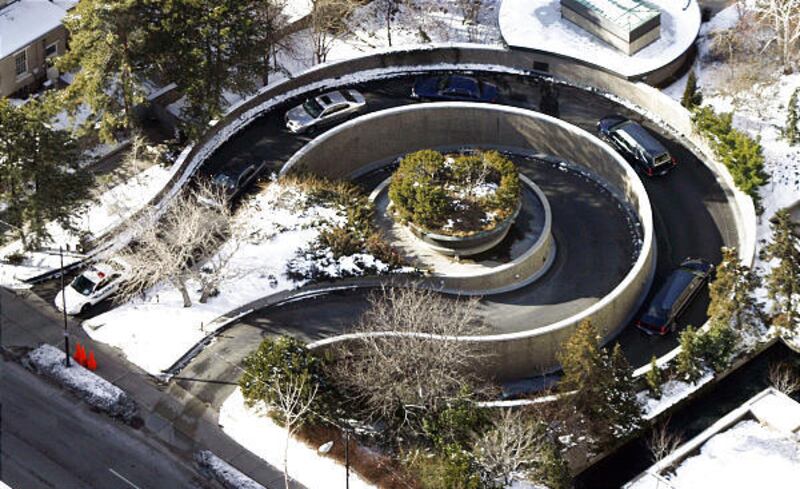
Once inside the hearse, President Hinckley's casket made its way out of the Conference Center's underground parking garage, traveling south on West Temple, turning east on South Temple where many leaving the service waved handkerchiefs and canes at his cortege, and others gathered in scattered pockets further east stood in respect as the hearse passed.
The procession moved east to N Street, and then north to the Salt Lake City Cemetery, where a short, private service was held before interment.
E-mail: carrie@desnews.com