

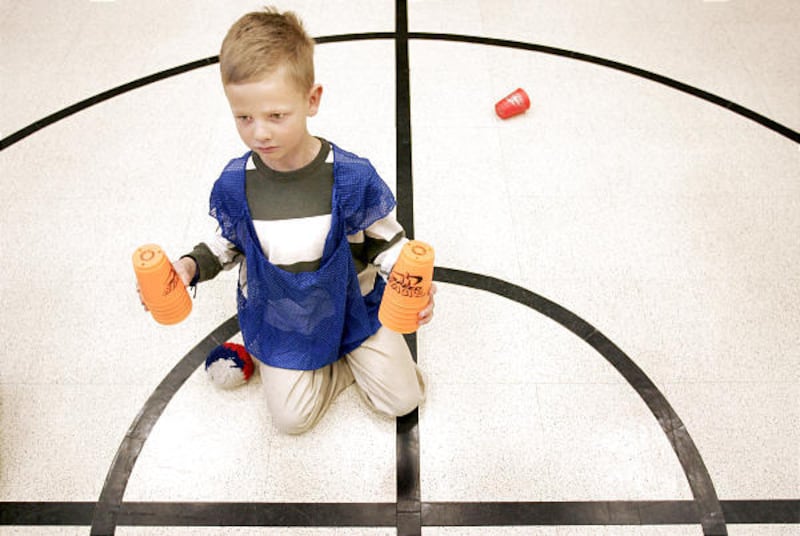
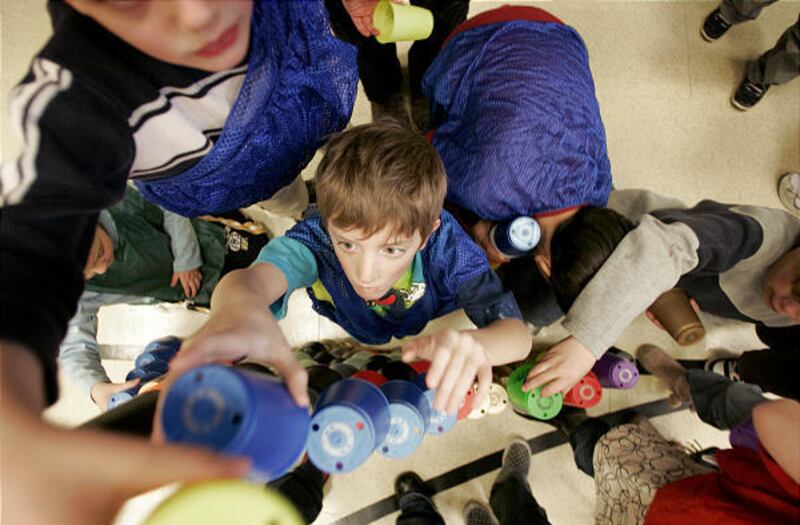
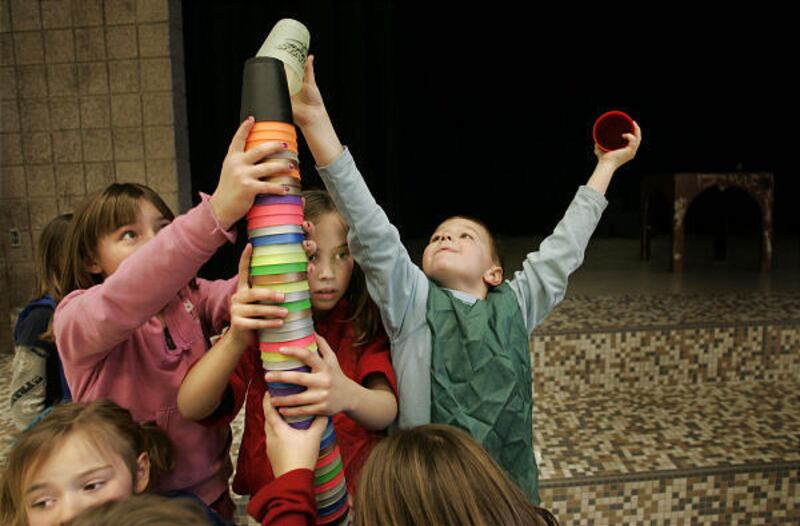

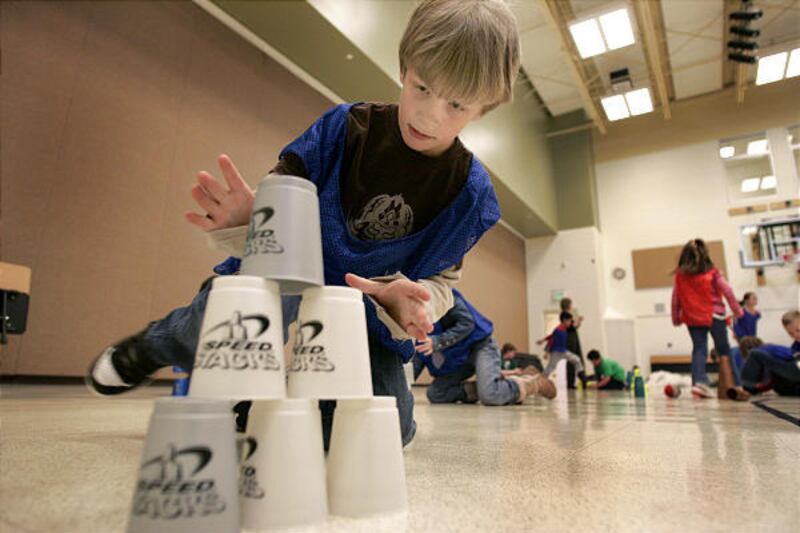
The plastic cups are upside down, stacked one on top of the other, so at first glance this looks less like a sport and more like a buffet table. But then second-grader Izzy Srivastava gets to work. Suddenly, cups are in motion and then, well, let Izzy explain: "You take three with the hand you write with, and two with the hand you don't write with, and then you put down two of the two and one of the three, and then you put these two on these three, and then one more on top of the two, and then with the hand you write with. ... "
In the world of sport stacking, this maneuver is known as a 6-6, which is technically not a stand-alone stack but is part of an event called the "cycle." Currently the world record holder for the cycle is David Wolf of Germany, who in 2007, at the age of 12, completed it in 7.15 seconds. If you think that's no big deal, you have obviously never tried to stack, unstack and restack 12 plastic cups in pyramids as fast as you can.
The 2008 World Sport Stacking Championships take place on April 5 and 6 in Denver, near the home of the Colorado-based World Sport Stacking Association. There will be more than 1,100 competitors from countries as far away as Singapore, and 90 percent of those competitors will be children and teens. Every year, more and more adults compete, says WSSA executive director Matt Reed. Still, perhaps because sport stacking was introduced in schools and after-school programs, it continues to be mostly a youth activity.
Sport stacking is flourishing in Michigan, Texas, Colorado, Florida and California, says Reed. It's still relatively new to Utah, where a smattering of elementary and middle schools offer it as a "nontraditional activity" in physical education. Proponents of sport stacking say it helps improve the kind of hand-eye coordination and ambidexterity that can transfer to other skills such as basketball and piano playing.
"It's a track meet for your hands," says Reed.
Originally sport stacking was called cup stacking, but that made it sound like "little kids just playing with cups," says Reed. The first time he himself tried stacking, he says, he was a physical education teacher, and he brought home a set of the cups to try out. "Two hours later, I was dripping with sweat, my heart rate was up and I felt invigorated."
A sport, reasons Reed, is something that requires skill and can be done in competition. People eat hot dogs in competitive eating contests and that's considered a sport, he notes. And even though he's not sure where he stands on that, the point is surely cup stacking requires more skill than wolfing down hot dogs or massive amounts of mayonnaise.
One way P.E. has failed some students in the past, says Utah State Office of Education health and physical education specialist Frank Wojtech, is that it focused too much on activities that required a degree of athleticism that not all children could muster. The trend now, Wojtech says, is "to find something for everybody."
"I would say most kids are not athletic and not competitive," echoes Jenifer Staniforth, who teaches P.E. at Bonneville Elementary School in the Salt Lake District. Sport stacking, she says, "levels the playing field."
On a recent morning, second-graders gathered in the multipurpose room at Bonneville to practice their upstacking and downstacking, their 3-3-3s and their 3-6-3s. By the end of the 30 minutes, Madelyn Grose said her hands hurt. Staniforth had them mix it up by asking some of the kids to be "bulldozers" and some to be "builders," and to skip between tasks. Sometimes the stacking becomes a relay game to add more exercise.
The whole cup thing started in 1980 at an after-school program in Oceanside, Calif. The grown-ups were having a meeting, so the kids took some Styrofoam cups and started making pyramids. Later, someone realized that plastic would be a lot easier to stack than Styrofoam cups, which tend to stick to each other. A few years later, a P.E. teacher named Bob Fox saw a kid stacking cups on "The Tonight Show Starring Johnny Carson" and thought it was so cool — "he looked at it as upside-down juggling," says Reed — he started a company called Speed Stacks to manufacture and sell the cups and timers. Fox founded the WSSA in 2002.
According to research conducted by Steven Murray, professor in the department of kinesiology at Mesa State College in Grand Junction, Colo., the mean energy expenditure for sport stacking is similar to archery, bowling, lifting light to moderate weights or walking 2.5 mph (a rather leisurely 25-minute mile, but still better than watching TV).
Both the Salt Lake and Jordan school districts have included sport stacking in their in-service training for P.E. teachers, and both have bought sets of cups and timers that schools can use. Quite a few elementary and middle schools in the Salt Lake district have included sport stacking in their P.E. units, says Cecie Scharman, healthy life-styles and character education specialist for the district.
Researcher Murray of Mesa State College has also studied the effect of sport stacking on hand-eye coordination. Compared to a control group, second-graders who participated in a five-week sport stacking program showed "significant improvement" on tests measuring hand-eye coordination and reaction time.
Last year, when he was 12, Zach Johnstun of St. Joseph, a private school in Ogden, began sport stacking in his P.E. class. Pretty soon, reports his mother, Leslie, the family had bought their own cups and timer mat and had turned the dining room table over to the activity. Zach even went to Texas to compete regionally (so far no competitions have been held in Utah), and then to the world championships in Denver last April.
Leslie started sport stacking too, and both became record holders at the regionals. Leslie thinks the sport has helped Zach's guitar playing and his other sports skills. Leslie says she thinks her own reaction time and ability to focus improved after stacking all those cups.
The Speed Stacks company is even more enthusiastic: The ambidexterity fostered by stacking integrates the right and left hemispheres of the brain, according to the company's Web site, and "studies have shown that ambidextrous people are more emotionally independent, more determined, more adaptable to new situations and more apt to handle problems without giving up."
E-mail: jarvik@desnews.com