

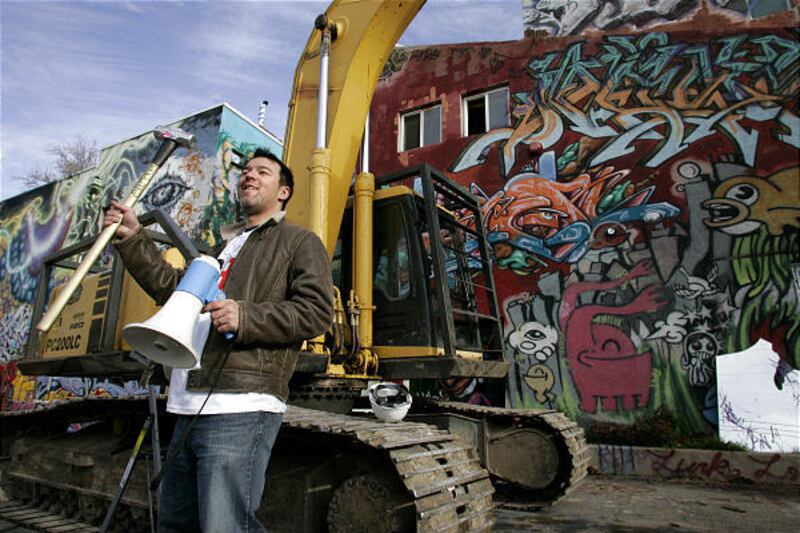
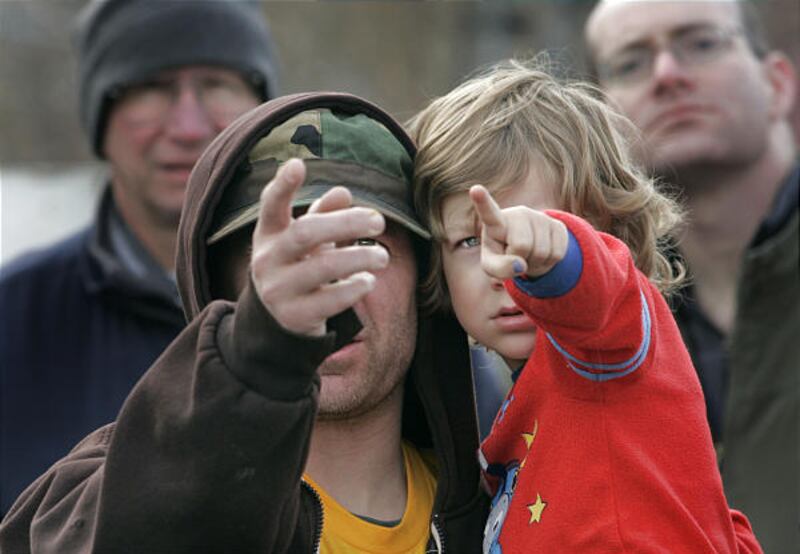
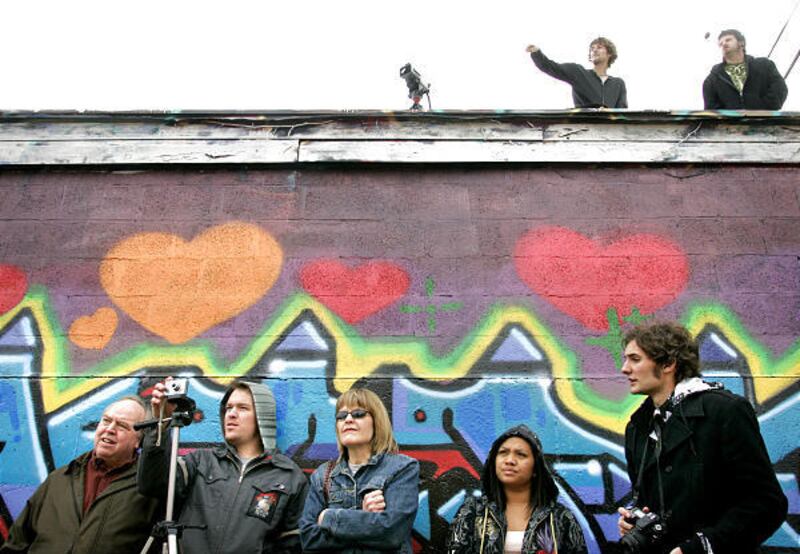
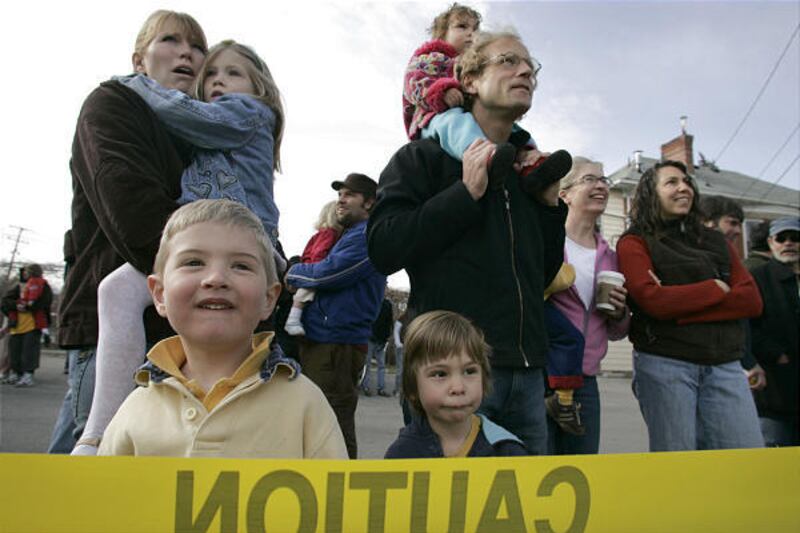
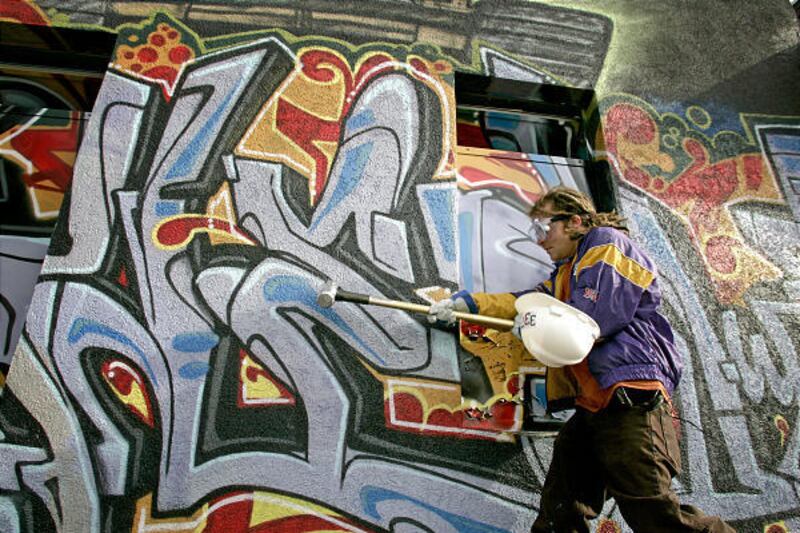

When Andrew Callis took a sledgehammer to a community art project earlier this month, onlookers didn't frown at the destruction — they cheered with approval.
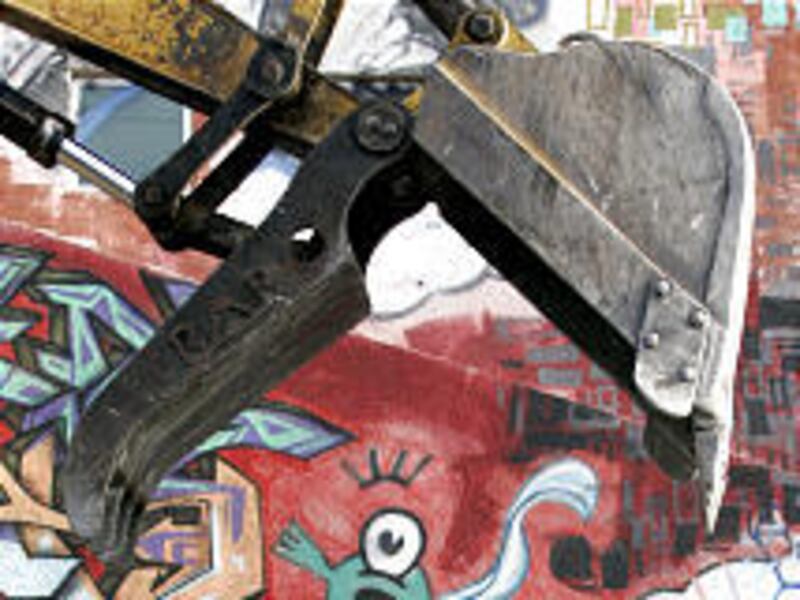
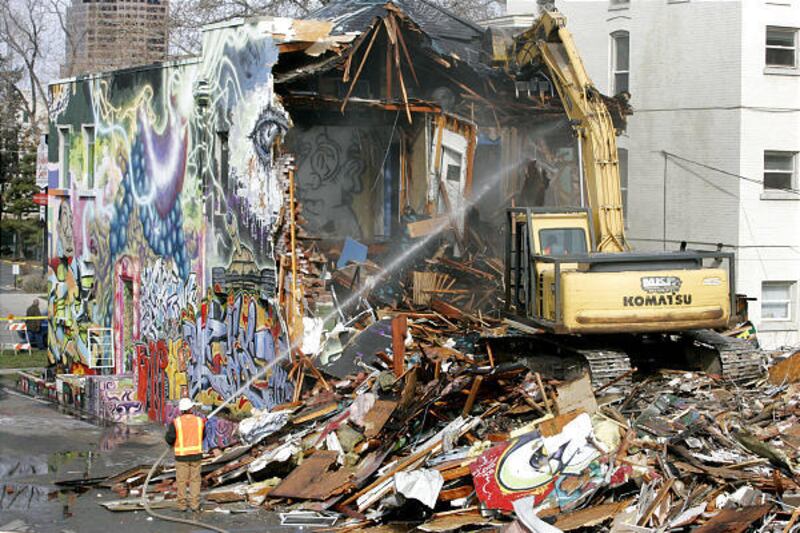
And when a bulldozer ripped through vibrant murals, reducing what was once an expanse of intertwined paintings to broken chunks of colored stucco and concrete, the cheering grew louder.
Callis, a Salt Lake City artist, was not recklessly destroying an exhibit, but rather initiating the final phase of a visual display known as the 337 Project. Comprised of a two-story building located at 337 S. 400 East, the 337 Project was a collaborative effort of more than 150 artists who covered the building in original artwork knowing it was intended for demolition.
"This (destruction) is totally the essence of why we're doing this," Callis said, watching as the claw of a bulldozer crashed through the east wall of the multicolored structure on April 5.
Owned by Salt Lake residents Adam and Dessie Price, the now-leveled building was initially just a drab-looking structure that occupied a lot on which they intended to build condos. With scores of professional artists and hobbyists the Prices had invited to transform the building, it stood as a conspicuous, ephemeral tribute to commercial-free art.
It was during a trip to New York in 2006 that the Prices were inspired about the project. They were impressed by a rundown building at 11 Spring St. in Manhattan where graffiti artists had spraypainted overlapping art for years. Before developers renovated the building, they turned it over to a group of street artists known as the Wooster Collective, who covered the building with spray paint and other media, transforming it into a six-story work of art which was open to the public for two days in December 2006.
Price said he was amazed at the droves of people who showed up to admire the art, and even more amazed that there was no admission fee, nor were the artists paid. Without the need to create pieces that were marketable, the artists truly had freedom of expression, he said.
"There was just this exuberance and energy to it," Price said.
Upon returning to Salt Lake City, the Prices decided they could do something similar with their own downtown building. Once Adam Price contacted a local artist friend, the word spread quickly and soon nearly 150 men, women and even some children painted, tagged and installed sculptures throughout the building.
Not only did the artists like the idea of using a building as a canvas, they were very excited that it was non-commercial and temporary, said local artist Trent Call, who was a participant in the project.
Call said it was freeing to not have to find a buyer when he was through with his creation. "A lot of the time you make art and then have to deal with it after the fact. This time, they're dealing with it for us — destroying it for us," he said.
It took three months for the artists to fill the building with their creations before it was opened to the public. Some artists took inspiration for their contributions from the project's ephemeral nature.
On his space on the upper-floor, a team of artists removed sections of the roof, allowing sunlight to shine on the grass and wildflowers he planted as part of their installation.
"I think the fact that the building was going to be destroyed gave (the artists) a lot of freedom," Price said.
For six days in May 2007, the Prices and a small band of volunteers manned the building as more than 10,000 visitors strolled through it. Some visitors expressed to Price that they wished it would stay open longer. Others were shocked there were no admission fees, and many wanted to give donations as they couldn't believe they could see something so impressive for free, he said.
"It evoked very strong emotions for the people," Price said.
In keeping with the goals of the project, however, Price made sure that it remained a commercial-free, temporary project, one that was meant to "divorce the art from motives of monetary gain." That separation really changed how people saw it and, in Price's opinion, it was good for the community. "It influenced how people perceived the whole project," he said.
The building was originally slated for demolition at the end of the open house last June, but the Prices decided to wait until they had a financially feasible design for the new building before they let the old one fall.
Not everyone was happy the building was being destroyed, though. Price heard from several people who were angry he was tearing it down, and one person even threatened to involve the mayor in halting the building's demolition, Price said.
But that furor was just evidence of the project's impact, he said.
"(That reaction) is a wonderful outcome. It means we've managed to connect with some dormant desire to see visual art. That doesn't happen very often."
As for the Prices' original real estate venture, a seven-story condominium complex will be built on the space by sometime next year.
In keeping with the 337 Project, the condos will be unconventional in that they will be built with recycled steel shipping containers. Just as the 337 Project was an office building repurposed as art, City Center Lofts, the name of the complex, will consist of shipping containers repurposed as living spaces.
"In the wake of it, it seemed ... important to build something that was consistent with the 337 project," Price said.
The Prices will live in one of the eight units, which range from 1,200 to 2,400 square feet. The building will display four panels on its exterior featuring murals done by local artists that will be changed out every six months, he said.
"The skin will be always changing," Price said. "(It) will hearken back to the 337 Project."
Although he's excited about the condominium development's completion, Price said witnessing the art project's demolition was bitter sweet. He's glad, though, that the artists and art appreciators in attendance April 5 were able to see the 337 Project's interior again as the bulldozer tore through walls room by room, exposing the paintings that had remained hidden for nearly the past year just before they were sent tumbling to the rubble below.
"All this art got one last encore," he said.
E-mail: mfarmer@desnews.com