

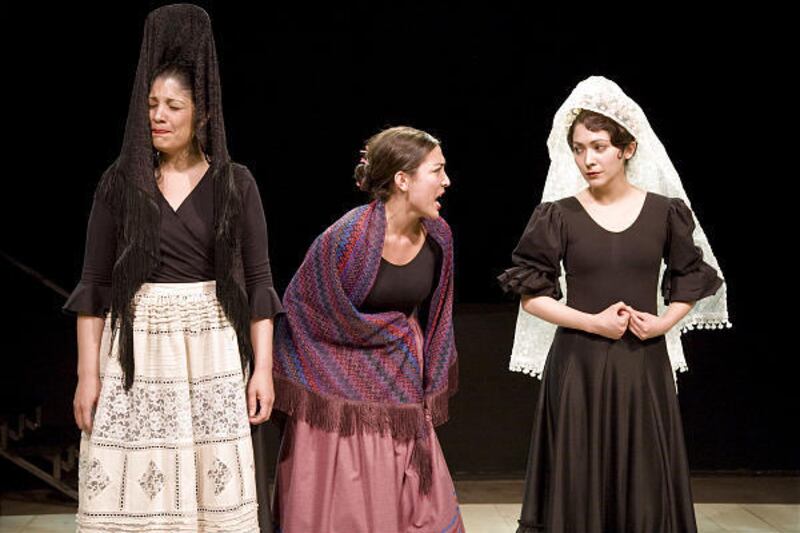
"BLOOD WEDDING," Babcock Theatre, University of Utah, through April 13 (581-7100), running time: 2 hours, 10 minutes (one intermission)
Sandra Shotwell, the director of Babcock Theatre's production of "Blood Wedding," not only directs, she translated this play from the poet Federico Garcia Lorca's original Spanish.
Then, too, Shotwell added a backdrop of flamenco dancing and arranged for original music to be written and performed by a quartet. The resulting production is visually and auditorily engrossing.
As for the drama itself, well, the production is unflinchingly dramatic, which is actually a flaw. The play begins in high emotion as a mother, played with eye-rolling anguish by Leticia Velez, freaks out when her grown son asks to be allowed to take a knife into the vineyards. He wants to cut a bunch of grapes for lunch. The mother can barely stand the thought because her husband was murdered and then her older son was murdered. To her, knives mean blood, not lunch.
As it turns out she is also in anguish about her son's impending marriage. His bride is not so keen on the idea either. The play continues on a dramatic high note as we learn of the pain in the home of another local couple. There, the husband seems to be lying about why the horse's shoes are wearing out so fast. It appears that Leonardo — the husband and the only person in the play with a name — has been riding far distances to visit his previous girlfriend, the young woman who is about to become engaged to the son from the vineyard.
The tone of the play is unwaveringly and chest-beatingly sad, but the words are often pretty. Shotwell has done a nice job with Lorca's poetry, allowing bits of the original Spanish to flow into the text. Here's an example of the intermingling of the poetic and the tragic: When the mother remembers her bleeding and dying son, she talks of wishing she had scraped the blood-soaked earth from around his body and kept it in a vase of crystal and topaz.
Marie Grudzien is the composer and musical director. Solange Gomes choreographed, and she had quite a range of dancing talent to work with. On opening night, the audience couldn't help but notice how niftily the dancers and castanet snappers kept to the beat.
Gwen De Veer was good in the role of the servant. Ironically, her part allowed for a bit more variety of emotion than that of the bridegroom, played by David Bohnet; or the bride, played by Nicol Razon; or the wife, played by Dominique Razon.
Sensitivity Rating: Passionate writhings stop short of being simulated sex.
E-MAIL: susan@desnews.com