

Composer Marc Blitzstein and playwright Lillian Hellman were kindred spirits.
Both championed the disenfranchised in their works, and both were impassioned social critics (which would land them in hot water during the McCarthy era).
So it's no wonder that their paths would cross. That happened in 1936, and their friendship would endure until Blitzstein's untimely death at age 58 in 1964.
While Blitzstein wrote incidental music to two of Hellman's plays, their artistic relationship was cemented when he turned Hellman's 1939 play "The Little Foxes" into an opera, which he called "Regina," after the play's main character.
Utah Opera will be going out on a limb when it opens the new year with a five-performance run of "Regina" starting Saturday.
The opera has occasionally been revived since it premiered in New York in 1949, but it certainly isn't on most operagoers' list of works today.
Nor is Blitzstein a household name. A well-known composer in his day and touted as one of the new breed of composers who were forging a new, distinctly American musical genre, Blitzstein is today relegated to a footnote in music history. And that does a disservice to his music.
"He is a fine composer, and 'Regina' is a good show that should be done more," Kristopher Irmiter, who sings the role of Horace Giddens, told the Deseret News. "It's a very entertaining piece and audiences respond well to it."
While it may be entertaining, "Regina" paints a bleak picture of upper-class American life at the turn of the last century.
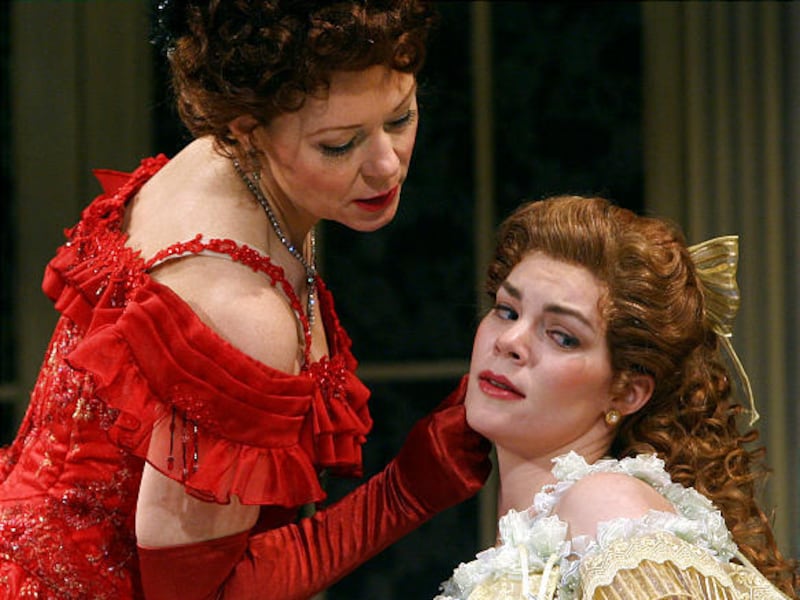
The story takes place in a small town in the South. It deals with greed and how greed can destroy a family. It opens with the Giddenses and Hubbards trying to charm an investor into financing the building of a new cotton mill in their hometown, but it quickly devolves into a power struggle between Regina Giddens and her brothers, Ben and Oscar Hubbard, as each tries to gain the upper hand.
Regina proves to be the cleverest schemer among the siblings, and she eventually gets her way.
But it also takes a huge toll on her — she alienates everyone in the two families — and by the time the story ends, Regina has immense power and wealth, but she is alone and lonely and more than a little frightened.
When Bltizstein came across Hellman's "The Little Foxes," he was mesmerized by its potency. In fact, he considered it the best play written in America. He also saw its potential as an opera.
"It has great subject matter for an opera — greed and the lust for power," said stage director Michael Scarola, who has been wanting to do "Regina" for years. "I love the play, I love the movie with Bette Davis, and I find the opera absolutely fascinating."
Hellman, however, was skeptical when Blitzstein approached her about turning her play into an opera. She told him at the time, "Of course you may do it if you really wish to, but I don't know how you can add anything to the Hubbards that will make them any more unpleasant than they are already."
True, the Hubbards are probably some of the most unlikable characters in all of opera. There is nothing redeemable about them. There is no love or respect for family to be found among the siblings. Hatred, envy and distrust run amok. And driving them is their desire to escape the quagmire of their lives by whatever means they can.
"They are all unpleasant characters," Irmiter said. "They are Hubbards on steroids."
But it's important to try and understand why they are like this.
"Regina feels trapped," Deanne Meek said. "Ever since she was a young girl she has been told what to do. She has never been in control of her life, and she believes that something inside her will die if she doesn't break free."
Meek, who plays the main character, said Regina had high hopes when she married Horace Giddens.
"But she quickly saw she wasn't going to get the freedom she needed through him." Her optimism was dashed soon after her marriage and her feelings for Horace slowly turned to contempt. "She then became driven with the need for power."
Regina's sister, Birdie Hubbard, also wants to escape her life. But unlike Regina, Birdie finds release through drinking. "Birdie is in the same rut as Regina," Lisa Vroman, who sings Birdie, said. "But instead of going the way Regina goes, she is an alcoholic. She finds release through drinking. But you can't blame her. It's heartbreaking to see her like that."
If there is a good person in the story, it's Horace. "He is a barometer of decency," Irmiter said. "Of all the Hubbards, he is the only one who shows any compassion, especially in how his daughter, Alexandra, is treated. He is a compass of goodness, and he is the only one who dies in the show."
"Regina" premiered on Broadway on Oct. 31, 1949. It was conducted by Maurice Abravanel, who was at the time the music director of the Utah Symphony. Originally, there was some talk of having Leonard Bernstein conduct, but Blitzstein had his doubts about Bernstein's ability to do the same show night after night without losing interest in it.
Blitzstein and Abravanel had known each other for a number of years, and Abravanel agreed to do "Regina" mainly because the Utah Symphony was experiencing severe financial problems and was considering canceling the 1949-50 season. Even so, Abravanel only agreed to a four-week contract with "Regina."
The work enjoyed a modicum of critical and popular success, but it would be four years before it would be revived, this time as an opera staged by New York City Opera.
That meant having the original three-act format restored and the score reworked and reorchestrated for a larger ensemble.
And that has been the case with "Regina" ever since. Almost every production has tinkered with the original. The most famous version was done by John Mauceri for Scottish Opera in 1991. And for Utah Opera's staging, which will also be the work's local premiere, Scarola and Keith Lockhart, who will conduct members of the Utah Symphony in this production, have done their own version.
"Blitzstein brought in a lot of jazz elements and added a layer that wasn't in the play," Scarola said. He also added a lengthy prologue that wasn't in "The Little Foxes," and which Hellman didn't like one bit. All of that has been removed from this production. "I went to (Utah Opera artistic director Christopher McBeth) and Keith and told them I want to go back to the play for the structure of the opera. They jumped on it, so we cut the prologue, the jazz references and all of the smaller African-American characters that aren't in the play.
"I am a man of the theater and I wanted a more intimate, intense, dramatic focus — and I think we achieved that."
Scarola promised that it's going to be an experience operagoers won't easily forget. "I think we will have an amazing evening of theater. We have a great cast, wonderfully drawn characters and great words from Lillian Hellman. You can't miss."
If you go
What: "Regina"
Where: Capitol Theatre
When: Jan. 17, 19, 21 and 23, 7:30 p.m.; also Jan. 25, 2 p.m.
How much: $13-$83
Phone: 355-2787 or 888-451-2787
Also: Opera preview lecture by Ardean Watts, Jan. 14, 7:30 p.m., Salt Lake City Library Auditorium, free.
Also: Question and answer session with Christopher McBeth in the Founders Room on the mezzanine level of the Capitol Theatre immediately following each performance.
E-mail: ereichel@desnews.com