

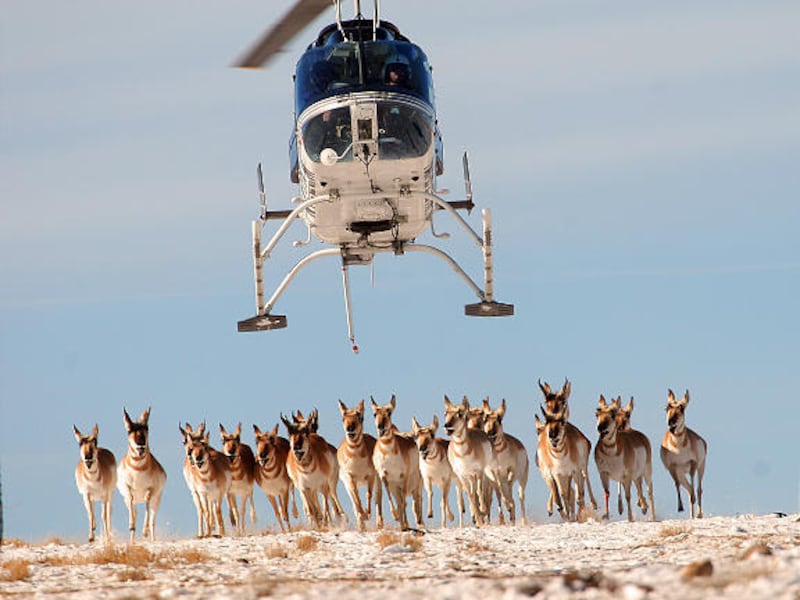
The rangeland southwest of Loa is, many agree, some of the best antelope habitat in the country, as good as any found in Wyoming.
There is an abundance of flowering non-woody plants to eat, water to drink and wide-open country to watch for and elude predators. Because of these conditions, there are lots of antelope.
It was home to just under 2,000 animals. The long-range management plan calls for a stable herd size of around 1,500 antelope.
Which is the reason a group gathered around a net enclosure last month, with plans to trap and move around 400 antelope.
In all, since the herd itself was started under a transplant program back in 1964, more than 5,000 antelope have been moved to other parts of Utah and other states.
This year, Mexico put in a request for 100 antelope. Plans also call for this year's catch to be placed in other regions within the state, including the Grand Staircase-Escalante National Monument.
The capture method was one that had been tried and proven.
Trapping is always done in the winter, when the antelope are bunched together in large groups. During the summer months the antelope are spread out in small groups.
A fixed-wing plane flew the areas the day before trapping and pinpointed the herds.
On roundup day, a helicopter located a herd and by flying low moved the animals toward the pens.
The pens were nothing more than rope netting staked out in the shape of a funnel — the larger end at the entrance — then narrowing into a round enclosure split into two halves.
Once in the pen, heavy tarps were hung from the netting to help calm the animals and block their view.
Next, in bunches of 10 to 15 animals, the antelope were moved into a second enclosure where they were subdued and carried out to waiting horse trailers. Those bulldogging and carrying the antelope are called "muggers." Jim Lamb, a biologist with the Division of Wildlife Resources, describes the job of bulldogging the antelope as something like "bailing out of the back of a pickup at 35 miles per hour and tackling a mailbox."
Lamb has been part of this capture program for more than a decade.
"The secret is to grab hold of the brisket on the neck so you can turn with them. This way you can spin them to the ground and it doesn't hurt them and it doesn't hurt you. It's important you don't hurt yourself," he said. "You can't blame (the antelope). They're trying to kick to get away, so you find a safe way to get on the ground for you and the animal. Once they're on the ground they give up pretty fast."
Pronghorn antelope once roamed almost all of the foothills and valleys in Utah. As settlements and agricultural development increased, they were forced into the deserts.
By 1900, unregulated livestock grazing and unrestricted hunting had almost eliminated the pronghorn from Utah. Only a few small bands remained in the west desert and in Daggett County. Pronghorn antelope were given full protection in 1898 but their numbers remained small for another 50 years.
In 1922, only 670 animals were counted in Utah. It was not until 1945 that Utah held its first legal hunt. That hunt was held on the herd in the Flaming Gorge area in Daggett County.
Through protection and transplant programs, pronghorn antelope have been returned to many areas of the state, but much of their traditional habitat is now cities, ranches and industries.
Pronghorns are commonly seen during the day. They are active day and night, with the most activity just after sunrise and just before sunset.
Antelope are also social animals and readily form herds. During the winter, large herds may have animals of both sexes and all age classes. In the spring, the large herds break up.
Young males band together in bachelor herds while the females form their own groups. Antelope fawns are born in May with twins being quite common. For the first three weeks of life, the fawns lie in the vegetation, hiding from predators.