

Here's something movie buffs might not know.
Before two of the airplanes flew in "Amelia," the Amelia Earhart biopic opening Oct. 23, they first flew over Kansas City.
That's because the planes were handmade made by Robert Baslee, owner of Airdrome Aeroplanes in Holden, Mo., the world leader in making replica vintage World War 1 aircraft.
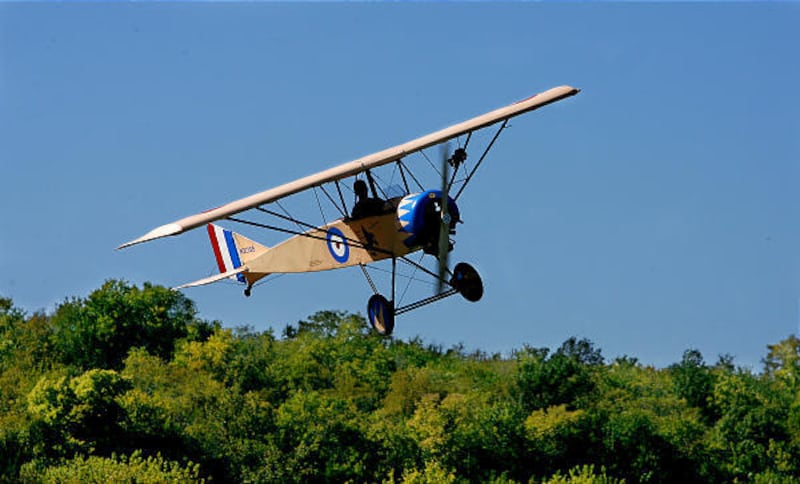
Producers paid handsomely to have Baslee (pronounced Bosley) make a Morane Saulnier L and a Bleriot XI for the movie. (He's too modest to say how much.)
Why Baslee?
Simple. No one else makes World War I replica airplanes.
The planes were used in flashback scenes in the movie. Now they're in Baslee's backyard.
Baslee, 44, has made about 60 planes. He built four for the 2006 movie "Flyboys" and has sold 500 kits to enthusiasts around the globe, ranging in price from $4,000 to $14,000.
Healways loved to take things apart to see how they work. At 2, when other toddlers were defeated by child safety locks, little Robert figured out how to take the pins out of hinges and remove entire cabinet doors. Later, he disassembled radios, toasters, washing machines, dryers, refrigerators, anything he could find. The world of switches, belts and pulleys just made sense to him.
And when he was in high school, he didn't have a car, but he did own an airplane.
It was a KR-2, a small, two-seat sport plane he built in his garage out of wood, fiberglass and an 1800-cc Volkswagen engine. He used it to give friends at Lee's Summit High School rides and have fun flying around the city.
Wait a minute. How did a high school kid from a dirt poor family with below average grades and little help build a real, working airplane from scratch in his spare time?
He shrugged his shoulders.
"No one told me I couldn't," he said.
After an aunt and uncle co-signed a loan, he paid it off with old-fashioned hard work. He had fast-food jobs. He shoveled snow in the winter, raked leaves in the fall. He wanted to cut grass, too, but his family didn't own a lawnmower. No problem. He found a broken one in the trash and fixed it up.
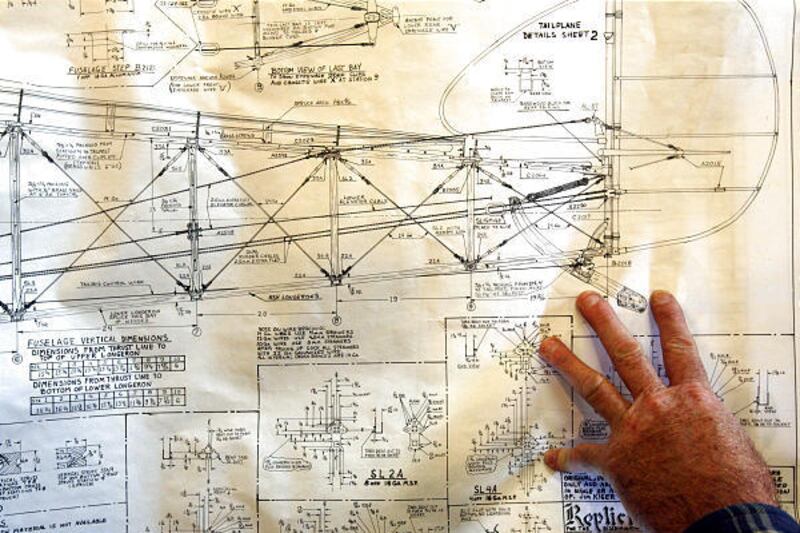
He built that first airplane from plans, working on it with a friend after school, evenings and weekends. In many ways, it was what he lived for. He says the day he got to fly it was one of the happiest days of his life.
After high school, Baslee studied mechanical engineering at several colleges, stopping just short of his degree. This time, he got good grades, because he was doing something he loved. Later, he became a certified air-frame and power-plant mechanic and a certified welder. He has put those skills to good use.
"I grant you there isn't a huge market for World War I airplanes, but I own the market," he said. "There are 19 available in kit form, and they're all mine."
His mother, Judy Baslee, is amazed by her talented son.
"When I went to see 'Flyboys' and saw the first scene with the airplanes flying toward you, I could hardly stand it because I knew that it was my son who built those planes," she said. "I have never experienced anything so good in my life."
Baslee liked the movie, too. But building the planes was an ordeal.
He had 60 days to build two.
"It was an almost impossible task," he said. "Normally, people expect five years to make one of these airplanes."
Then the impossible became even more impossible.
Producers asked for two more airplanes. Baslee didn't promise anything other than he'd do his best.
"On Day 52, we had all the airplanes finished," he said. "I was eight days ahead of schedule — for four airplanes!"
Friends and customers aren't surprised.
Baslee, who often helps customers build their planes at his workshop, is famous for his relentless work ethic.
Just ask Dick Starks, a world-renowned aviation author and enthusiast.
"I can't keep up with him," Starks said. "Robert finishes one job, and he doesn't straighten up. He jumps right into the next one. I'm like, 'Let's have a pizza. Let's have a Coke.' And he's like 'No.'
"I like to have 'blue sky' moments where you sit and cogitate about what you're going to do next. There are no blue sky moments with Robert ...
"We call it Bull Whip Baslee's House of Pain. He never stops to take a break. Twelve- to 16-hour days are not unusual. He just jumps out of bed every morning with a knife in his teeth ready to go to work. You don't even get a coffee break when you work with Robert. You have to sneak off and hide behind something and have a quick sip before he starts yelling at you."
But if you can keep up, he said, Baslee's help is invaluable.
"The big advantage is he has every tool you could possibly need to build one of these within 20 feet of the table," he said. "And I tell you, in two days with all the tools he has, you'll get a year's amount of work compared to doing it yourself. You can walk in there on a Saturday morning and leave Sunday afternoon with fuselage sitting on the landing gear."
Baslee started his business in 1989. Blame it on his romantic affinity for a triplane.
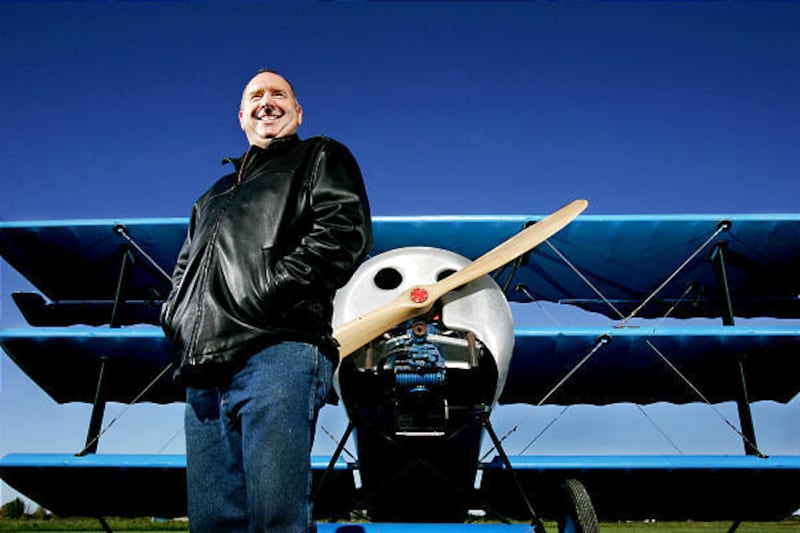
The 24-year-old longed to build a Fokker DR-1, the three-winged kind made famous by the Red Baron. He wanted to buy a kit. He searched everywhere only to discover there wasn't one.
No problem.
Baslee simply built his own triplane from a picture, a beautiful blue one. Later that year, he took it to an air show in Oshkosh, Wis. Drooling, wide-eyed enthusiasts asked him where he got the kit.
"I didn't," he said. "I built it from scratch."
Which prompted the question that would change his life.
"Are you going to sell a kit?" they asked.
"Maybe," he said.
When he got home, he'd decided to get into the kit business.
On a recent day, Baslee took a visitor through his 10-acre property, which sits, quite literally, down the road-less-taken. You'll find his place across a thin gravel road from a massive cornfield. There's a hangar for his airplanes and an enormous assembly shed.
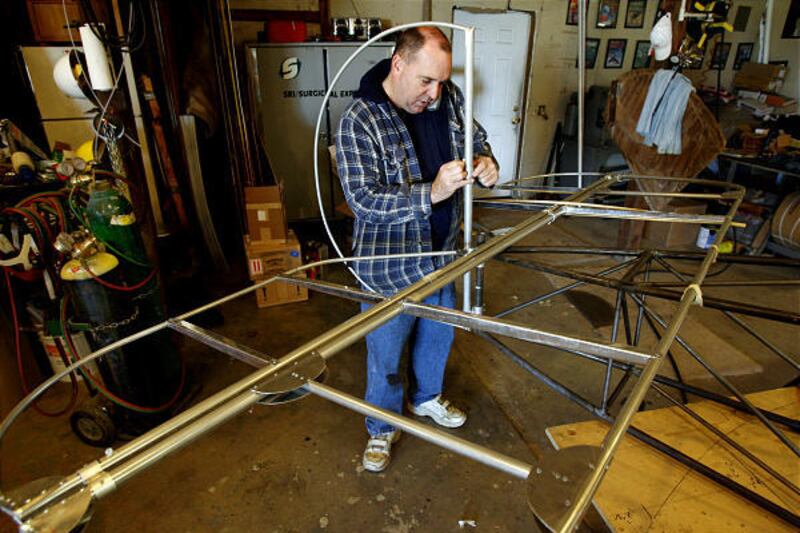
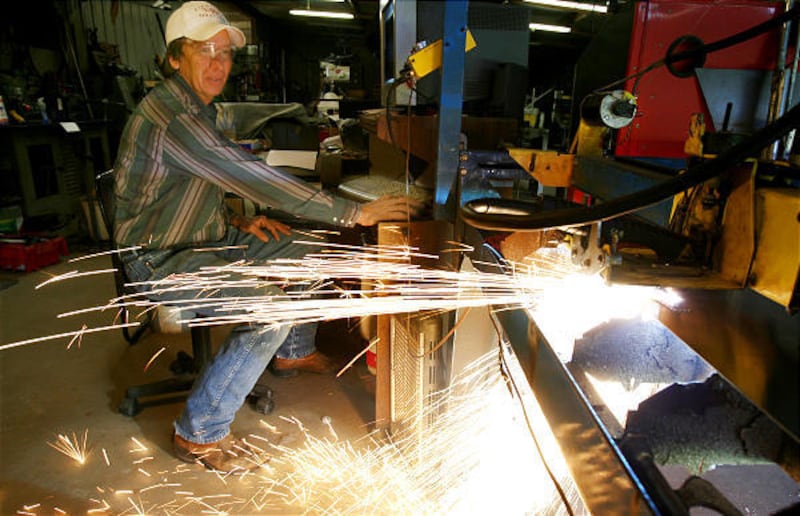
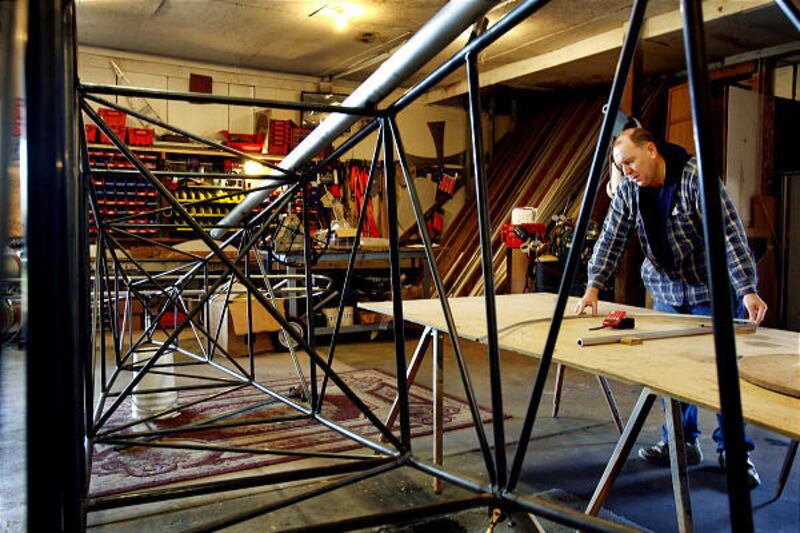
His workshop is cluttered, but computerized, with a dizzying array of machines, tools and raw materials that you just won't find at your typical home improvement store. He has one employee, who assembles the kits for shipment. Many of his machines, bought at auctions or specialty supply houses, are 50 years old.
"New stuff ain't near as nice," he said.
His machines would make Bob Vila'shead spin — a quarter million dollars' worth in all. He has shrinking and stretching machines, bead rollers, bender presses, pneumatic presses, a plasma cutter, a three-axis computer-controlled machining center, manual milling machines, TIG welders, a manual lathe and a large jet-turret lathe that lets him do, he says, "Nine individual operations without ever touching the machine."
Even in the recession, Baslee continues to turn out products his customers want. He has shipped kits to Canada, Hong Kong, South Africa, Australia, New Zealand, the former Soviet Union, Japan and all over Europe.
His customers find him through his Web site (www.airdromeaeroplanes.com) and articles in Popular Mechanics and international aviation publications such as Kit Planes, Sport Pilot, Sport Aviation, Replica Fighters and Custom Planes.
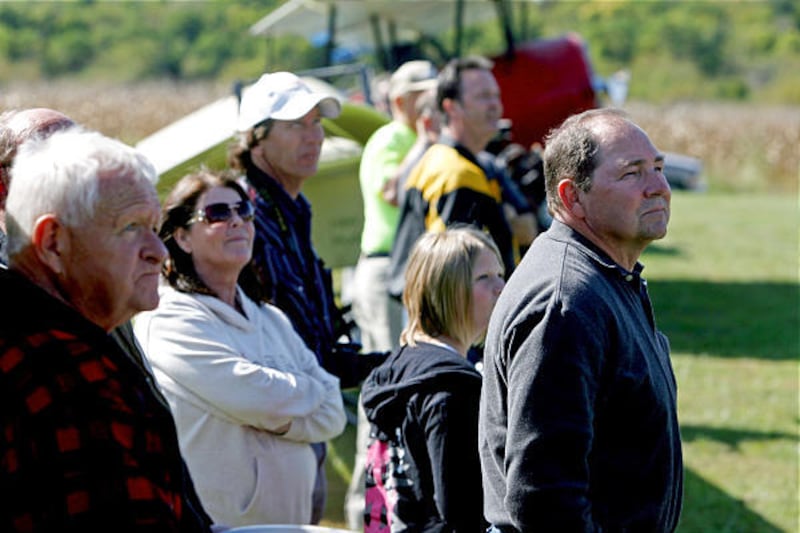
Baslee shows visitors his aircraft, which sit in a grassy field like a picture out of a history book. That day, he was working on nine kits slated to be sent overseas. While he was walking outside his hangar, James Neely, a retired teacher, walked up, seemingly out of nowhere.
Neely, who was considering buying a vintage airplane kit, had just arrived from Essex, Ontario. He and his wife came specifically to see Baslee.
"Basically, I want a plane that flies (well) and handles the weather," Neely said. "I don't like being bounced around."
Baslee recommended the Fokker D-7, a biplane. Like other international visitors, Neely had seen Baslee's company in an aircraft magazine, then found him on the Internet.
After Blake Thomas, a retired fighter pilot and active Southwest Airlines pilot based in Houston, found Baslee, he built a Newport 28 from one of Baslee's kits.
"He made a dream happen for me," Thomas said. "I wanted to build a World War I airplane, but I wanted to get rid of all the problems they have. I wanted modern technology and modern safety in an airplane that would bring me back to that time during the beginning of flying."
The plane is everything he wanted. And the quality?
Second to none.
"I can actually take my hands off the stick at almost any speed or any attitude (the pitch of the aircraft, such as nose up, nose down or level)," he said.
In the end, Thomas got more than an airplane. He'd found a friend.
"He's the kind of guy who if I was in a trench somewhere, I'd want him right next to me," Thomas said. "I trust my life to him every time I fly my plane."
Baslee is happy his customers like his work. Because there is nothing — save for his two college-age daughters and a 15-month-old daughter he and his second wife recently adopted from China — that is more important to him.
Harvey Cleveland of Riverside, Mo., is Baslee's close friend and test pilot. He described Baslee as a perfectionist who will do anything to give his clients the fun they want and the safety and quality they need.
"He doesn't have any fingernails," Cleveland said. "He's chewed them off worrying about the next airplane. He just wants to make sure everybody is safe. He overbuilds everything. Everything is twice as strong as it needs to be."
As good an engineer as Baslee is, he's an even better person.
"Nice as you can imagine," Cleveland said. "I tried to lend him money to get his business started, but he wouldn't take a dime. He wouldn't take money from the bank, either."
Baslee doesn't borrow money. He works for it.
Hard.
"Last year, I worked every single day," he said. " Every Saturday, every Sunday."
Even Christmas.
Why does he work so much?
"If I got the opportunity, I've got to do it," he said. "I might have a heart attack tomorrow, I may get struck by lightning, I may fall off a ladder and be paralyzed and can't do this anymore. You have to make hay when the sun is shining."
All the work has paid off.
Today, he is not only a successful businessman, he is debt-free. Still, the trappings of success haven't gone to his head. While he could afford to drive anything he wants, he drives an old beat-up pickup truck. While he could afford a mansion, he lives in a high efficiency earth-contact home that he built just off of his airfield.
"I'm in awe every day," his mother said.
"He's just amazing. That workshop? All the people he's met from all different walks of life, and the countries he's seen? The movies he's done? I don't know where he got all of that drive. I'm just in awe."
(c) 2009, The Kansas City Star.