

PROVO — Michael Goldsmith knew in August that he would not be back to teach in the fall.
For three years, the BYU law professor had battled amyotrophic lateral sclerosis — ALS, or Lou Gehrig's disease. The disease had weakened him, and most significantly, had taken his voice.
"I have devoted most of my career to teaching at BYU," Goldsmith wrote in an e-mail to the dean of the J. Reuben Clark Law School announcing his decision to retire. "The experience has been a total joy. During this difficult past year, I often thought that I teach within a community of compassionate friends."
That community now mourns the loss of Goldsmith, who died Sunday at the age of 58.
"We'll miss him greatly," said former law school dean Kevin Worthen. "Our world is a little less vibrant without him in it."
Goldsmith died from respiratory failure in a hospice at St. Peter's Hospital in Albany, N.Y., where he'd been living since August, according to his son, Austen Goldsmith.
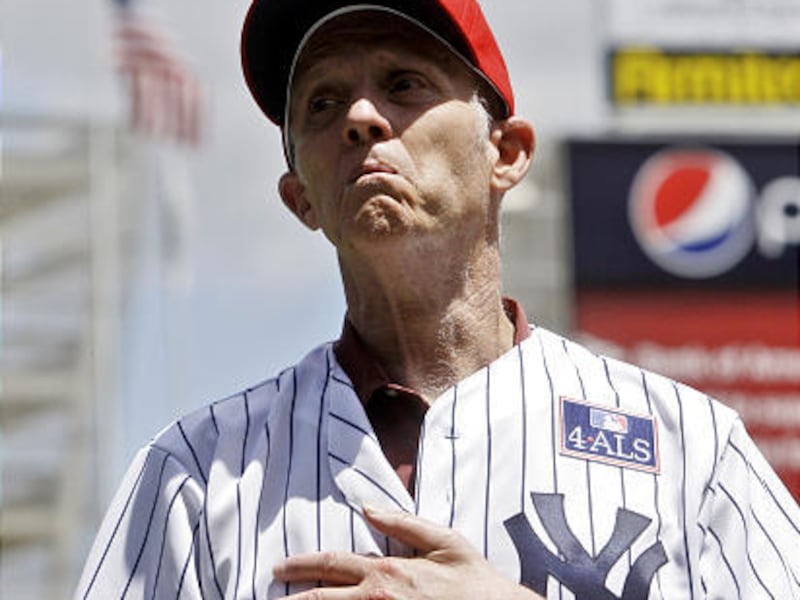
An advocate for ALS awareness, Michael Goldsmith threw out the ceremonial first pitch for the July 4, 2009, game at Yankee Stadium — on the 70th anniversary of baseball legend Gehrig's famous speech in which he called himself "the luckiest man on the face of the earth."
In stadiums across the nation, fans were encouraged to donate money for ALS awareness and research. Gehrig died in 1941 from the disease.
Major League Baseball again honored Goldsmith and his fight by dedicating Monday night's Game 5 of the 105th World Series to him and the organization 4 ALS — a first-time community-service dedication and an honor Goldsmith's colleagues called "amazing."
"I am deeply saddened by the passing of Michael Goldsmith yesterday," said MLB Commissioner Bud Selig. "On behalf of Major League Baseball, my condolences go out to his family and friends."
"He faced his illness with great courage," said BYU law professor Jim Gordon, who worked with Goldsmith for more than 24 years. "His life and his impacts and his contributions are worth sharing and remembering."
Goldsmith, born in Israel, earned a law degree from Cornell Law School and spent time as a deputy state's attorney, senior staff counsel to the House Select Committee on Assassinations and then as counsel to the New York State Organized Crime Task Force, before going to BYU in 1985.
He taught classes in criminal procedure, evidence and racketeering until last winter semester, which ended in April.
"Michael loved the law and loved his students," said Law School Dean James Rasband, who had just flown to New York to attend Goldsmith's memorial services. "He had a commitment to public service and, until the end, lived his life as an example of how one person can make a positive difference in society."
Worthen remembered Goldsmith's outstanding scholarship, which earned him national renown, as well as his mentoring of countless students.
"His keen insights and incredible wit made even faculty meetings enjoyable," Worthen said. "He generated enthusiasm for any activity in which he was involved."
Goldsmith earned the "teacher-of-the-year" award from students five or six times in his career and frequently gave presentations to other attorneys, Gordon said.
"He was a gifted teacher. Students loved him," Gordon said. "He was energetic. He worked to make the world a better place. He became involved in things to try to improve society.
Goldsmith is survived by his wife, Carolyn Goldsmith, and his two children from a previous marriage, Jillian Goldsmith and Austen Goldsmith, both of New York, as well as two sisters, Lynn Goldsmith and Edna Goldsmith, and their mother, Anitta Goldsmith of Albany, N.Y.
Contributing: George Vecsey, New York Times News Service
e-mail: sisraelsen@desnews.com