

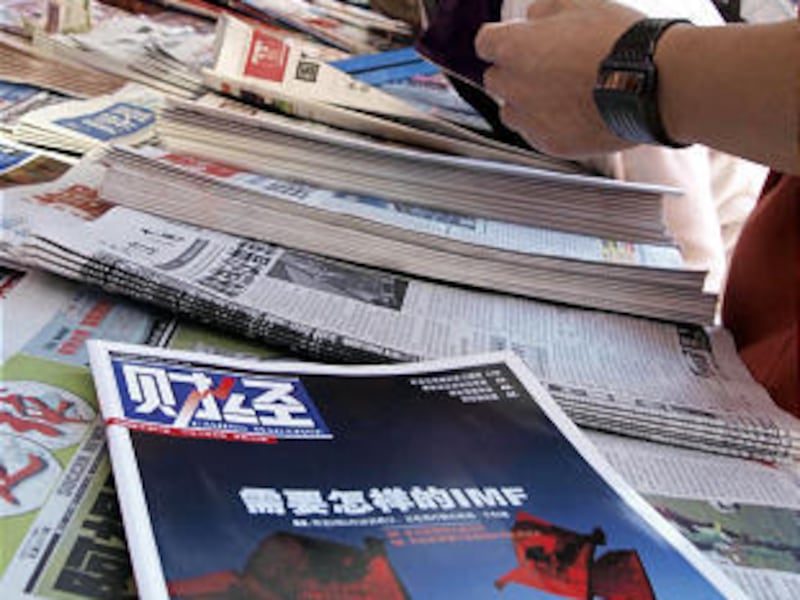
BEIJING — The founder and editor-in-chief of a Chinese magazine known for pushing boundaries with the country's censors and chasing stories that could embarrass the government resigned Monday amid friction with her publisher, colleagues and the magazine said.
Hu Shuli's departure is a major blow to Caijing, an 11-year-old financial news magazine that under her guidance tackled tough subjects such as corruption, pollution and public health scares. The magazine boldly reported on SARS and demanded greater government transparency on the epidemic well before authorities acknowledged the full extent of the crisis.
A less-aggressive Caijing could set back efforts to establish a free press in China.
Two Caijing employees said that Hu left because of disagreements with Caijing's publisher, Hong Kong-listed SEEC Media Group, over editorial and financial control. One said dozens of the magazine's 180-strong editorial staff resigned Monday in a show of support for Hu.
The two spoke on condition of anonymity because they were not authorized because they said they were not authorized to announce the resignations.
Managing editor Wang Shuo announced on Twitter that he had resigned but did not give a reason.
A woman who answered the phone at SEEC's Hong Kong office and would only give her surname, Chan, said the company had no comment and referred calls to a Beijing office, where the phone rang unanswered.
Caijing spokeswoman Heidi Zhang told The Associated Press that Hu has no immediate plans to start a new magazine or other publication. Hu instead will likely take up an academic post in the communications department of Sun Yat-sen University in south China's Guangzhou.
The magazine was not closing down and Hu would stay on for about a month to help with the transition, Zhang said.
SEEC has other magazines in its portfolio, but Caijing is its flagship publication.
Jeremy Goldkorn, editor-in-chief of Danwei, a Web site that covers Chinese media issues called Hu's resignation "a big loss for SEEC."
"No one will take Caijing seriously now," he said. "Hu Shuli is almost half the brand, if not more."
Rumors of problems at Caijing have been swirling for months. The magazine's general manager and 60 to 70 employees from the business department resigned last month.
The uncertainty surrounding around the magazine has raised questions about the future of a partnership between it and Hong Kong tycoon Richard Li that is expected to launch an English-language financial news service focused on China next year.
Cai Business Indepth Ltd., the Hong Kong-based company set up to run the service, said in an e-mailed statement late Monday that it was "monitoring developments" at Caijing.
"Regardless of the changes announced at Caijing, we have understandings in place which ensure that we will continue to have exclusive content from China's premier financial news editors and journalists," it said, without providing details.