

About half the students enrolled in one of the nation's top university harp programs belong to The Church of Jesus Christ of Latter-day Saints. The University of Arizona in Tucson is known for its harp program because of Harp Fusion, a traveling ensemble tied to the program.
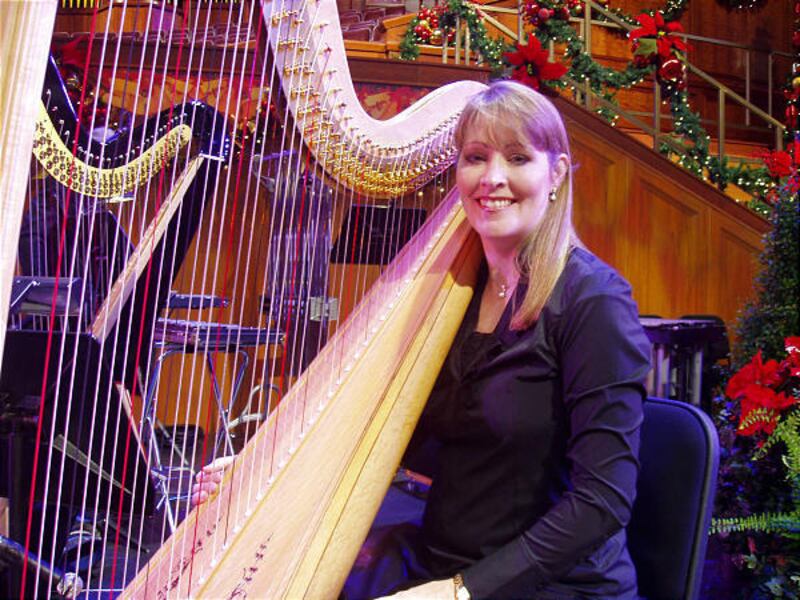
Of the 14 students in Harp Fusion, eight are Mormon, and several were taught by Julie Keyes, who plays the harp for the Orchestra at Temple Square in Salt Lake City. Keyes said that when her students reach levels of excellence, she recommends they audition for Harp Fusion — mainly because of its founder, Carrol McLaughlin.
"They seem to gravitate to Dr. McLaughlin — she's just a very gravitating type of person. She's like a mother hen. She really loves these girls," Keyes said. "She respects … their beliefs. And she is a devout Christian herself."
McLaughlin doesn't intentionally try to recruit Mormons.
"I accept the best players," McLaughlin said, "and I care very much about their attitude and their work ethic."
"Dr. McLaughlin is just so inspiring," said Kate Zurcher, a student in the program from Holladay. "She sees the individual worth in each person. I think that is why she attracts so many LDS kids."
Carolyn Lund is a member of the church from Augusta, Ga., and McLaughlin's teaching assistant. "Honest to goodness, we are each other's best friend here," Lund said. "We are the family away from our own family. I have never seen any sort of contention or competitiveness or jealousy in any form — even though we are all at different levels … it's not your typical harp department. I think other programs around the country have a reputation of being very competitive amongst the girls. Here we just honestly all love each other so much. And we hang out with each other after school."
Keyes said, "Utah has more harpists per capita than any other state."
She attributes the interest to large and supportive Mormon families. It is natural, she said, that if one girl gets interested, her siblings will also pick up the instrument.
Lund agrees. "I think Mormons in general put a little more focus on getting their kids in music lessons, and there is a strong family environment in which to nurture talent, I guess."
Keyes thinks that another reason there are a large number of harpists in Utah is Shrudeli Ownbey, who brought the Suzuki Harp program to Utah 22 years ago.
"There were just hundreds of little 3-year-olds learning to play the harp," Keyes said. "And now they are all in their 20s and 30s and teaching (harp)."
Megan Russell, of Taylorsville, followed in her sisters' footsteps when she fell in love with the harp.
"One day, I was 7 or 8, and I sat down and just started playing around on the harp and my mom came in and said, 'Oh, you are going to take lessons now.' And she just signed me up with my sisters," Russell said.
It was hard for Russell to start college far away from home. But it helped that she was in the company of other harpists. "We could relate right off the bat."
Mellissa Greaves, also of Holladay, joined the program because she wanted a teacher who believed in her and could help her accomplish her goals.
Greaves heard a man play the harp in her ward when she was 6 and was hooked. She didn't think about pursuing it as a career until her senior year in high school. "I decided that engineering was too boring," Greaves said.
Harp Fusion came about as a result of McLaughlin's travels. "I was touring a lot as an international performer," she said. She realized one day that her musical tours didn't have to take her away from her students — she could take her students with her.
"It is like the old apprenticeships," McLaughlin said. "They experience everything I do as an international performer. If I get jet lag, they get jet lag."
Last year Harp Fusion, which is the largest touring harp ensemble in the United States, went to Austria, Switzerland, Liechtenstein and Belgium. This year they are scheduled to travel to Brazil. Because of budget cuts they need to raise about $7,000 for the trip, Russell said.
Lund says there are only about 40 professional harpists in Brazil. Harp Fusion's visit will boost the number of harpists in Brazil, if temporarily, by about 35 percent.
"I think it is a pretty big deal for a well-established group to go down there and play," Lund said. "I'm really excited."
E-mail: mdegroote@desnews.com