

If it feels like you have been waiting in line at the DMV for 100 years, you're right.
On May 11, 1909, Harry N. Mayo became the first person to license his motor vehicle, a Stoddard Dayton, with the state of Utah, and someone has stood in line behind him ever since.
One hundred years ago, rural roads in Utah were little more than cow paths, and if improvements were to be made, funds would need to be raised.
That's when the 1909 Legislature decided every automobile owner in the state — all 800 of them — would be required to license their automobiles.
A 2-inch aluminum seal, stamped with the license number, was handed to motorists after they paid a fee of $2 to the secretary of state.
After attaching the seal to the dashboard of the car, they were then instructed to display the number on the rear of the car in Arabic numerals no less than 4 inches in height.
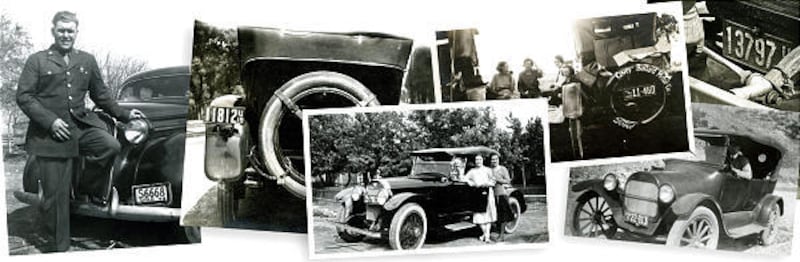
Utah's first license plates were whatever material, color or size motorists wished — so long as they conformed to the law.
Some people even skipped the process of making a plate and resorted to painting the number on the car. In rural Utah, a farmer might even use leftover house paint to accomplish the task.
By 1915, nearly 8,000 automobiles appeared on state license books, a number that had grown exponentially since Henry Ford's production of the Model T.
That year, the Legislature cooked up another plan to take advantage of the growing number of automobiles on the roads. It passed a new law requiring motorists to renew their registration ever year.
Before 1915, if you had paid your $2, you didn't need to register again.
And, in 1915, the state also decided to bring some uniformity to license plates. No more aluminum seals or hand-painted numbers, just a clean set of white license plates with green numbers pressed into them.
The decals that so conveniently renew your registration today were still far in the future when your license came due in 1916.
An entirely new plate was issued to motorists, making the 1915 number obsolete.
Worse yet, everyone's renewal came due at the same time — in January.
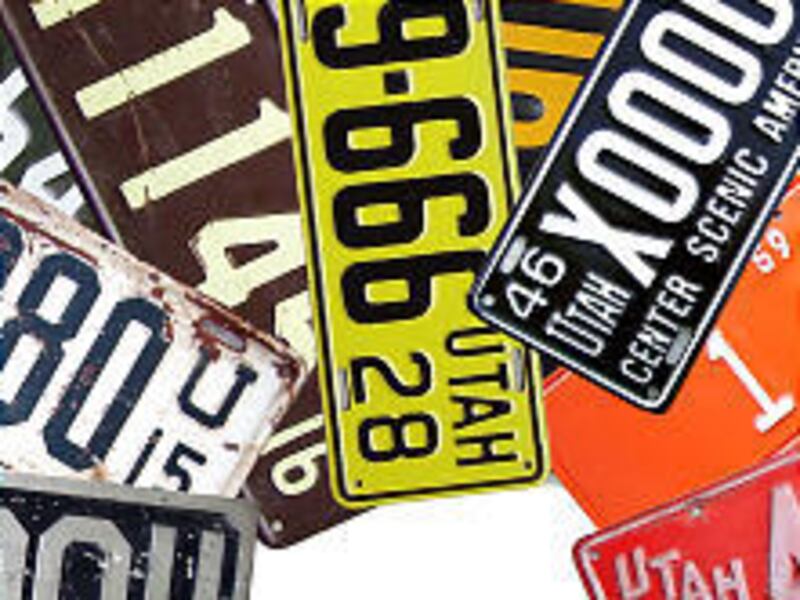
With annual licensing came an array of license plate colors and styles that changed with the year. If you waited long enough, your plate might actually match the color of your car.
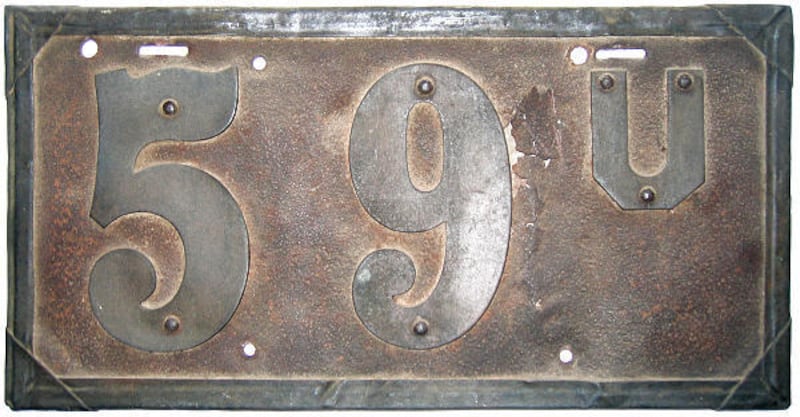
The size of the plates also changed depending on the independent contractor hired to make them. Utah's largest license plate — from 1922 — measured 6 inches by 15 inches and weighed nearly a pound.
The idea of promoting the state on license plates came in 1923, when "Utah" was spelled out on the red-and-white tags. Up until that time, plates only carried the letter "U."
The colorful plates of the roarin' 1920s became smaller and more drab in the depressed decade that followed.
To save money, the state also decided to make its own plates in the '30s, and in 1936, the job was turned over to inmates at the state prison.
The equipment was expensive but the labor was cheap, and Utah's license plates have been made by prisoners ever since.
Emerging from the Great Depression, Utah's license plates gained a renewed sense of purpose when the slogan "Center Scenic America" appeared in 1942.
The slogan-bearing plates were scrapped after only a year due to metal shortages brought on by World War II.
An awkward system involving a water-tranfer windshield decal was instituted in 1943.
In 1944, license plates were made of an organic plastic called Ligonolite. (The wood-based material resembled today's masonite board.)
Farm animals often thought the plates resembled food and would eat them if you parked your car in a corral.
One man reported losing his plates to hungry hogs in a Scipio stockyard. The incident inspired new lyrics to a familiar tune, "Mares eat oats and does eat oats and dogs and hogs eat Utah license plates."
Whether due to snacking farm animals or to the availability of better alternatives, steel-stamped numbers returned in 1945.
More than 120,000 automobiles across Utah again carried the slogan "Center Scenic America" in 1945 and 1946.
The slogan "This is the Place" appeared in 1947 to celebrate the Mormon Pioneer Centennial, and the slogan "The Friendly State" suggested that Utah drivers were kind in 1948.
Slogans were yanked from plates in 1949 and would not return for 36 years.
By the late 1960s, nearly a half million vehicles were licensed in the state. Stickers were introduced in 1969 to validate Utah's first multiyear plates since annual registration began in 1915. Every sticker, however, still came due in January.
In 1973, lines extending out the door and around street corners prompted lawmakers to stagger automobile licensing by month. That same year, a new plate debuted that was as plain as the cars to which they were bolted.
Aside from a small beehive separating numbers and letters, Utah plates were black on white from 1973 to 1985, matching the economic sentiment that made chrome behemoths small and square during America's first major gasoline shortages.
A new and improved feature of these boring numbers, however, was an entirely reflective background that made them more visible at night.
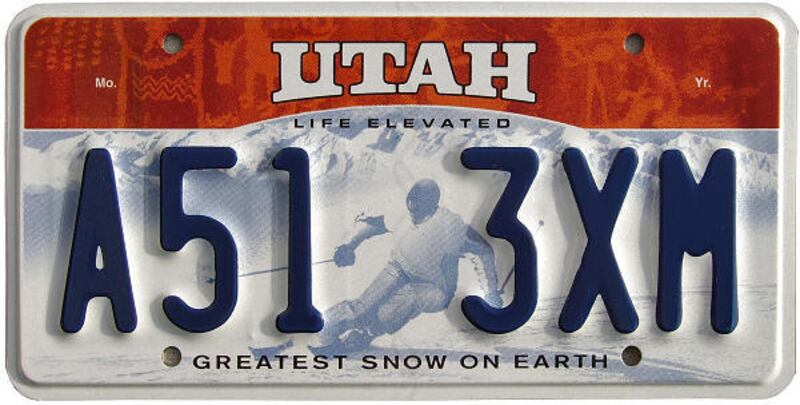
A glimmer of graphic hope broke through the dim design of Utah plates in 1985 when an East High School art class proposed skiing be featured on a license plate.
Utah Gov. Norm Bangerter liked the idea and so did the Legislature. Utah plates were changed, perhaps, forever, becoming miniature billboards to advertise "The Greatest Snow on Earth."
By 1992, license plates celebrated Utah's centennial with a colorful rendition of Delicate Arch. Since the early '90s, everything from the American Legion to Zion National Park has been advertised from the bumpers of Utah vehicles.
Modern license plates have gone high-tech, featuring photographic designs and holographic security devices.
And, if you are tired of standing in line, the Internet has made online renewal a quick and painless alternative for a vehicle population that tops 2 million today.
What the future will bring to automobile registration is anyone's guess. Microchips may be integrated. Data could be stored right in the plate. Fees might be paid with the scanning of a barcode. Technology could even bring an end to license plates as we know them. But to find out, we will have to wait at the DMV for another 100 years.
E-mail: johnc@desnews.com