

For some, there's nothing more nostalgic than the house they grew up in. Why else do we continue to drive past the family homestead long after Mom and Dad have moved out, or pay artists big bucks to re-create them in watercolors or pen-and-ink?
Imagine, then, being able to cradle an exact replica of your childhood home in your palms or hang it on a Christmas tree next to your daughter's "Baby's First Christmas" ornament. That'd be a keepsake to trump all keepsakes, wouldn't you agree?
Kent Wallisch thinks so.
About a year ago, the Whitehall, Pa., artist began handcrafting miniature versions of people's houses out of cold-press illustration board as gifts for a small group of friends. The one-of-a-kind paper structures proved to be such a hit that friends of those friends -- followed by a few complete strangers -- soon came knocking, turning his hobby into a part-time business.
Wallisch, 40, who studied sculpture at the University of Pittsburgh and who also has taught art for the past 15 years, says he was looking to do something unique when he started building the houses.
"I thought, why not some kind of three-dimensional sculpture or ornament?"
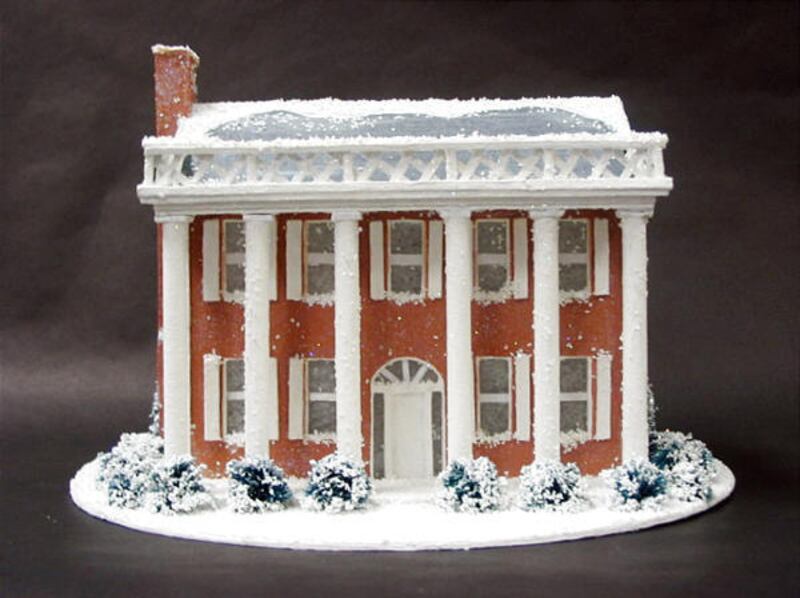
Christmas, he explains, conjures up thoughts of the old-time snow villages some people set up near train sets and on mantels; why not personalize those displays with a "real" home fitted for twinkling white lights and dusted with fake snow?
Not that it'd be especially easy, or cheap: Breaking a house down to build it to scale and capturing exterior architectural details from paint color to the width of the clapboards is a time-consuming process.
Even the most basic home, for which Wallisch charges $225, takes 30 hours to complete; more elaborate structures with dormers, shutters, turrets and balconies take 50 hours or more and can run upward of $1,000, depending on size and details.
"Every one is so different," he says.
Each is so beautiful, though, that many of his word-of-mouth buyers are choosing to display them not just during the holidays but all the time. One client, for example, had his home encased in a glass globe to keep it safe 24/7.
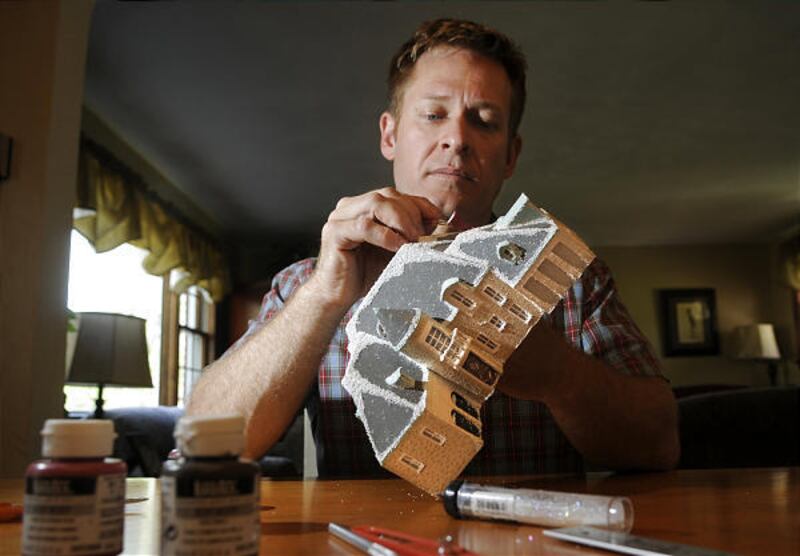
Wallisch begins by taking detailed pictures of a home's exterior and noting how the sides are pieced together. He pays particular attention to rooflines and features such as dormers and eaves, along with the size of the windows, texture of the wood grain and decorative accents such as columns and dentil moldings.
After making a template on tracing paper, Wallisch cuts the pieces out of illustration board and carefully glues them together. Balconies and railings are crafted out of balsa wood; stone, out of little cut-up chips of paper. The final step is painting the house with acrylics and dusting the roof, surrounding yard and plantings with drifts of fake snow -- something he believes makes them "much more magical." Critiquing him every step of the way are sons Logan, 6, and Colton, 7.
Many of Wallisch's customers, who can also find samples of his artwork on CafePress.com (search "wallisch"), treat themselves to the houses. But they make equally great presents for family members.
Sue McCool of Bethel Park, Pa., was so captivated by a friend's miniature that she commissioned four copies of the house she grew up in -- one for her and each of her three siblings.
Now in their 80s, her parents are thinking of moving from the tiny city home they've been in for almost 60 years, a life event that has left the family feeling "kind of sad."
"We have a lot of memories there," says McCool.
To have such a wonderful memento of her childhood and parents, then, is extremely comforting.
Interior designer Brigette Pavlik is another fan of Wallisch's work. Earlier this year, she spotted a house he'd made as a housewarming gift in a client's home. "And I just went crazy for it," she says.
Within weeks, Wallisch was busy re-creating the stately 1920s French Normandy home in Fox Chapel, Pa., she and her husband, Bill Kolano, bought five years ago.
Her original intent was to surprise her husband, who holds a degree in architecture and appreciates fine design, with the gift at Christmas. But the secret was so delicious, she ended up spilling the beans. "They're amazing," she says.
Still a mystery is whether the finished product will sit out year-round or just make an appearance at Christmas. Regardless, Pavlik knows just where it will go.
"Kent took a measurement of the mantel," she says.
Wallisch concedes that his tiny houses, because of their high price tag, will probably appeal to a niche market, someone willing to spend some bucks on a piece of custom artwork. But that's OK. Already his miniatures are gracing living rooms as far away as in California and Florida -- proof positive there's a market for his work.
Besides, if he gets too busy, he'll never get around to replicating the simple ranch house he and his five siblings grew up in, for his own Christmas tree.
"I know," he says with a laugh. "I know."
(Gretchen McKay can be reached at gmckay@post-gazette.com.)