

ZION NATIONAL PARK — Peering down a cliff face at the valley floor several hundred feet below, I faltered and gulped. My son, Ian, probably fortified by the sense of immortality that often infects young men in their late teens, scrambled up the narrow trail like a mountain goat.
We'd already sloshed and waded through two remarkable slot canyons in Zion National Park, and in a few days would be about 160 miles away at Grand Staircase-Escalante National Monument, squeezing through two more that were so narrow my relaxed-fit waistline threatened to block our progress.
This was our last father-son vacation before Ian left for college, and he was calling the shots. We'd pinballed from one remarkable location to the next, across four states. But exploring southern Utah's canyons and gulches, carved into fantastic shapes and textures by wind and water over many millennia, was the highlight.
That involved a lot of climbing and hiking and being a human pack mule — payback, of sorts, for the many backpacking trips, euphemistically known by friends and family as "death marches," that Ian and his younger sister had endured throughout their childhood at my instigation.
Now Ian was setting the pace. His sister had declared a moratorium on such trips and stayed at home, muttering, I recall, something about running water and electricity and her father's unenviable ranking as the world's most embarrassing person to be seen with. And I was the one who sometimes struggled to keep up.
I was fine with that. Ian showed that he had become a confident young adult, willing to take risks, but also using good judgment. And since he would soon be leaving home, that was a comfort.
Climbing to the top of Angels Landing was probably our most breathtaking experience, both in terms of the views and the pucker factor.
The trail follows a series of switchbacks and then crosses a rugged spine of sandstone — with steep cliffs on either side — that thrusts out into Zion Canyon. It reportedly was named by an early visitor who observed that only an angel could land there.
On some of the more exposed portions (as in, a long way to fall), chains have been anchored into the stone so that climbers have a grip as they slowly ascend.
As you complete the climb, a panorama of Zion Canyon is revealed, almost as if you're suspended in air. Far below, the Virgin River snakes through the valley. Many of the park's landmarks, which tower over visitors on the canyon floor, are at eye-level.
Hiking overnight through the Zion Narrows, one of the world's most spectacular slot canyons, provides a very different perspective and different challenges.
The riverbed, a mixture of sand, gravel, boulders and slick rock, is the primary trail. Hikers walk, wade and sometimes swim for 16 miles.
Flash floods are a very real threat, and weather must be monitored carefully in advance of a trip. A ranger explained some of the signs that a flash flood may be approaching: debris in the river and a change in color, the sound of rushing water — or the sudden appearance of other hikers being swept along by the current. In light of that talk, we were happy to learn that "High Camp" was our designated campsite.
At times, the canyon is only 20 to 30 feet wide. Its towering walls can rise up to 2,000 feet above the riverbed. Hikers pass by strange rock formations, including sandstone grottoes. Clear water gushes or trickles from springs along the canyon walls, where hanging gardens cling and sunlight produces a kaleidoscope of colors.
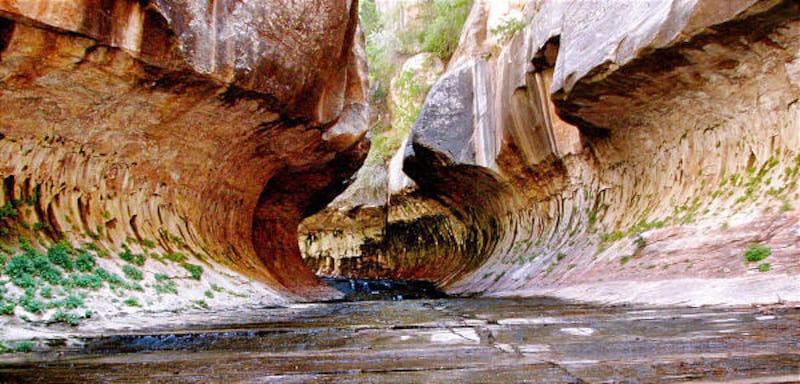
One grueling hike was simply not enough for my son, so we obtained another backcountry permit to explore The Subway, a much smaller slot canyon in Zion.
Hikers first must make a steep descent along a canyon wall and then follow a creek upstream. There's little in the way of shade, and in the summer, expect to be sun-baked.
The relatively cooler temperatures along the creek are a welcome relief. The creek gurgles over several small waterfalls and glistening cascades over slick rock that is brilliant red-orange in the sunlight.
When The Subway first appears, the source of its name is apparent. At its base, water has sculpted a tunnel-shaped chamber. Rushing water also has created a series of bowl-shaped depressions. And here, the colors change. The hues of desert rock clash with the muted blue-green colors of the algae-stained creek bed.
Farther up the creek is the Waterfall Room. Stone walls rise from the creek bed on three sides. Overhead, water tumbles through a narrow crack in the rocks.
Exploring slot canyons had become an obsession. So we headed to Peek-a-Boo and Spooky, two very claustrophobic examples deep within the remote Grand Staircase-Escalante National Monument in southern Utah.
We camped nearby so that we could get an early start. In the summer, afternoon thunderstorms are common, and that can translate into deadly flash floods.
As we walked along a larger gulch to the entrance to Peek-a-Boo, there was still evidence of a recent flash flood. A murky pool of orange-colored water was at its base. The only sound was croaking frogs.
And after we'd scaled a nearly vertical rock face about 12 feet tall to enter Peek-a-Boo, we encountered several pools of water in the many potholes scalloped into the canyon floor by erosion. Erosion also has sculpted remarkable fins and swirls into the desert rock, and arches overhead.
After a relatively short distance, perhaps a quarter of a mile, the slot flattens into a large wash. We retraced our steps and hiked a short distance east to the entrance of Spooky. Its entrance is at ground level, so getting inside was much easier.
Despite its proximity to Peek-a-Boo, Spooky has a very different feel. By comparison, Peek-a-Boo's reddish-orange interior is bright and cheery. Spooky is darker and more foreboding, and portions of its walls have a bizarrely nubby texture.
And the farther we went, the tighter the fit. My son was able to wiggle through even the most constricted point; but with at least six more inches at the waist, I ended up crawling on my hands and knees closer to the ground, where the opening was wider.
That, and my dismal performance climbing the rock wall to the entrance of Peek-a-Boo, had provided some amusement to my son. But he was the only one who got stuck, ever so briefly.
Before we'd left Peek-a-Boo, he'd sat down in a pothole and had to ask for a hand to get up.
His father had remained standing. One of many lessons learned through life experience: If the rear's too big to fit, don't sit.
If you go:
For more information about the Zion Narrows, Angels Landing and other features of Zion National Park, go to www.nps.gov/zion. Backcountry permits are required for many slot canyon hikes, including overnight trips and day hikes from the top to the bottom of the Narrows and for hikes to The Subway. No permit is required for day hikes through the Narrows up to Big Springs.
GETTING TO ZION: McCarran International Airport in Las Vegas, Nev., is the closest major airport. It's about a three-hour drive from Zion. Salt Lake City International Airport is about five hours away by car. Commuter air service is available to St. George, about 46 miles southwest of Zion, from Salt Lake City and Los Angeles.
GETTING TO GRAND STAIRCASE: Drive east from Zion National Park on State Highway 9. Go northeast on U.S. 89, then east on State Highway 12 to Escalante. A few miles east of Escalante, turn south on the Hole-in-the-Rock Road (Road 200) and drive 26 miles south to Dry Fork Road (Road 252) on the left. Drive east 1.7 miles to the trailhead parking area.
HIKING SITES: For more facts on Peek-a-Boo and Spooky gulches, and Grand Staircase-Escalante National Monument, go to www.blm.gov/ut/st/en/fo/grand_staircase-escalante.html.
For specifics on Peek-a-Boo and Spooky, contact the Escalante Interagency Visitor Center at 435-826-5499.