

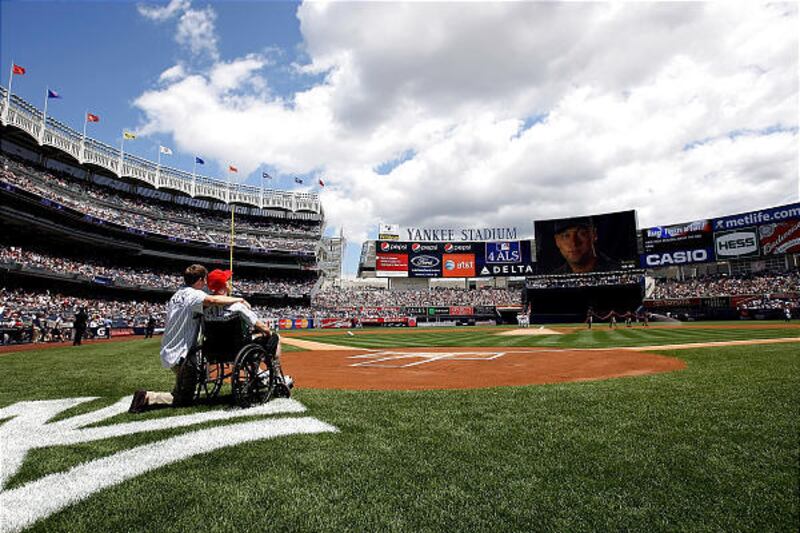
NEW YORK CITY — BYU professor Michael Goldsmith was concerned a few fans might boo when they saw his underhanded flip of the ball in the ceremonial first pitch on Saturday.
But 70 years to the day after Lou Gehrig's immortal speech in Yankee Stadium, the fans understood the courage it took for Goldsmith just to stand on the field.
Stricken by the vicious illness that now bears Gehrig's name, Goldsmith was responsible for Major League Baseball's planning ceremonies in 15 parks on Saturday to raise money and raise awareness to fight ALS, also known as Lou Gehrig's disease.
ALS is "a progressive neurodegenerative disease that affects nerve cells in the brain and the spinal cord," in the words of the ALS Association. It is invariably fatal, usually within four years.
Goldsmith, a lawyer and professor at BYU who was found to have ALS in 2006, lighted the bulb in Major League Baseball's brain. The sport had used the doomed Gehrig as one of its central heroes for seven decades, he said, and now it was time to give something back.
He wrote a guest column in Newsweek in November 2008, and his idea was picked up in this column and was noticed by Commissioner Bud Selig, who set Saturday's event in motion.
As the Yankees prepared to play the Blue Jays on Saturday, as part of a project called 4ALS Awareness, all on-field personnel wore patches with Gehrig's No. 4 on them. Portions of Gehrig's speech were recited by current Yankee stalwarts during pregame ceremonies on a gorgeous afternoon. Bases used during the game will be auctioned off. And the Yankees donated $25,000 as an example to help fight ALS.
The Web site, mlb4als.mlblogs.com, is in operation for people to learn more about the illness and to pledge money for base hits by their favorite players, in the major and minor leagues, to finance research by various ALS organizations. As an example of what can be done in a unified effort, the Philadelphia Phillies had raised $867,670 this year in a separate drive against ALS.
More money is needed because pharmaceutical companies are not interested in research for drugs to fight ALS. because of the current lack of progress, according to Steven Perrin, the chief executive of the ALS. Therapy Development Institute in Cambridge, Mass., who was in a private suite provided by the Yankees.
No donation of gate receipts from the 30 clubs was specified, and perhaps it could have been, but baseball does take on a number of causes. The major leagues have been working for months to produce this day, under the leadership of Jacqueline Parkes, the chief marketing officer.
"MLB has billed this as an awareness event rather than a fundraiser," Goldsmith wrote in a recent e-mail message, adding, "but each of the four charities will have ample opportunity to raise funds."
Goldsmith's dream came to fruition not far from the old place where, on July 4, 1939, Gehrig called himself "the luckiest man on the face of the earth." He died on June 2, 1941, not quite 38. Goldsmith, 58, has proved he is one of the most determined people on the face of the earth.
"You know you are going to die a horrible death," said Ron Goldstock, Goldsmith's friend and former boss at the New York State Organized Crime Task Force.
"But there has not been a word of complaint from him," Goldstock added. "He spent his time working on this project knowing that the money raised could not help him, and that is an extraordinary thing."
Goldsmith's life had been an adventure. His vivacious mother, Anita Burg, who was present Saturday, left Austria in 1939 and moved to Israel, where her son was born in 1951.
"I told Michael he did not need to go to such extremes to get me to a baseball game," she said. After growing up in Forest Hills, Queens, as a fan of the Orioles, Goldsmith left the task force for BYU because of the long ski season, said Aric Press, the editor of The American Lawyer and a friend since their undergraduate days at Cornell.
"Michael said, 'Where else could a Jewish lawyer from Queens get a job through affirmative action,' " Goldstock said, clearly joking.
When Goldsmith learned he had ALS, he kept going, attending the Orioles' fantasy camp, taking batting practice at BYU. But he knew enough about the public decline of Gehrig, the powerful and durable first baseman. Gehrig's courage was depicted in the classic 1942 movie "The Pride of the Yankees" with Gary Cooper, and has since been described by Ray Robinson in the 1990 book "Iron Horse: Lou Gehrig in His Time" and by Jonathan Eig in the 2005 book "Luckiest Man."
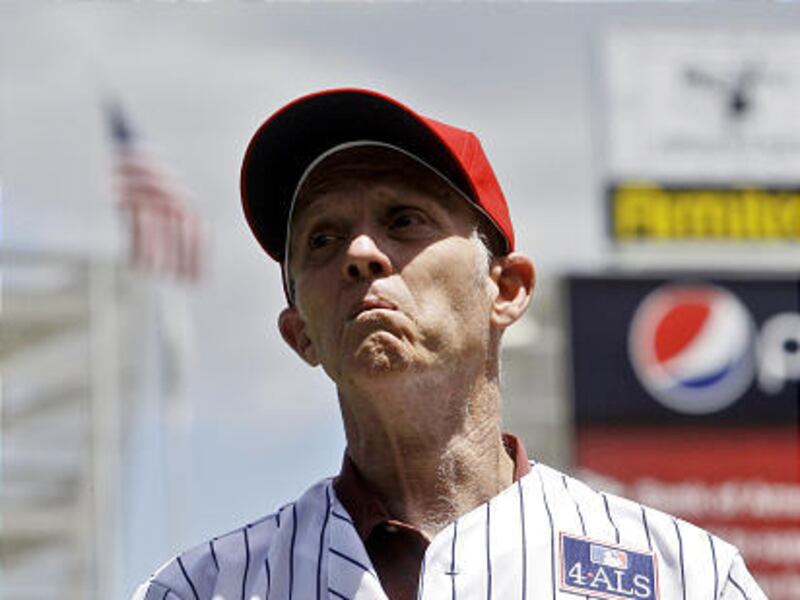
It took courage for Goldsmith to make the long haul from Utah to New York, accompanied by his wife, Carolyn, and his two children from a previous marriage, Jillian and Austen. The son escorted his dad onto the field for the dignified half-hour that included a video linking Gehrig and Goldsmith. Yankee manager Joe Girardi gave Goldsmith, who wore a special ALS Yankee-striped jersey, a copy of the day's lineup.
"I have spent more than two decades exhorting law students to take a proactive 'can-do' approach to the law and life in general," Goldsmith wrote last week. "And I have tried to lead by example, showing them how creativity and commitment to a cause can produce positive results. The success of this effort demonstrates yet again how 'the power of one' can make a difference."
When he goaded baseball into honoring Gehrig, Goldsmith was still teaching.
"As for me, my health has declined considerably recently," Goldsmith added. "I use a wheelchair part time, have skinny chicken arms, voice has become impaired, etc. But I'm still in the game and intend to go down swinging."
Lou Gehrig, who swung for the fences as long as he could, still holds the record with 23 grand slams. On the 70th anniversary of Gehrig's speech, Michael Goldsmith hit his own grand slam. His underhand pitch was short, as he knew it would be, but the fans understood, and cheered.