

In the realm of adoption, the word "family" evokes feelings of comfort, of strength. There, family is a goal and an accomplishment. It is something made, no matter how it is born.
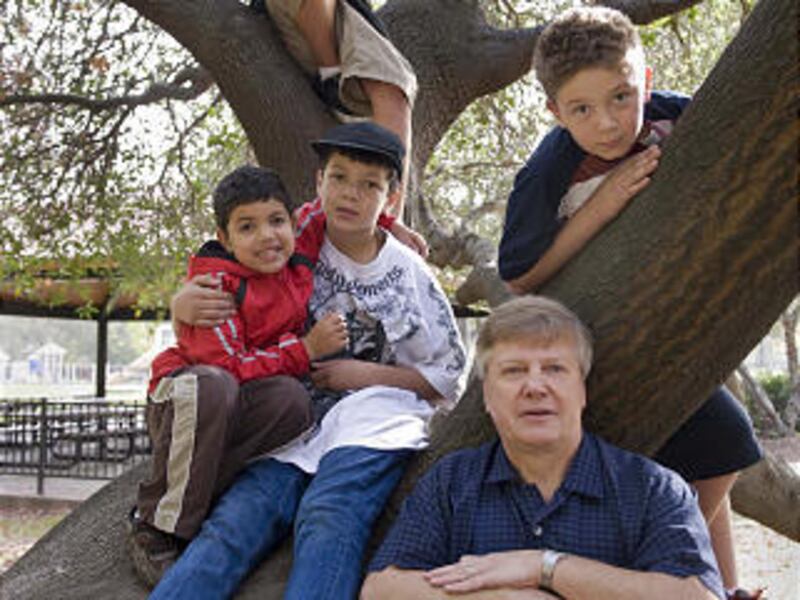
For Ken Richey and James Buckmaster, family conjures up images of their five sons, the brothers they adopted out of Sacramento County's foster system.
For Michele and Michael Williams, family is their 10-year-old daughter and the four young siblings whose adoption was completed in August.
For Scott and Dawn Rowe, their two adult daughters, their 9-year-old biological twins and their son and daughter adopted from China come to mind.
They all exemplify how adoption and the meaning of family have evolved over the years.
In decades past, prospective parents sought out babies, siblings were split up, a lot fewer foster kids were being adopted, and adoptions were closed, meaning parents knew little about the birth family.
Now the emphasis has shifted to focus on the child's best interest. Adoptions have moved from closed to open and, in doing so, have become more respectful, less clandestine and less stigmatized, said Adam Pertman, executive director of the New York-based Evan B. Donaldson Adoption Institute, a nonprofit organization dedicated to improving adoption policy, laws and practice.
"We haven't leveled the playing field quite yet, but there is movement in that direction," he said.
For instance, foster children are not stuck in a holding pattern for as long as they once were. The number of adoptions from foster care now hovers around 50,000, constituting the largest segment of adoptions nationwide, Pertman said.
Fathers know best
Ken Richey and James Buckmaster, both from large families, knew they wanted to adopt children when they committed to a long-term relationship in 1996, but they never anticipated adopting five brothers.
"We didn't want an older child that was our original thought," Richey said. "We were thinking of two kids."
One meeting with Kenny, then 11 years old, and the couple knew they had found something special.
"Most families have caretakers, and Kenny is the caretaker," Richey said. "The boys were all at different foster homes, and Kenny's dream was to reunite them. … We were so charmed by this young man. There was no question in our head."
The four boys, Kenny, DJ, Alex and Daniel, were officially adopted in 2004. One year later, their 7- month-old baby brother, Kody, joined the family.
"The day he was given to us, the boys ran home from school," Richey said. "Kody was in the playpen lying down and there was a brother at each corner staring at him. It was one of those days in your life when you think 'It can't get better than this.' "
The family has its share of challenges three of the boys were born addicted to drugs, two suffer from bipolar disorder and all struggle with abandonment issues.
Alex, now 13, used to carry a plastic bag filled with food and trinkets wherever he went, a by-product of having been moved from home to home while in the foster system.
Alex and DJ agreed that it was difficult to live apart from each other and their other brothers. Neither thought they would all be adopted.
"It was really hard," DJ said.
A place of their own
More than 62,000 children live in foster care in California, and about 4,000 of them are in the Sacramento region, said Sara Hanson, public relations specialist for Sierra Forever Families, a local nonprofit adoption agency.
Families are needed to provide stable home environments for the children while reunification is attempted with their birth families. Families also are needed for the roughly 2,000 children in the Sacramento area for whom reunification is no longer possible.
Foster families are compensated, and fees for adopting children from the foster system often are nominal.
"We need families now more than ever," she said.
They're seeking people like Michael and Michele Williams of Roseville, who were honored on National Adoption Day as "Adoptive Parents of the Year."
The Williamses had one daughter, Alexis, and after years of trying unsuccessfully to have another child, opted to adopt.
They took classes through Placer Kids, a collaboration between Sierra Forever Families and Placer County's Children's System of Care, and were licensed for foster children when they got the call that a set of siblings needed a home.
All the children had suffered from neglect, and some have special needs. Jose, 4, is autistic. Oscar, 3, has reactive attachment disorder along with a sleep disorder and obsessive compulsive disorder.
America, 2, couldn't crawl or walk when she came to live with them at 13 months.
Bryan, now 20 months, was just 5 days old when he was placed in Michele's arms.
"I thought my diaper-changing days were over," she said. "It was tough the first couple of months, but we had a great social worker helping us."
The built-in support system for foster parents can be a huge help for families, both emotionally and financially.
Some parents think that love is enough and that the children are going to be grateful, but that isn't always the reality and such perceptions can make adjustments difficult for both parent and child, said Debra Wiegel, a marriage and family therapist and instructional specialist for Yolo County Foster Care.
"Adoption is the solution, not the problem," she said, "but children internationally adopted, out of the foster care system, even children adopted at birth have been rejected, abandoned and traumatized.
"You can take the kids out of the trauma, but you can't take the trauma out of the kids. It's not ever resolved. It's integrated as part of (their) life. … That's what we're trying to help the families and kids come to peace with and it happens. It definitely happens."
Home and heart
Dawn and Scott Rowe of Sacramento have adopted two children from China in recent years.
In March 2007, Fu Mei joined their family of six Scott has two adult daughters and the couple also have 9-year-old twins, Toby and Nola.
Fu, a cleft-affected child, had been abandoned at 2 weeks old. The huge hole in her mouth went unrepaired the three years she lived at the orphanage.
The first few weeks weren't easy.
The Rowes came to rely on friends who spoke Fu's native Cantonese to interpret. There were a few late-night phone calls to interpret things like "Don't drink water out of the toilet" and "Don't go outside in the middle of the night," Dawn Rowe said.
Those challenges decreased over time. Now, Fu is a vibrant, happy 5-year-old kindergartner working at the first-grade level.
"It's hard to explain how blessed you feel through adoption," Rowe said. "It was such a good and positive experience. How could we not do it one more time? As the kids said, we had another seat still in the minivan."
The process to adopt Huahong, 6, took about two years, during which Rowe would send her son letters and family photos.
Then, about a month ago, they made the trip to Hong Kong to get Hong, also a cleft-affected child.
Hong cried for about 40 minutes after his nannies from the orphanage left him with his new family. His eyes teared again a few days later as he and his mother walked to the door of the plane after they arrived in San Francisco.
"He knew the moment he stepped off that plane that he was an American citizen," she said. "I picked him up and carried him off the plane. By the time I walked up the ramp he was fine."
He has since told the Rowes' Mandarin-speaking friends that he is "very, very happy to be in the United States and has a fun family."
His growing comfort with his new family is evidenced in the joy he has playing with his brother and sisters, the deep laughter that fills their Sacramento home.
And the quiet moment he shares with his mother each morning.
"Hong wakes up at about 6 a.m. and crawls into bed next to me, snuggles down into the covers and holds my hand, as though he has been doing it his whole life," Dawn Rowe said. "That is incredibly rewarding."
(c) 2009, The Sacramento Bee (Sacramento, Calif.).