


All Lacy Schnoor did was raise her hand faster than the other kids in her junior high class, and just like that, her life turned on a single, seemingly insignificant moment, a mix of luck and fate that rerouted her orbit.
Because of that moment, she has a professional athletic career, exotic travel, training camps, a circle of international friends, world-class competition, and now this: She is an Olympian.
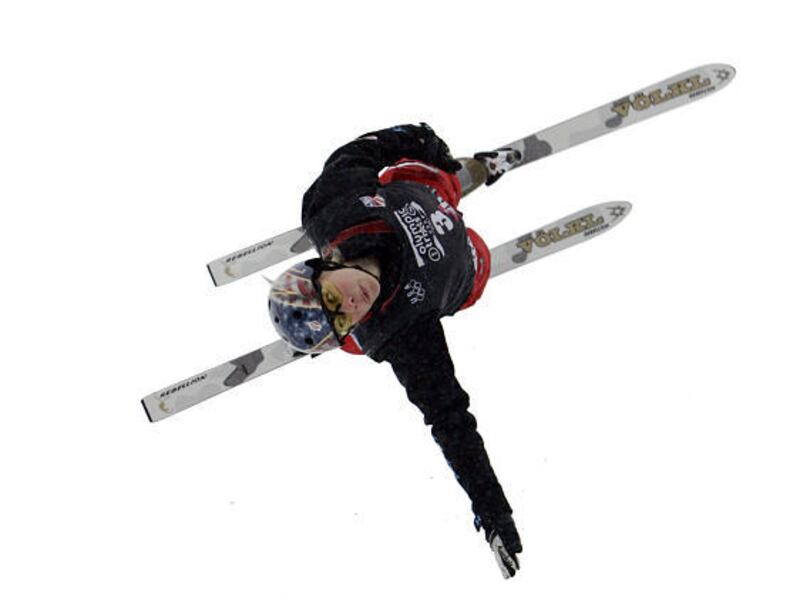
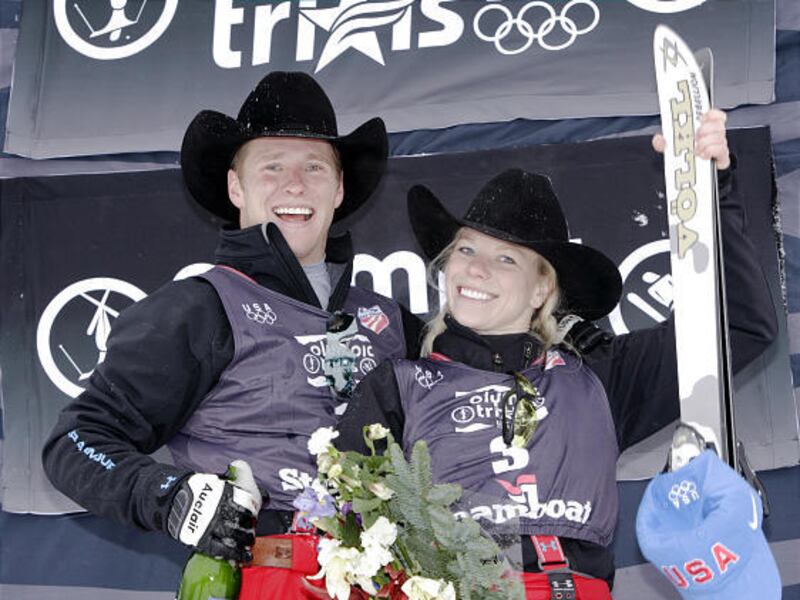
Schnoor, a petite 24-year-old from Draper, earned a berth in next month's Winter Games by winning the freestyle aerials at the U.S. Olympic trials in Steamboat Springs, Colo. She won by going for broke, landing two triple-twisting double backflips that she practiced for the first time on snow only the day before the competition.
"I had qualified it this summer (in the pool)," she explained. "I was going to do it sometime. I figured that was a good time to do it."
Schnoor said this just hours before placing ninth (first among Americans) in a World Cup event in Park City, and then on Monday flew to Lake Placid for more training and competition in the continuing buildup toward Vancouver.
She wouldn't be here if not for an Olympic outreach program that came to Sandy's Crescent View Middle School in 1999. Simulations of the various winter sports were set up around the gym, and students were moved from one event to the other to try them. As fate would have it, they ran out of time as the students arrived at the bungee exercise — a contraption that allows kids to perform various aerial maneuvers while strapped to the safety of bungee cords. It was decided there was time enough only for one student to try it. The instructor asked an easy question and whoever answered correctly would be picked. All hands shot up.
"One girl even shouted the answer, but the guy looked at me," says Schnoor. "He said, 'OK, you raised your hand quickly.' "
Schnoor, who had recently retired from a gymnastics career, was so impressive on the bungee exercise that she was immediately invited to an Olympic development camp that would be held in the summer. She was 15.
"He could have chosen anyone, but he just happened to pick me," says Schnoor. "I didn't even know what aerial skiing was. And now I'm going to the Olympics."
She had to make difficult choices at the time. I was her track and field coach at Alta High School at the time, and one night her father called me to explain that his daughter had decided to quit the track team so she could focus on aerials — apparently, given her Olympic status, it was the right decision.
She traded one life for another. A cheerleader for the sophomore squad at Alta High, she gave up that pursuit. She also quit traditional school, finishing her senior year via correspondence courses to graduate in 2003.
She trained year round with the U.S. Ski Team, whose regimen included two stints at the Navy SEALs facility in California. She moved rapidly through the baby steps of the sport. Trampoline, then bungee, then small jumps, then jumps into a pool, then progressively bigger jumps into a pool.
Aerialists are required to take more than 200 jumps in a pool to qualify for jumps on snow. That winter, at 16, as she waited in line to take her first jump on snow, she saw the girl ahead of her crash. Undaunted, Schnoor performed a single backflip and nailed the landing.
"Jumping into water and doing it on snow and having to ski away are definitely different," she says. "It's mental."
"It was an eye-opener for me first time I saw it," says her father, Steve. "The jumps are scary big. They throw you straight up in the air. If she was scared, she hid it well."
With her skills and background in gymnastics, Schnoor was fast-tracked in her training program and it paid off early. She began competing in 2002, and by 2005 she was the national champion. But injuries — which seem to be a rite of passage in this sport — slowed her progress. She blew out first one knee in 2003 and then the other knee in 2007. In 2006, she landed on her back on solid ice and broke her scapula.
She produced her best season in 2009, with two top-10 World Cup finishes, a seventh-place finish at the world championships in Japan, and a third-place finish at the U.S. championships. That set the stage for the Olympic year.
"When she has a good jump, she looks good in the air," says Schnoor's coach, Matt Christensen. "She has a really good body line in the air. A clean body line. She's straight."
Schnoor faces some unique challenges. For one thing, at 5-foot-3 and 110 pounds, she becomes a kite in windy conditions. "I try to be heavier," she says. "I try to put on muscle and a little bit of fat because I don't want the wind to push me around. With me being smaller, the wind really pushes me."
Says Christensen, "She's definitely a little thin. We want them to be a little stockier. It helps with injury prevention, too. We don't want Barbie dolls doing aerials."
This is not a sport for the timid. Aerialists ski down a 37-degree run and reach a speed of about 35 miles per hour as they approach a 15-foot high, 65-degree jump that launches them 30 feet into the air. This gives them enough air time to perform a dizzying array of gymnastic maneuvers before landing on two impossibly thin skis and skiing away cleanly.
Race officials place tree boughs onto the landing area to help aerialists find the ground while gyrating through the air. "Some of them get lost in the air — they don't know where they are — and open up too late or too soon," says Steve. "That's the scariest time for a parent."
Aerialists make adjustments according to snow and wind conditions, either by adjusting their starting point on the approach or actually adjusting in the air. If the snow is fast and they're going to "go big" (over rotate), they stretch their bodies in the air to slow their rotation so they don't open too soon and land on their faces. If the snow is slow — which is normally the case among the first to jump in a competition — they'll "pull harder" (pull themselves into a tighter tuck).
"The coaches will stand there and yell to the aerialists while they're in the air to pull or stretch," says Steve. "The athletes know before the coaches can tell them, but the coach yells anyway. There are a lot of intricacies to the sport."
Lacy, the second of Steve and Pat's four children, began walking when she was 81/2 months and almost immediately began jumping off the couch and tumbling.
"I would call her a calculated daredevil," says Steve.
She competed in gymnastics for five years before quitting at the age of 14.
"My body was getting sore," she says. "I had a broken foot. I took three years for my elbow to heal. I couldn't lift weights. I couldn't even grip. My heels hurt. I had aches and pains. Plus, I wanted a normal life."
She acknowledges that she didn't get a "normal life" when she took up aerials, "but this is more fun."
"It's changed her life," says Pat. "Her friends came out of the sport. She became interested in things she discovered through this sport — she surfs in the summer and mountain bikes."
Looking ahead to Vancouver, Schnoor is not satisfied with just winning a place on the Olympic team.
"I'm very ecstatic, but at the same time I still have work to do. I see a lot of people go to the Olympics who don't do as well as they expected. I want to do something."
e-mail: drob@desnews.com