

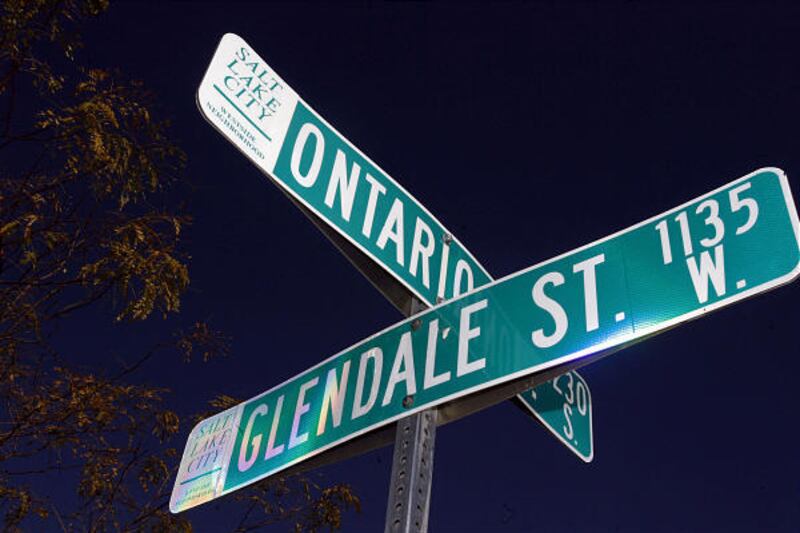

SALT LAKE CITY — Call it a sign of the times: With the first of the Baby Boomers turning 65 in January, the federal government has told cities to make important road signs easier to read.
That means better reflective quality for railroad crossings and no left turn and stop signs and a mandate to replace street signs in all-caps with a quieter uppercase/lowercase combo that's easier to read. The Federal Highway Administration rules give communities until 2015 to make sure signs are sufficiently reflective, while the all-caps ban can phase in as signs are replaced.
But there's no money with the mandate and there are a lot of signs out there, warn officials across Utah.
"We've switched out a few," said Cameron Cutler of St. George's transportation services. "Fortunately, they've given us some time."
St. George officials estimate they have 10,000 street name signs — and they can't begin to guess how many total signs, when you add the stop and yield and right turn, the speed limit and caution and other warning signs.
Most Utah cities use capital letters for street name signs.
Cameron says the cost to make a street name sign is $32.26. A stop sign costs about $30 to make.
"We had to buy a piece of equipment called a retroreflectometer to check the reflectivity of the signs. And we have to reinventory them" to see that their reflective quality falls within the prescribed range, he said.
Salt Lake City has about 19,000 street name signs, according Lisa Harrison-Smith, city spokeswoman, who said it costs on average $89 to make and place one of the street name signs in the city. "We have no intention of replacing them all by 2015. But as we put up new signs, they will be uppercase and lowercase."
If they did it all at once, it would cost at least $1.5 million just to change street name signs. As for the costs of the other signs, it varies, "but obviously a large arterial street sign is more costly than small street name signs."
Salt Lake City, too, has its own sign-making shop and as they replace missing and damaged street name signs, they are already using the new style, said Salt Lake City traffic engineer Scott Vanderlaus, who predicts it will be some time before they all meet the new mandate set forth in the federal Manual for Uniform Traffic Control Devices. Crews are already going out at night to measure sign reflectivity.
And while some communities are grousing about the costs, there's a bright side to it, said Scott D. Wright, director of the Gerontology Interdisciplinary Program at the University of Utah.
"The catalyst is due to an aging society, but everybody will eventually age and whatever we do to transform for a particular cohort will offer intergenerational benefit," he said. "If the money we spend reduces fatalities and accidents not only for Boomers, but for all generations, isn't that a good investment?"
e-mail: lois@desnews.com Twitter: Loisco